OpenAI Dots: What Always-On Agents Mean for Teams
OpenAI's dots are always-on ChatGPT agents with their own cloud computer. What Business Premium buyers get, what it costs and what the Enterprise beta lacks.

Table of contents
OpenAI's dots are always-on ChatGPT agents with their own cloud computer and browser. The first dot comes with a Business Premium seat. For Enterprise it is an opt-in beta that, by OpenAI's own documentation, lacks data residency and strict zero data retention.123
The Agentic Edge: AI agents and automation, explained for the people who decide, fund and ship.
TL;DR
OpenAI launched dots at DevDay on September 29, 2026: agents you message in ChatGPT, Slack or Microsoft Teams that keep working on their own cloud computer when your devices are off.1456
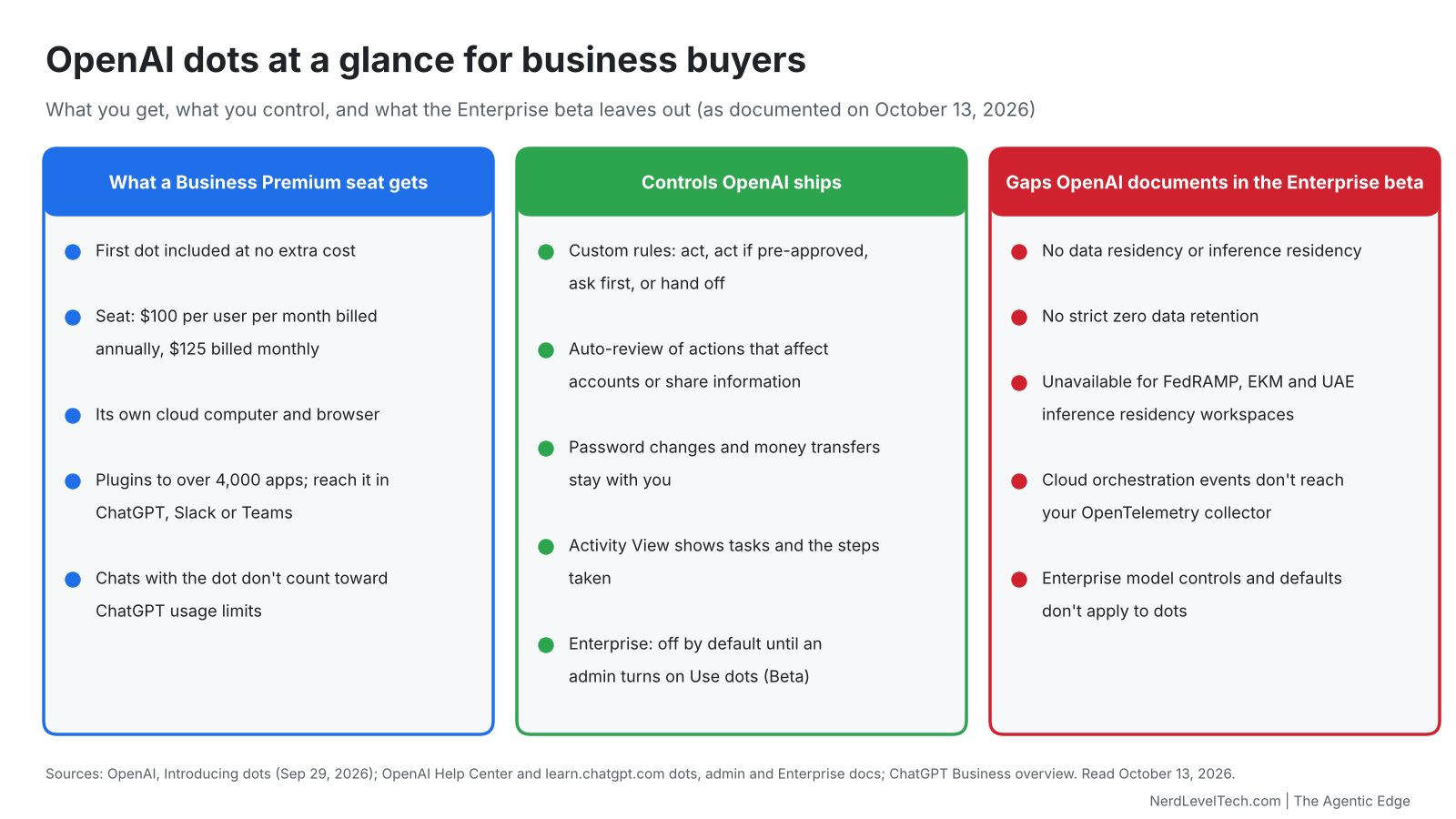
A business gets one with a ChatGPT Business Premium seat, listed at $100 per user per month on annual billing, or through an Enterprise beta that an admin must switch on.27 Our advice: pilot it with a small group, write the approval rules first, and keep regulated data away from it until the residency and audit gaps close.3
What happened
What a dot is
On September 29, OpenAI introduced dots, writing that "Dots are remarkably capable, always-on agents built to handle everything." Dots run on OpenAI's GPT-6 Astra model and learn your preferences over time.1
Each dot gets its own cloud computer and browser, which keep working when your devices are off. You can open that computer to inspect its work, select "Take over" to do a step yourself, then return control. You can also connect one of your own computers at a time, and it must be online with the ChatGPT app open.15
Dots reach other software through plugins, which OpenAI says connect to over 4,000 apps. You can message a dot in ChatGPT, Slack or Teams, and it carries context across those channels.1
When you aren't actively working with it, a dot runs what OpenAI calls proactive research. It looks through connected apps in read-only mode for ways to help and keeps private notes. Acting on what it finds needs the normal permissions.15
Each person starts with one primary dot. OpenAI says that "over time" it envisions teams of dots working together, and that specialist dots for organizations are in preview, starting with focused enterprise pilots.1
The controls OpenAI ships
Custom rules set what the dot may do alone. Each rule has one of four behaviors: "Take action without asking", "Take action if pre-approved", "Ask before taking action" or "Hand off to you". Rules cannot grant app or computer access and cannot override built-in safeguards.2
Auto-review checks actions that could affect your accounts or share information. Changing a password always stays with the person. Purchases with a saved card need your approval, which you can give in advance for a specific purchase, and the dot asks you to complete money transfers yourself.18
Activity View in the desktop app shows ongoing and delegated tasks and the steps the dot took.8 Stopping a task does not undo actions it already completed.5
Memory has a blunt edge. You cannot view, edit or delete individual dot memories, and disconnecting an app does not delete information the dot already obtained from it. Resetting the dot deletes it, including its conversations, saved memories and scheduled tasks.28
Who can get one, and what it costs
| Plan | Dots access | List price (USD) |
|---|---|---|
| ChatGPT Business, Premium seat | First dot included, in all supported ChatGPT regions | $100 per user per month billed annually, $125 billed monthly |
| ChatGPT Business, Standard seat | Not among the plans OpenAI lists for dots | $20 per user per month billed annually, $25 billed monthly |
| ChatGPT Enterprise, Edu, Healthcare | Beta, off by default, an admin must enable it | No public price, OpenAI says to contact sales |
| ChatGPT Pro 100, 200, 500 | First dot included for users 18 or older outside the EEA, UK and Switzerland | $100, $200 or $500 per month |
| Free, Go, Plus | Not included | n/a |
⚠ Prices change frequently. The values above are for illustration only and may be out of date. Always verify current pricing directly with the provider before making cost decisions: Anthropic · OpenAI · Google Gemini · Google Vertex AI · AWS Bedrock · Azure OpenAI · Mistral · Cohere · Together AI · DeepSeek · Groq · Fireworks AI · Perplexity · xAI · Cursor · GitHub Copilot · Windsurf.
Sources: OpenAI launch post, help center, documentation and pricing page, read October 13, 2026.1527910
A Business workspace needs at least two paid seats, in any mix of Standard and Premium. A Premium seat gives five times the usage of a Standard seat and has no five-hour usage limit.711
The first dot costs nothing extra on top of those seats. Chatting with it does not count toward ChatGPT usage limits, but work it starts in Codex or ChatGPT Work counts as usual. OpenAI says plans include "an allowance for deeper work, with extended limits for the first month after launch."15
That first month is a launch window. OpenAI's release notes say "For the next month, dots usage won't count toward eligible Pro, Business, and Enterprise users' plan allowances," and "After this period, we'll share usage terms for each plan."12
OpenAI also says that "In the future, you'll be able to add more dots, and scale the output of each dot." OpenAI's dots help articles give no specific limit numbers for dots, and we found no published price for extra dots or extra output.2
What the Enterprise beta leaves out
OpenAI's Enterprise documentation states the gaps plainly:3
- "During the Enterprise beta, dots do not support data residency or inference residency."
- "Neither experience provides strict zero data retention." OpenAI says this of dots and of Work with local computer access.
- "Dots are unavailable for FedRAMP workspaces, workspaces with EKM, and workspaces with inference residency set to AE (UAE)." EKM is OpenAI's Enterprise Key Management, which encrypts your content with keys held in your own key management system.13 HIPAA workspaces can use dots if they meet the other requirements.
- "Cloud orchestration events do not reach your existing OpenTelemetry collector." OpenTelemetry is an open-source standard for capturing traces, metrics and logs from software so they can be monitored.14
- When an admin enables managed policy and remote hooks, dots use admin-managed hooks, which are automated checks a company can run at points in an agent's work. OpenAI warns that if a check that runs before a tool step errors, times out or returns a malformed response, it "can fail the hook without blocking the tool." It adds that "MCP hooks are not a substitute for audit coverage."
For usage and audit records, OpenAI points admins to its Analytics API and to its Compliance API for "supported" records. The admin guide also says "Enterprise model controls and defaults do not apply to dots," and tells admins to confirm Compliance API record coverage before relying on it for an audit.153
The safety backdrop
The model behind dots has a published safety record. OpenAI's GPT-6 Astra system card, published September 3, 2026 and updated on September 29 with an appendix on dots, reports OpenAI's own tests in realistic work environments, which it says are "designed to be intentionally adversarial." Read the rates below as test results rather than everyday failure rates. Astra's overall misaligned outcome rate was 3.4% without a confirmation policy and 3.0% with the confirmation policy that is the default for users. OpenAI's GPT-5.6 Sol scored 18.8% and 8.0% on the same tests.16
On Monday, September 28, the eve of DevDay, OpenAI announced it would not release a newer model, GPT-6.1 Astra. According to Al Jazeera, Saachi Jain, OpenAI's head of safety systems, said the model failed to meet company standards for acting in line with human wishes during internal testing. In a statement to Al Jazeera, she said it fell short on "scope and authorization, and how it communicates back to the user about the type of work it's done."17 Dots run on GPT-6 Astra, not on the withheld model.1
How dots compare with other always-on agents
Dots arrived in a busy few weeks for agent launches. These are the most comparable offers for a business buyer:
| Agent | Announced | Status | Identity model | Pricing signal |
|---|---|---|---|---|
| OpenAI dots | Sep 29, 2026 | Rolling out to Pro and Business Premium, beta for Enterprise | One primary dot per user, no standalone email address at launch | First dot included with the seat |
| Google Gemini agent | Oct 8, 2026 | Private preview | Coworker agents get their own Workspace account and email | Per-project spend caps, pricing not disclosed for most announcements |
| Microsoft Autopilot | Sep 25, 2026 | Private preview from the end of September | Own Entra identity and agent user account | Usage billing through Copilot Credits |
| Meta Muse | Sep 8, 2026 | Rolling out in the US | Personal AI agent for consumers | Free for most needs, subscription plans for heavier use |
⚠ Prices change frequently. The values above are for illustration only and may be out of date. Always verify current pricing directly with the provider before making cost decisions: Anthropic · OpenAI · Google Gemini · Google Vertex AI · AWS Bedrock · Azure OpenAI · Mistral · Cohere · Together AI · DeepSeek · Groq · Fireworks AI · Perplexity · xAI · Cursor · GitHub Copilot · Windsurf.
Sources: vendor announcements and reports, plus Futurum for Google's undisclosed pricing.121819202122
The design choice to notice is identity. Google and Microsoft give an agent its own account, like a new hire.1820 With dots, each person starts with one primary dot, and at launch you cannot give it its own standalone email address. You can connect your personal email account so it can use it for your tasks.12 On Enterprise, an admin can let a dot join Slack or Teams and post "with its own identity, where available," and OpenAI is previewing specialist dots for organizations.123 Our read: that makes a dot closer to a personal chief of staff than a new team member, which changes who answers for what it does. We compared the Google and Microsoft approach in AI Agents Are Getting Work Email: What to Decide.
Why it matters
For executives
On ChatGPT Business, getting a dot means buying a Premium seat, at $100 to $125 per user per month, with the first dot included.17 Our read: that makes experiments cheap and unmanaged adoption easy. If your Business workspace already has Premium seats, expect people to try dots without asking.
The cost model is seat-first for now. Extra dots and more output per dot are promised, with no published price.2 We gave the same advice for Salesforce's plan to meter agent calls: put a budget owner on agent usage before the price lands.
For product managers
Dots work across the tools your team already uses: ChatGPT, Slack, Teams and thousands of connected apps.1 OpenAI's launch examples include "Turn feedback into tested fixes", "Revise a launch as scope changes" and "Update analysis with new evidence".1
Proactive research is the feature to watch. Our read: a dot that reads connected apps while idle may surface useful work, and it also reads more than any single task required. Decide which apps are connected before you decide which tasks to assign.
For project and delivery leads
A dot that keeps working while you sleep needs the same hand-off discipline as a contractor. Define what "done" looks like, what it must ask before doing, and where its work shows up for review. Activity View is the record to check, and stopping a task does not reverse steps already completed.58
Some practical friction is documented. Some websites block cloud browsers or ask for extra verification, and adding a dot to a Slack channel does not make it watch that channel until you tell it which channels and events to follow.5
What to do this week
- Find out if you already have it. Check whether your Business workspace has Premium seats. On Enterprise, check whether any role grants "Use dots (Beta)", because if any role a member holds grants it, that member can use dots.23
- Write custom rules before the first task. Pick the actions that must always ask first, such as messages to people outside the company, edits to shared files and purchases, and the few it may do alone. On Enterprise, an admin must first enable "Use custom rules for dots", which is off by default.223
- Run a two-week pilot with three to five people on one bounded workflow, such as a weekly status digest or a research brief. Record the time saved and every correction you had to make.
- Keep regulated data out for now. If your policies require data residency, strict zero data retention, FedRAMP or customer-held encryption keys, the Enterprise beta does not meet them today.3
- Ask security to confirm the audit path. Agree whether Compliance API records are enough for your auditors, since cloud orchestration events skip your OpenTelemetry collector.153
Questions to ask your team or vendor
- Which apps will the dot connect to, and who approved each connection?
- What happens to information the dot already pulled if we disconnect an app or remove a user?
- Which Compliance API records cover dot actions, and do they satisfy our auditors?
- What will extra dots and extra output cost after the launch period?
- Which of our ChatGPT Enterprise controls still apply, given that OpenAI says Enterprise model controls and defaults do not apply to dots?15
- Who is accountable when a dot acts for a person: that person, their manager or IT?
- When will data residency and strict zero data retention be supported, and in which regions?
Risks and what we don't know yet
Pricing after month one. OpenAI says more dots and more output per dot are coming, and that it will share usage terms for each plan after the first month. It has not yet published those terms or prices.1212
Audit coverage. OpenAI says to use the Compliance API for "supported" records and to confirm coverage before relying on it. The pages we read do not list exactly which dot actions are covered.153
Memory you cannot edit. If a dot learns something wrong or sensitive, the documented way to clear it is resetting the whole dot. Information from a disconnected app stays with the dot until then.28
Model behavior. OpenAI's own tests show a lower misaligned outcome rate for GPT-6 Astra than for GPT-5.6 Sol, but not zero, and OpenAI held back a newer model partly over scope and authorization.1617 OpenAI's own advice: "Dots can still make mistakes, so always review consequential work."1
Regional limits. Pro users in the EEA, the UK and Switzerland cannot get a dot. Business Premium covers all supported ChatGPT regions.52
This post summarizes vendor documentation and is not legal advice. Check data-protection obligations with your own counsel.
Bottom line
Dots make an always-on agent as easy to get as a seat upgrade, which helps experiments and strains governance. Pilot with a small group and written rules, and keep regulated work out until OpenAI closes the residency and audit gaps it documents itself.
Related reads
- AI Agents Are Getting Work Email: What to Decide compares Google's and Microsoft's agents with their own accounts.
- OpenAI Agents API: The Managed Codex Harness 2026 covers the developer side of OpenAI's agent platform.
- Claude Code Hooks Fail Open: onFailure Tested (2026) shows in a hands-on test what happens when a policy hook fails.
- Rogue AI Agents Hit Wikimedia: Lessons for Leaders explains why you need to know which agent did what, and whose it is.
Facts checked on October 13, 2026. Dots are rolling out and are in beta for Enterprise, so details may change.
References
Frequently Asked Questions
What is an OpenAI dot?
A dot is an always-on agent in ChatGPT that OpenAI launched on September 29, 2026. It runs on GPT-6 Astra, has its own cloud computer and browser, connects to apps through plugins, and can be messaged in ChatGPT, Slack or Microsoft Teams.
How much do OpenAI dots cost for a business?
The first dot is included at no extra cost with a ChatGPT Business Premium seat, listed at $100 per user per month billed annually or $125 billed monthly. Enterprise access is a beta with no public price. OpenAI has not published prices for extra dots, and says usage terms for each plan will follow the first month.
Can ChatGPT Enterprise customers use dots?
Yes, as a beta that is off by default. A workspace admin must turn on "Use dots (Beta)" under Permissions & roles. During the beta, dots do not support data residency, and they are unavailable for FedRAMP, EKM and UAE inference residency workspaces.
Does a dot have its own email address?
No, not at launch. OpenAI's help center says you cannot give your dot its own standalone email address, and that it cannot start calls to you at launch. You can connect Slack and your personal email account.
Can a dot spend money or change passwords on its own?
Only within limits you approve. Purchases with a saved card need your approval, which you can give in advance for a specific purchase. Money transfers are handed back to you, and changing a password always requires you to take over.
Is it safe to give a dot access to company data?
That depends on your requirements. OpenAI does not use Business, Enterprise or Edu workspace content to improve its models by default. During the beta there is no strict zero data retention, and cloud orchestration events do not reach your existing OpenTelemetry collector.
Footnotes
-
Introducing dots, OpenAI, September 29, 2026. Primary source for the launch quote, GPT-6 Astra, the cloud computer and browser, 4,000 apps, ChatGPT, Slack and Teams, the primary dot, teams of dots and specialist dots, proactive research, Auto-review, plans, the included first dot, usage limits, training defaults, examples and the review advice. ↩ ↩2 ↩3 ↩4 ↩5 ↩6 ↩7 ↩8 ↩9 ↩10 ↩11 ↩12 ↩13 ↩14 ↩15 ↩16 ↩17 ↩18 ↩19 ↩20 ↩21 ↩22 ↩23
-
Getting started with your dot, OpenAI Help Center, accessed October 13, 2026. Source for the four custom rule behaviors, plan availability, future dots and output, no standalone email address or calls at launch, connecting Slack and personal email, Reset and disconnecting apps. ↩ ↩2 ↩3 ↩4 ↩5 ↩6 ↩7 ↩8 ↩9 ↩10 ↩11 ↩12 ↩13 ↩14 ↩15
-
Local computer access for Work Cloud and dots, OpenAI documentation, accessed October 13, 2026. Source for the residency, zero data retention, FedRAMP, EKM, UAE, HIPAA, OpenTelemetry and hook statements, including the condition that hooks apply when managed policy and remote hooks are enabled. ↩ ↩2 ↩3 ↩4 ↩5 ↩6 ↩7 ↩8 ↩9
-
DevDay 2026 recap, OpenAI, September 29, 2026. Source for dots on Pro and Business Premium in eligible markets and the Enterprise, Edu and Healthcare beta. ↩
-
Dots, OpenAI documentation, accessed October 13, 2026. Source for regional eligibility, the cloud computer working while devices are off, Take over, one local computer at a time, read-only research, usage counting, blocked cloud browsers, Slack monitoring and completed actions. ↩ ↩2 ↩3 ↩4 ↩5 ↩6 ↩7 ↩8 ↩9
-
OpenAI launches Dots, new 'always-on agents' you can assign tasks to, 9to5Google, September 29, 2026. Independent report of the DevDay launch and plan availability. ↩
-
ChatGPT Business overview, OpenAI Help Center, accessed October 13, 2026. Source for Standard and Premium seat prices, the two-seat minimum and Premium usage. ↩ ↩2 ↩3 ↩4 ↩5
-
Dots privacy, security and safety FAQs, OpenAI Help Center, accessed October 13, 2026. Source for individual memories, Activity View, purchases, money transfers and passwords. ↩ ↩2 ↩3 ↩4 ↩5 ↩6
-
About ChatGPT Pro tiers, OpenAI Help Center, accessed October 13, 2026. Source for Pro 100, Pro 200 and Pro 500 monthly prices. ↩
-
ChatGPT pricing, OpenAI, accessed October 13, 2026. Source for dots not being included in Free, Go and Plus, and for contacting sales about Enterprise. ↩ ↩2
-
Premium seats are coming to ChatGPT Business, OpenAI, August 10, 2026, updated August 25, 2026. Source for five times Standard usage and no five-hour limit. ↩
-
ChatGPT release notes, OpenAI Help Center, "Meet your dot" entry, September 29, 2026. Source for dots usage not counting toward plan allowances for the next month and usage terms to follow. ↩ ↩2 ↩3
-
OpenAI Enterprise Key Management (EKM) overview, OpenAI Help Center, accessed October 13, 2026. Source for the EKM definition. ↩
-
OpenTelemetry, OpenTelemetry project, accessed October 13, 2026. Source for the definition of OpenTelemetry as a way to capture traces, metrics and logs. ↩
-
Dots admin guide, OpenAI documentation, accessed October 13, 2026. Source for Use dots (Beta), Enterprise model controls not applying to dots and the Compliance API coverage advice. ↩ ↩2 ↩3 ↩4 ↩5
-
GPT-6 Astra System Card, OpenAI Deployment Safety Hub, September 3, 2026, updated September 29, 2026. Source for the misaligned outcome rates in realistic work environments (Table 8), the intentionally adversarial design of those tests and the dots appendix. ↩ ↩2
-
OpenAI cancels release of AI model GPT-6.1 Astra, citing safety concerns, Al Jazeera, September 29, 2026. Source for the Monday announcement on the eve of DevDay, Saachi Jain's finding on internal testing and her statement to Al Jazeera. ↩ ↩2
-
Welcome to Gemini at Work 2026: Introducing the Gemini agent, Google Cloud Blog, October 8, 2026. Source for coworker agents with their own Workspace account and per-project spend caps. ↩ ↩2
-
Google Cloud announces 'Gemini agent' as 'universal agent for work', 9to5Google, October 8, 2026. Source for private preview status. ↩
-
Microsoft's new Copilot agents get their own email, calendar, and a place in the org chart, The New Stack, September 25, 2026. Source for Autopilot, its Entra identity and agent user account, private preview and Copilot Credits billing. ↩ ↩2
-
Introducing Muse, Meta, September 8, 2026. Source for Muse availability and pricing. ↩
-
Google Collapses Enterprise AI Into a Single Gemini Agent at Gemini at Work 2026, Keith Kirkpatrick, Futurum, October 9, 2026. Source for Google not disclosing pricing or general availability dates for most announcements. ↩
-
Manage dots in ChatGPT workspaces, OpenAI Help Center, accessed October 13, 2026. Source for Enterprise defaults, custom role behavior, custom rules being off by default and dots posting in Slack or Teams with their own identity. ↩ ↩2 ↩3
- ai for business
- ai agents
- the agentic edge
- OpenAI dots
- ChatGPT Business Premium
- always-on agents
- ChatGPT Enterprise
- AI agent governance
- GPT-6 Astra
Free newsletter
Stay on the Nerd Track
Two emails a week: a Monday deep dive on one topic and a Thursday digest of courses, guides, posts, podcasts and jobs.