AI Agents Are Getting Work Email: What to Decide
October 12, 2026
Google and Microsoft now let an AI agent join your company as a named colleague, with its own email address, calendar, file storage and directory entry. Both offers are still in preview. Before you turn them on, decide who manages each agent, what it can see, what it may spend and how you retire it.12
The Agentic Edge: AI agents and automation, explained for the people who decide, fund and ship.
TL;DR
On October 8, Google introduced the Gemini agent, whose "coworker agents" get their own @agents.company.com email, calendar and Drive. About two weeks earlier, on September 25, Microsoft announced Autopilot for Copilot. Its documentation describes autopilots, built in its Foundry platform, with their own email, calendar, OneDrive, Teams presence and a place in the org chart.132
That changes the agent question from "which tool?" to "which roles?" Treat an agent with a mailbox the way you treat a new hire: a manager, a defined job, limited access, a budget and an exit process.
What happened
Google: one agent, plus coworkers with their own accounts
Google Cloud chief executive Thomas Kurian introduced the Gemini agent at Gemini at Work 2026 on October 8. Google calls it "a single, universal agent for work." It answers questions, handles knowledge work, creates media and writes code, and long jobs keep running after you close your laptop.1
Google says you can reach it from the web, phones and desktops, and from Google Workspace, Microsoft 365, Slack and the command line. It picks a model per job, using Google's Gemini models and Anthropic's Claude models today, with other models promised later.1
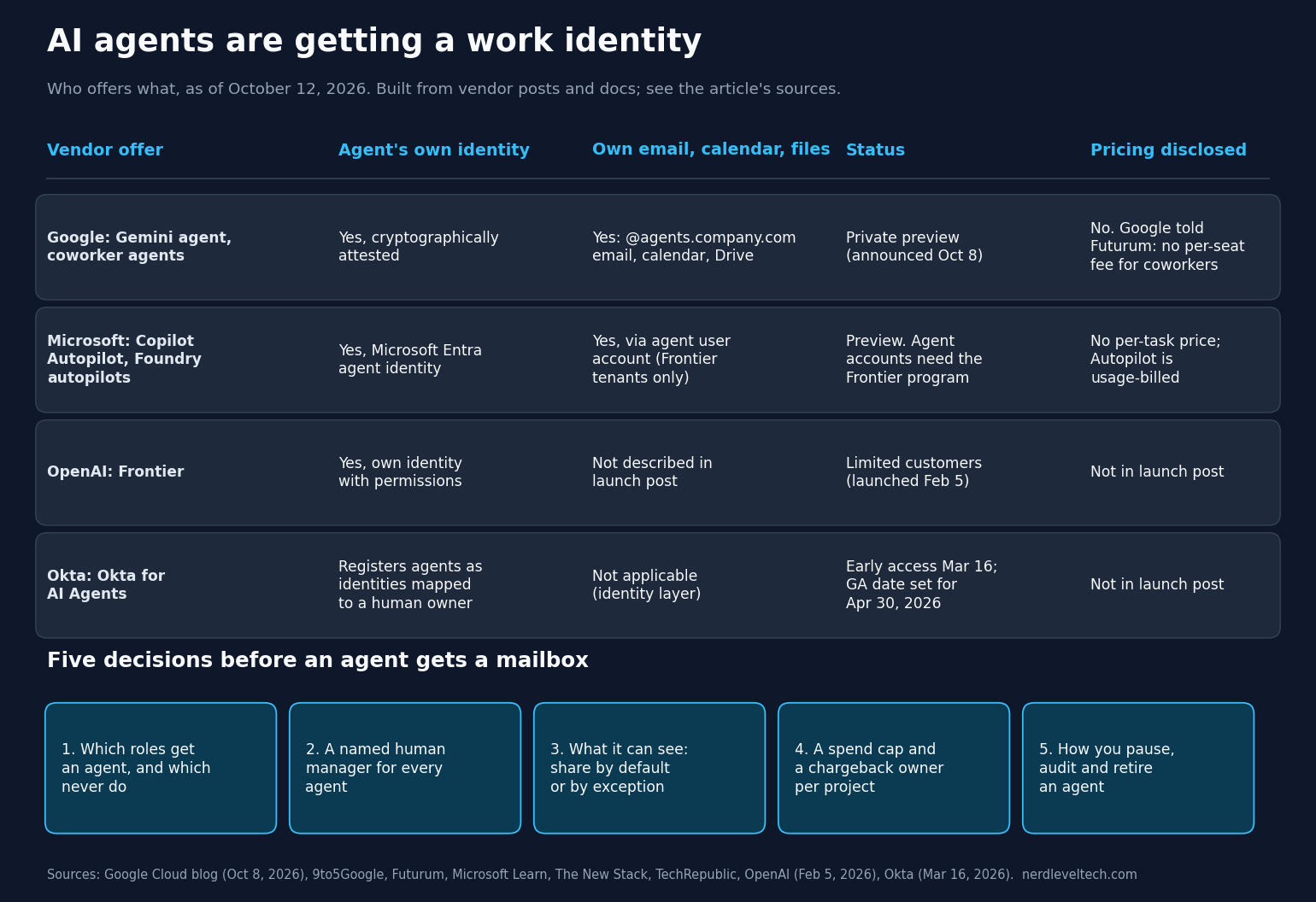
The bigger news for managers is the coworker agent. According to Google, "The agent receives its own Workspace account, including an email address, calendar, Drive, and presence in your company directory." It works under its own identity and "sees only what you share with it."1
Google also listed the controls. Each agent gets a cryptographically attested identity (a digital ID the system can verify) and every action goes into an audit trail "attributed to the agent rather than to a person."1
All traffic in, out and between agents passes through Agent Gateway, which Google calls an AI network firewall, to enforce company policy. Companies can also set a hard limit on a project's AI spend in Google's Cloud Billing Console, and that project's agent pauses when the cap is triggered.1
Status and price. According to 9to5Google, the Gemini agent is in private preview and will see wide availability "soon" for Workspace customers on select Business and Enterprise plans.4 TechRepublic reports that not every announced capability is generally available and that Google has not given a firm date for wider availability.5 The analyst firm Futurum notes that Google did not disclose pricing or general availability dates for most of the announcements, and a Google representative told Futurum that Google "does not intend to charge a per-seat license" for coworker agents in Workspace.6
Microsoft: Autopilot and the agent user account
On September 25, Microsoft announced a new Copilot that adds Home, Code and Autopilot.37 Autopilot is a rebrand of the earlier Scout agent. You give it a role and an objective, and it works across Teams, Outlook and documents without a new prompt for each step. Microsoft said Autopilot would expand to private preview at the end of September, not general availability.789
Billing changes too. Chat and Copilot in the Office apps stay on a per-user license, while Cowork, Code and Autopilot are billed by usage. Microsoft's own line, quoted by SQ Magazine: "Agentic work requires a different type of spend, one that gives you the best quality possible with the most advanced models."710
Microsoft's documentation spells out the identity model. In Microsoft Foundry, Microsoft's platform for building agents, an autopilot "works under its own identity as a persistent, named member of your organization," and it has a manager who is responsible for it. Its agent user account gives it "its own email, calendar, OneDrive, Teams presence, and a place in the organization chart."2
There is a gate. Microsoft's Agent 365 documentation says "Agents with their own user account are available only to tenants participating in the Frontier preview program," Microsoft's early access scheme (no relation to OpenAI's Frontier product below).11 Developers publish an autopilot blueprint, a Microsoft 365 administrator approves it, and people in the approved group then "hire" their own instances from the Teams app store or the Copilot agent store. Each instance uses one license from a 25-seat preview subscription that eligible tenants receive when they enroll.12
The rest of the field
OpenAI took a similar line in February with Frontier, its enterprise platform for what it calls AI coworkers. "Each AI coworker has its own identity, with explicit permissions and guardrails," OpenAI wrote on February 5, when it made Frontier available to a limited set of customers. It named HP, Intuit, Oracle, State Farm, Thermo Fisher and Uber among the first to adopt it.13
Identity vendors are building the layer underneath. Okta for AI Agents entered early access on March 16. It lets companies register agents as identities in Okta's directory, map each one to a human owner and find unmanaged "shadow" agents. Okta said the product would be generally available on April 30, 2026.14
Why it matters
An agent that acts under its own name fixes a real problem. Microsoft's documentation explains it plainly: without its own user account, an agent can take Microsoft 365 actions, such as sending an email, only on behalf of a signed-in person. In a group chat it has to guess whose permissions to use, and actions get attributed to someone who didn't ask for them.2
It also creates a new kind of staff record. A named agent can receive email, sit on a calendar and show up in the directory. Someone has to own it, review its access and switch it off when the project ends.
The evidence that this matters is not new. In a May 2025 SailPoint survey of 353 IT professionals run by Dimensional Research, 82% said their organizations already used AI agents, 44% had policies to secure them, and 80% said their agents had taken unintended actions.15
For executives
The headline decision is where agents sit in the org chart. Google describes a coworker agent as "more like a team member," and Microsoft gives each Foundry autopilot a manager who answers for it.12 Our read: agree a short list of roles where a named agent is welcome (meeting coordination, report assembly, first-line triage) and a short list where it is not, before departments start hiring their own.
Cost is moving away from a simple seat count. Microsoft bills Autopilot by usage, and during the preview each Foundry autopilot instance also takes one license. A Google representative told Futurum that Google does not intend to charge a per-seat license for coworker agents.61012 That makes a project-level budget and a chargeback owner more useful than a head count. If you already run Microsoft 365, note that the Agent 365 control plane lists at $15 per user per month, paid yearly.16
For product managers
Agents now plug into the same tools your team already uses. Google lists connections to Salesforce, ServiceNow, Jira, Snowflake, Databricks and any MCP server (MCP is an open standard for connecting AI tools to business systems), plus company-wide tool and skill registries.1 Before you build a custom agent, check whether a coworker agent with the right shared folders already does the job.
Write the agent's job description like a spec. What it owns, which channels it answers in, what it escalates to a human and what "done" means. Microsoft's blueprint model makes this concrete: one approved design, many team instances, each with its own access.212
For project and delivery leads
Gemini can take delegated work. Google's example is asking it to set up a meeting with "the usual team of regional event leads" without naming anyone.1 A coworker agent also follows your sharing habits: Google says access "follows the sharing and membership your team already uses."1 Our read: a folder shared with everyone in the company may be visible to a coworker agent too, so tidy access before you invite one in.
Plan for the exit as well as the start. When the project closes, someone must remove the agent's access, archive its mailbox and confirm its scheduled work has stopped. Our guide to AI agent kill switches covers how to stop an agent cleanly.
What to do this week
- Pick two pilot roles. Choose one internal role, such as weekly status reports, and one coordination role, such as meeting scheduling. Write a one-page job description for each.
- Name a human manager for every agent. Microsoft's model already separates owners (technical admins), sponsors (business accountability) and managers, and every agent identity needs at least one sponsor.1117 Copy that split even if you use Google.
- Check your sharing settings. Ask IT for a list of folders and chat spaces shared company-wide. Fix those before any agent gets an account that can read them.
- Set a spend cap per pilot project. Use the caps the vendor provides and name who pays. Our explainer on AI agent cost control shows how session and project caps work.
- Ask your identity team for an agent inventory. If you use Microsoft, the Agent 365 registry is one place to start. Our post on Microsoft Agent 365 explains what it tracks.
Questions to ask your team or vendor
- Does a coworker agent or autopilot use up a paid user license, and if not, how is its activity metered?
- Which preview features are in our tenant today, and which are announced but not yet available to us?
- Can we see and export every action an agent took, attributed to that agent, for the last 90 days?
- What happens to an agent's mailbox, files and scheduled tasks when we retire it?
- Who approves a new agent role, and can a department create one without IT?
- When the agent routes work to a third-party model, such as Claude inside the Gemini agent, what data leaves our environment and under which terms?
- How do we stop one agent immediately without disrupting the others?
Risks and what we don't know yet
Both offers are previews. Google has not given a firm date for wider availability of the Gemini agent, and Microsoft said Autopilot would expand to private preview at the end of September. Features and limits can change before launch.459
Pricing is open. Google has not published prices, and Futurum notes that dropping seat-based licensing moves the cost question to how Google meters agent activity.6 Microsoft has said Autopilot is usage-billed, but we found no published per-task price. Its Copilot Credits guidance lists $0.01 per credit on the pay-as-you-go meter for Copilot Studio agents and does not mention Autopilot.18
Customer results are about earlier products. Google cites strong numbers, such as Commerzbank cutting manual document review from 20 hours to one. Futurum points out that most of these figures "reflect prior Gemini Enterprise deployments rather than the new unified agent."16
Licensing after the preview is unclear. Microsoft's quickstart says each Foundry autopilot instance consumes one Agent 365 Frontier license "because each instance creates an agent user account," drawn from a 25-seat preview subscription.12 We found no published price for those agent licenses after the preview. Ask your reseller before you budget.
Older survey data. The SailPoint figures come from May 2025, before most of these products existed. Treat them as a signal of the risk, not a measure of today's tools.15
Not legal advice. Employment, records-retention and data-protection rules may apply to agents that send email and hold files under your company's name. Check with your counsel.
Bottom line
AI agents are moving from tools you open to colleagues with a name, an inbox and a manager. The vendors are building the plumbing. Your part is the HR-style policy: which roles, which manager, what access, what budget and how they leave.
Related reads
- AI Agent Identity: Why Cyera Paid $1B for Oasis in 2026 explains why identity for non-human workers became a security market.
- Microsoft Agent 365 Goes GA: AI Agent Control Plane 2026 covers Microsoft's registry and controls for agents.
- Salesforce Will Meter AI Agent Calls: What to Do looks at how Salesforce plans to meter agent activity with Flex Credits.
- Rogue AI Agents Hit Wikimedia: Lessons for Leaders shows why you need to know which agent did what, and whose it is.
Facts checked on October 12, 2026. Both Google's and Microsoft's offers are in preview and details may change.
References
Footnotes
-
Welcome to Gemini at Work 2026: Introducing the Gemini agent, Thomas Kurian, Google Cloud Blog, October 8, 2026. Primary source for the Gemini agent, coworker agents, Workspace accounts, models, tools, identity, audit trail, Agent Gateway, spend caps and customer claims. ↩ ↩2 ↩3 ↩4 ↩5 ↩6 ↩7 ↩8 ↩9 ↩10 ↩11 ↩12 ↩13 ↩14 ↩15
-
What is an autopilot in Microsoft Foundry?, Microsoft Learn, accessed October 12, 2026. Source for the autopilot definition, the manager who answers for it, the agent user account with email, calendar, OneDrive, Teams presence and org chart, the Microsoft 365 actions and group-chat problem, and blueprints with per-team instances. ↩ ↩2 ↩3 ↩4 ↩5 ↩6 ↩7 ↩8 ↩9
-
Introducing the new Copilot with Home, Code and Autopilot, Official Microsoft Blog, September 25, 2026. Primary announcement. Our research tool could not load the full text, so details are taken from the reports in notes 5, 6, 7 and 17 and from Microsoft's documentation. ↩ ↩2
-
Google Cloud announces 'Gemini agent' as 'universal agent for work', 9to5Google, October 8, 2026. Source for private preview status and wide availability "soon" on select Workspace Business and Enterprise plans. ↩ ↩2
-
Google's New Gemini Agent Can Handle Work Across Multiple Apps, Liz Ticong, TechRepublic, October 9, 2026. Source for not every announced capability being generally available and Google giving no firm date for wider availability. ↩ ↩2
-
Google Collapses Enterprise AI Into a Single Gemini Agent at Gemini at Work 2026, Keith Kirkpatrick, Futurum, October 9, 2026. Source for undisclosed pricing and dates, the no per-seat license statement, and the note that customer metrics reflect prior deployments. ↩ ↩2 ↩3 ↩4 ↩5
-
Microsoft's new Copilot agents get their own email, calendar, and a place in the org chart, Amanda Caswell, The New Stack, September 25, 2026. Source for the announcement date, Home, Code and Autopilot, Autopilot turning Scout into a persistent background worker without a new prompt for each step, private preview at month's end, and usage billing through Copilot Credits. ↩ ↩2 ↩3 ↩4 ↩5
-
Microsoft wants Copilot to become an "OS" that writes your documents and manages your work, Daniel Sims, TechSpot, September 26, 2026. Source for Autopilot as a rebrand of Scout, its role and objective setup, its work across Teams, Outlook and documents, and private preview at the end of September. ↩ ↩2
-
Microsoft's New Copilot Combines Home, Code, and Autopilot: What Users Actually Get, TechRepublic Staff, TechRepublic, September 30, 2026. Source for Autopilot "expanding to private preview rather than general availability", no announced general availability date, and usage-based billing. ↩ ↩2
-
Microsoft Copilot Complete Overhaul Adds Code and Autopilot, Barry Elad, SQ Magazine, September 25, 2026. Source for usage billing of Cowork, Code and Autopilot, per-user licensing for Chat and Office apps, and the "different type of spend" quote. ↩ ↩2 ↩3 ↩4
-
Agent 365 identity, Microsoft Learn, accessed October 12, 2026. Source for the Frontier preview program restriction on agents with their own user account and the sponsor requirement for every agent identity. ↩ ↩2 ↩3 ↩4
-
Quickstart: Build your first autopilot, Microsoft Learn, accessed October 12, 2026. Source for blueprint publishing, administrator approval, hiring instances from the Teams app store or Copilot agent store, the 25-seat preview subscription and one license per autopilot instance. ↩ ↩2 ↩3 ↩4 ↩5
-
Introducing OpenAI Frontier, OpenAI, February 5, 2026. Source for the AI coworker identity quote, limited availability and first adopters. ↩ ↩2
-
Every Agent Needs an Identity: Introducing Okta for AI Agents in Early Access (EA), Okta, March 16, 2026. Source for agent registration in Universal Directory, ownership mapping for human accountability, shadow agent discovery and the stated April 30, 2026 general availability date. ↩ ↩2 ↩3
-
SailPoint research highlights rapid AI agent adoption, driving urgent need for evolved security, SailPoint, May 28, 2025. Source for the Dimensional Research survey of 353 IT professionals and the 82%, 44% and 80% figures. ↩ ↩2
-
Microsoft Agent 365, Microsoft, accessed October 12, 2026. Source for the $15.00 per user per month list price, paid yearly. ↩
-
Microsoft Entra Agent ID key concepts, Microsoft Learn, accessed October 12, 2026. Source for owners, sponsors and managers. ↩ ↩2
-
Copilot Credits, Microsoft Licensing guidance, accessed October 12, 2026. Source for the $0.01 per Copilot Credit pay-as-you-go rate for Copilot Studio agents. The page does not mention Autopilot. ↩