SK Telecom's AI Agent Employee IDs: What to Copy
SK Telecom's report describes IDs for reviewed AI agents, owners tied to autonomy and impact, and ending agents whose need fell. What to copy, what is unproven.

Table of contents
SK Telecom's first AI Governance Report, announced on October 26, 2026,1 says AI agents that pass a separate review get an employee ID, agents with higher impact or autonomy must have a business owner such as a team leader or an executive, employee-ID agents are checked regularly, and, after evaluation, agents whose need has declined have their operation ended.2 The report also says agents whose in-house development is complete are tracked through a basic ID, and we found no counts of agents, IDs issued or retirements in the report.2
The Agentic Edge: AI agents and automation, explained for the people who decide, fund and ship.
TL;DR
SK Telecom (SKT) says it tracks the AI agents it builds in-house, gives the ones that pass a review an employee ID, designates owners by weighing factors such as each agent's autonomy, business impact and data access, logs what the agents do, checks the employee-ID agents regularly and, after evaluation, ends agents whose need has declined.2 Its roadmap lists, as best we can read the page layout, management through retirement as a 2028 item.2 The report is SKT's own description of its policy, and we found no agent counts or measured results in it, so it shows one company's method, not proof that the method works.2 You can copy the idea this week with a one-page agent register that lists an owner, a purpose, the access granted and a review date for every agent.
What happened
What did SK Telecom announce on October 26?
SK Telecom, a South Korean telecom operator, said on October 26, 2026 that it had published an AI Governance Report covering its AI governance principles, accountability structure, specific implementation measures and key achievements. The press release says the report presents management guidelines for AI agents that make their own judgments and carry out tasks. It also says SKT applies consistent management standards to the agents it uses internally across development, testing, operation and termination.1 The full report is a PDF linked from the press release.12
ISO/IEC 42001 is an international standard that specifies requirements for an AI management system.3 SKT's release says SKT became the first domestic telecom operator in South Korea to earn this certification in 2024, for its customer-facing AI services. It says that in October 2026 SKT also obtained certification for its internal AI agent management system.1 The report names ISO/IEC 42001 for that October 2026 scope.2
SKT's chief privacy officer (CPO), Cha Ho-beom, said in the release that AI governance is becoming more important in the era of AI agents. The release says the CPO oversees SKT's integrated privacy-protection and AI-governance system.12
What does the report say about agent IDs and owners?
The report's section on internal AI use runs from page 21 to page 30, and the agent ID, ownership, Agent OS and evaluation material sits mainly on pages 25 to 30. We read it in Korean through a machine-assisted translation, so treat the exact wording and page references as approximate.2
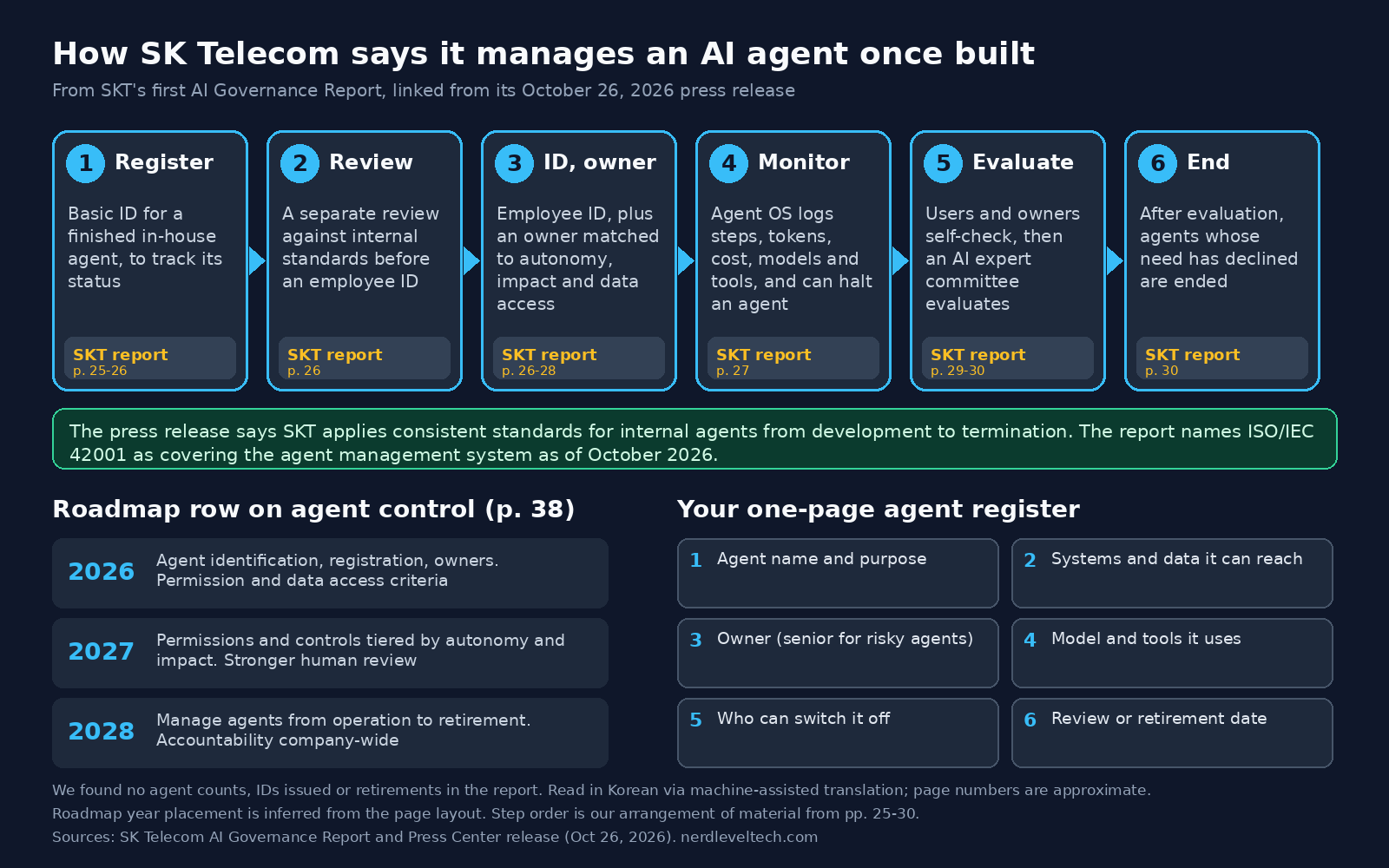
IDs. The report says SKT tracks agents whose in-house development is finished through a basic ID, so it can see their status. It lists the basic information collected as when development and operation began, its linkage status with internal work systems and the scope of its tasks. It says agents that pass a separate review against internal agent standards and requirements are assigned an employee ID, after which the agent's role, owner, operating status and performance are monitored continuously.2
Three factors. When SKT assigns an employee ID and decides an agent's scope of work, it says it always considers three factors: whether a standard operating procedure exists, whether performance can be measured objectively, and whether the agent can complete tasks without human intervention.2 As we read it, the report words these as factors it considers, not as a pass or fail test.
Owners. SKT says it designates a suitable owner by considering factors such as an agent's level of autonomy, the scope of its business impact and the way it reaches data. The report says an agent that assists one person's work can be managed by that user, while an agent with greater impact or higher autonomy must have a business owner such as a team leader or an executive.2
Human review. The report says the level of human involvement depends on the task and its risk, and that review and approval get stricter as an agent's autonomy rises. Its table lists human confirmation before key decisions or actions, monitoring with intervention during operation, and a check of results and operating history afterward.2
Agent OS. The report says SKT's Agent OS manages each agent's execution status, usage and change history. It records step-by-step logs, token and call volumes and cost, and the models and tools each agent uses. The report also says an agent's execution can be halted in an abnormal situation or when an immediate response is needed, with the related action and change history managed alongside.2
Reviews and shutdown. The report says users and owners complete self-checks that explain the practical effect of the changes in their working methods and operations, and an evaluation committee of AI experts assesses those self-checks and the agent's competence and performance. It says agents that hold an employee ID are checked regularly on results, performance, operating cost and functions, even after they are running. Depending on the evaluation result, an agent is kept as it is, has its functions or scope adjusted, or, if the need for it has declined, has its operation ended.2
Pay and targets. The report's table lists, as uses of the evaluation results, a short-term link to executive evaluation and compensation and to staff awards. For the long term, it says SKT considers reflecting agent performance in organizational KPIs (key performance indicators). It also says SKT is reviewing ways to share agent results with staff.2 We found no statement on whether the pay and reward links are already in effect. The report does say SKT operates a system that links agent evaluation results to organizational performance; it does not say whether that affects pay.2
What was reported about this in June?
Seoul Economic Daily reported on June 16, 2026, in an article about SKT's AX Innovation 2.0 vision, that SKT is launching an organizational experiment in which AI agents receive employee ID numbers and are assigned affiliations, job functions and authority, and are managed in a manner similar to people from hiring to departure.4 As we read it, the June article does not mention the separate review step that the October report describes.
RCR Wireless reported on June 18 that SKT says it already uses thousands of AI agents alongside staff, and that its stated goal is one AI agent per employee. RCR also reported that SKT's A. Biz agent platform is set to roll out to 25 SK Group companies by the end of the year, and described the expansion as expected to cover roughly 80,000 employees, without saying whose estimate that is.5 The thousands-of-agents figure and the one-agent-per-employee goal are SKT's own claims, not independently confirmed results. RCR also relayed SKT's claim, from early trials in what RCR calls an AI sandbox, of meaningful reductions in planning and coordination time. RCR gave no numbers and said these are the company's own pilot figures rather than independently verified results.5 RCR's June account also describes broader assignment than the report does: it says every SKT AI agent gets an employee-style ID, a department, a job function and role-based access, though RCR describes the access scope as the intent and says the hiring-to-termination lifecycle has not been fleshed out publicly, while the report ties employee IDs to a separate review.5
What is the roadmap?
The report's roadmap, on page 38, is a grid of workstreams across three phases: foundation building in 2026, integration and upgrading in 2027, and establishment and spread in 2028. In the row on strengthening agents' authority, responsibility and control, and as best we can read the page layout, the 2026 items are agent identification and registration, owner designation, and criteria for usage permissions and data access. The 2027 items are permissions and controls that differ by an agent's autonomy and business impact, and stronger human review, approval and intervention. The 2028 items are managing agents from operation through evaluation, maintenance and upgrade to retirement, and embedding accountability and oversight across the company.2 S Journal's report on the announcement describes the same broad sequence of foundation, then permissions and human review, then full lifecycle management.6 The roadmap puts agent registration and owner designation in 2026 and management through retirement in 2028, yet the report describes the ID system and Agent OS as operating, and the chief privacy officer's message on page 3 says SKT plans to put in place, in stages, a management system that runs from identification and owner designation through suspension and retirement.2 We found no per-step status or coverage figures, so we cannot tell how widely each step is applied.
Why does it matter?
For executives
In our view, leaders need three answers about their AI agents: how many are running, who answers for each, and what each one can touch. As we read it, SKT's described approach addresses all three in principle, but the report gives no counts, so the first question stays open. Our read: the useful part is the accountability rule, not the label "employee ID."
In SKT's design, who owns an agent depends on its autonomy and business impact.2 The report says a helper that assists one person can be managed by that person, while an agent with higher autonomy or greater business impact must have a business owner, such as a team leader or an executive. You can adopt that rule without buying anything.
Be careful with the "employee ID" framing. We found no agent counts, no incident data and no measured results from the governance program in the report, so it shows how one company says it organizes its agents, not that the method works.2
For product managers
If your product ships agents to customers, our read is that buyers are likely to ask for the same kinds of things SKT's design addresses: who owns the agent, what it can access, what it did and how to switch it off. Put those four items in your admin screens and your security documentation.
Microsoft's Entra Agent ID documentation separates owners, sponsors and managers, and two of those roles matter here. A sponsor is a business representative accountable for an agent's purpose and lifecycle decisions, including access reviews and agent retention, and at least one sponsor is required for each agent identity. Owners are technical administrators.7
For project and delivery leads
Our read: an agent that outlives its project can become a risk nobody budgets for. Add an end date, or a review date, to every agent you launch, and write down who takes it over when its business owner changes roles. In Microsoft's Entra terms, our closest match to SKT's business owner is the sponsor, and its documentation says sponsorship should be maintained to ensure succession when a sponsor moves or leaves.7
Our read: a shared spreadsheet that every launch has to appear in before it goes live is a low-cost control.
Who should act on this?
The actions in this table are our suggestions, not SKT practice, and the benefits are our expectation, not measured results.
| Role | What to add this week | Why it may help |
|---|---|---|
| Executive | Ask for a count of AI agents in use and a named owner for each | Leaders can learn how many agents exist before they set policy |
| Operations | Add every agent to one register, with its purpose and the systems it touches | Ownerless agents become easier to spot |
| HR | Decide who handles an agent when its owner leaves, and add it to the exit checklist | The agent is less likely to outlive its owner's access |
| Finance | Ask which agents spend money or touch ledgers, and who approves their changes | Agents with money access can be reviewed most strictly |
| Customer support | List the agents that talk to customers and the escalation path to a person | Failures should reach a human sooner |
| Product | Log which model and tools each agent uses | Problems are easier to trace to a cause |
| Project delivery | Set a review date for each agent at launch | Pilots are less likely to turn into permanent, unwatched software |
How do software tools fit?
You do not need SKT's internal software to start, and Microsoft, for one, sells a register. Microsoft's U.S. English page lists Agent 365 at $15.00 per user per month and Microsoft 365 E7 at $99.00 per user per month (a version without Teams is listed at $90.45), both with an annual commitment, and its FAQ says E7 includes Agent 365. The page describes a view of all agents in an organization, including Microsoft platform agents, partner agents and agents an organization registers itself, and rules such as expiring inactive agents, flagging ownerless agents or blocking risky agents.8 Agent 365 reached general availability for commercial customers on May 1, 2026.9
On October 19, Microsoft wrote about "agentic insiders," and a companion post introduced new controls. Neither post, as we read them, gives release dates or prices for the new controls, and we found no statement of which plan includes which control, although the companion post's summary line links its new capabilities to Microsoft 365 E7.1011 See our guide to Microsoft's agentic insider message for what is confirmed. Among suppliers, we checked only Microsoft's pages for this post, so ask your other agent suppliers whether they offer an inventory, owner fields and a stop switch.
What to do this week
- Count your agents. Ask each department head to list the AI agents, assistants and automations their teams run, including ones built by staff. Expect gaps. A first list with holes beats no list.
- Create a one-page register. For each agent, record its name, purpose, the systems and data it can reach, the person who answers for it, the model and tools it uses, who can switch it off and a review date.
- Set an entry test. SKT says it considers three factors when it assigns employee IDs and decides task scope: whether a procedure is written down, whether results can be measured, and whether the agent can finish a task without a person stepping in. Our adaptation, which is not how SKT says it uses the factors, is to use the first two as a simple entry test: an agent with no written procedure and no way to measure its results should be logged but should not run unattended. Treat the third as a signal that an agent needs a more senior owner and stricter review, since the report says review and approval get stricter as autonomy rises.
- Match the owner to the risk. Let a user own a helper that only works on their own tasks. Require a manager or executive for any agent that acts on its own, has wide business impact, touches customer data or moves money.
- Agree on a stop rule. Decide who can switch an agent off and how fast. Our guide to AI agent kill switches covers what stopping really involves.
- Set a retirement rule. Pick a date or an inactivity period after which an unused agent loses its access unless an owner renews it.
Questions to ask your team or vendor
- How many AI agents are running in our company today, and who answers for each one?
- Which agents can act without a person approving each step, and who is their supervisor?
- What systems and data can each agent reach, and who approved that access?
- If an agent misbehaves, who can stop it, how fast, and is the stop recorded?
- What happens to an agent when its owner changes jobs or leaves?
- Can our supplier show a log of the models, tools and steps behind any agent decision?
- Which agents have not been used in the period we set, such as 90 days, and why do they still have access?
Risks and what we don't know yet
It is SKT's own account. The report describes SKT's policy and design. In the report and the other sources we read, we found no independent evaluation of how the agent program performs in practice. In the report itself we found no counts of agents, IDs issued or retirements.2
No measured results. We found no productivity, cost or incident figures from the agent program in the report. SKT's release says the report covers key achievements, but in what we read these were milestones such as certifications, not measured outcomes.12 The thousands-of-agents figure, the one-agent-per-employee goal and the claimed time savings, all as relayed by RCR in June, are SKT claims and plans, not verified results.5
A certificate is not proof of results. ISO/IEC 42001 specifies requirements for a management system, and SKT's certification is described as covering its AI agent management system.13 Our read: a certificate on a management system says little about how any single agent behaves.
An ID can become paperwork. Our read: a register nobody checks is worse than none, because it gives false comfort. Assign someone to review it on a schedule.
Treating agents like staff has limits. Our read: an agent is software, not a person, so the staff comparison works for ownership and access but should stop there.
Linking pay to agent results can distort behavior. The report lists a short-term link between agent results and executive evaluation and compensation.2 Our read: done carelessly, it could push teams to keep agents running for the score.
Language and reading limits. The report is in Korean and we read it through machine-assisted translation, so exact wording and page numbers may differ slightly.
Rules differ by country, so check yours. South Korea's AI Basic Act took effect on January 22, 2026.12 As of January 2026, Cooley reports that South Korea's Ministry of Science and ICT (MSIT) has indicated it will grant businesses a one-year grace period before administrative fines, and that operators of high-impact AI, a category the act defines, must have a mechanism for human intervention and supervision.12 Whether any of your agents fall into that category is a question for your legal adviser. SKT's report says it is aligning its internal systems with the act.2 This post is for general information and is not legal advice.
Bottom line
SK Telecom's report describes a defined model: agents whose in-house development is complete are tracked, agents that pass a review get an employee ID, owners are matched to autonomy and impact with a business owner such as a team leader or executive required for agents with higher impact or autonomy, activity is logged, and, after evaluation, agents whose need has declined have their operation ended. The report is SKT's own account, and we found no agent counts, incident data or measured outcomes in it. You can copy the idea this week with a one-page register and a named owner for each agent.
For related reading, see our guides to AI agents as insider threats, AI agent identity and AI agents getting work email.
Get the full teardown, the three signals, and one job lead in Thursday's NerdLevelTech Weekly. Link in the first comment.
Frequently Asked Questions
What is an AI agent employee ID?
Here it means the employee number that SK Telecom's report says it assigns to an AI agent. SKT says it assigns it to agents that pass a separate review against internal standards, and afterward the agent's role, owner, operating status and performance are monitored.
What does SK Telecom consider before giving an agent an ID?
SKT says it always considers three factors when assigning an employee ID: whether a standard operating procedure exists, whether performance can be measured objectively, and whether the agent can complete tasks without human intervention. It also says the agent must pass a separate review against internal standards and requirements.
Who is responsible for an AI agent at SK Telecom?
SKT says it designates a suitable owner by considering factors such as an agent's autonomy, business impact and data access. It says a user can manage an agent that assists their own work, while an agent with greater impact or higher autonomy must have a business owner such as a team leader or an executive.
Does SK Telecom retire AI agents?
The report says agents that hold an employee ID are checked regularly, and, after evaluation, an agent whose need has declined has its operation ended. As best we can read it, its roadmap lists management through retirement as a 2028 item. We found no number of agents ended in the report.
What is ISO/IEC 42001?
It is an international standard that specifies requirements for an AI management system. SKT says it became the first domestic telecom operator in South Korea to earn the certification in 2024, for customer-facing AI services, and that in October 2026 its scope reached the internal AI agent management system.
How do I start governing AI agents in a small company?
Start with a shared register. List every agent, its purpose, the access it has, the person who answers for it and a review date. Then decide who can switch an agent off. A spreadsheet is enough to begin.
Does Microsoft Agent 365 offer an agent register?
Microsoft's page describes a view of all agents in an organization and rules such as expiring inactive agents, flagging ownerless agents or blocking risky agents. It lists Agent 365 at $15.00 per user per month with an annual commitment, and says Microsoft 365 E7, at $99.00 per user per month, includes it. Check with Microsoft which features apply to the agents your company actually runs.
Footnotes
-
SKT strengthens "AI trust management" with its first AI Governance Report, SK Telecom Press Center (Korean-language, title translated by us), October 26, 2026. Source for the report's announcement and contents, the lifecycle standards for internal agents, the ISO/IEC 42001 history and the chief privacy officer's remarks. ↩ ↩2 ↩3 ↩4 ↩5 ↩6 ↩7 ↩8
-
SK Telecom AI Governance Report, SK Telecom (Korean-language PDF linked from the press release; undated, latest content October 2026). Source for the agent ID, review, owner, Agent OS, evaluation, pay and targets and roadmap details, the ISO/IEC 42001 scope and the AI Basic Act alignment. Read through machine-assisted translation, so wording and page references are approximate. ↩ ↩2 ↩3 ↩4 ↩5 ↩6 ↩7 ↩8 ↩9 ↩10 ↩11 ↩12 ↩13 ↩14 ↩15 ↩16 ↩17 ↩18 ↩19 ↩20 ↩21 ↩22 ↩23 ↩24 ↩25 ↩26 ↩27 ↩28 ↩29 ↩30
-
ISO/IEC 42001:2023, Information technology, Artificial intelligence, Management system, International Organization for Standardization (ISO committee site), accessed October 29, 2026. Source for the standard's title, edition and scope. ↩ ↩2 ↩3
-
SK Telecom Drives AX Innovation 2.0, Assigns Employee IDs to AI Agents, Seoul Economic Daily, June 16, 2026. Source for the June announcement. The English text is machine-translated from Korean. ↩
-
SK Telecom wants to give every employee their own AI agent, Christian de Looper, RCR Wireless, June 18, 2026. Source for "thousands" of agents, the one-agent-per-employee goal, the rollout to 25 SK Group companies, the roughly 80,000 employees, the AI sandbox trial claim, the note that those pilot figures are not independently verified and the wording about every agent getting an employee-style ID. ↩ ↩2 ↩3 ↩4
-
SK Telecom gives AI employee IDs and evaluates performance, tightening controls as internal use expands, S Journal (Korean-language, headline translated by us), October 26, 2026. Consistent with the broad 2026, 2027 and 2028 sequence of the roadmap. It does not list every item on the report's page 38. ↩
-
Agent owners, sponsors, and managers, Microsoft Learn, accessed October 29, 2026. Source for the definitions of sponsor and owner and the succession guidance. The page shows inconsistent update dates. ↩ ↩2
-
Microsoft Agent 365, Microsoft, accessed October 29, 2026. Source for the $15.00 and $99.00 prices, the annual commitment, the FAQ line that E7 includes Agent 365, the agent registry and the lifecycle rules. ↩ ↩2
-
Microsoft Agent 365, now generally available, expands capabilities and integrations, Microsoft Security Blog, May 1, 2026, accessed October 29, 2026. Source for the general availability date and the commercial-customer scope. ↩
-
Securing the agentic insider, Hayete Gallot, The Official Microsoft Blog, October 19, 2026, accessed October 29, 2026. Source for the "agentic insiders" wording and for the absence of dates and prices. ↩
-
Agents are your newest insiders. Security must move at their speed., Nadim Abdo, Microsoft Security Blog, October 19, 2026, accessed October 29, 2026. Companion post. Source for the absence of availability dates, preview status and prices for the new controls. ↩
-
South Korea's AI Basic Act: Overview and Key Takeaways, Cooley, January 27, 2026. Source for the effective date, the one-year grace period and the human intervention requirement for high-impact AI. ↩ ↩2
- ai for business
- ai agents
- the agentic edge
- SK Telecom
- AI governance
- AI agent governance
- agent employee ID
- ISO 42001
- Microsoft Agent 365
Free newsletter
Stay on the Nerd Track
One email a week: a Thursday issue with one system teardown, three signals, one workflow, one job and one Arabic takeaway.