AI at Work 2026: What the Data Actually Shows
Morgan McKinley's 2026 survey finds 62% of employees use AI daily and 48% use personal accounts. We check its claims against Gallup, Pew and Microsoft.
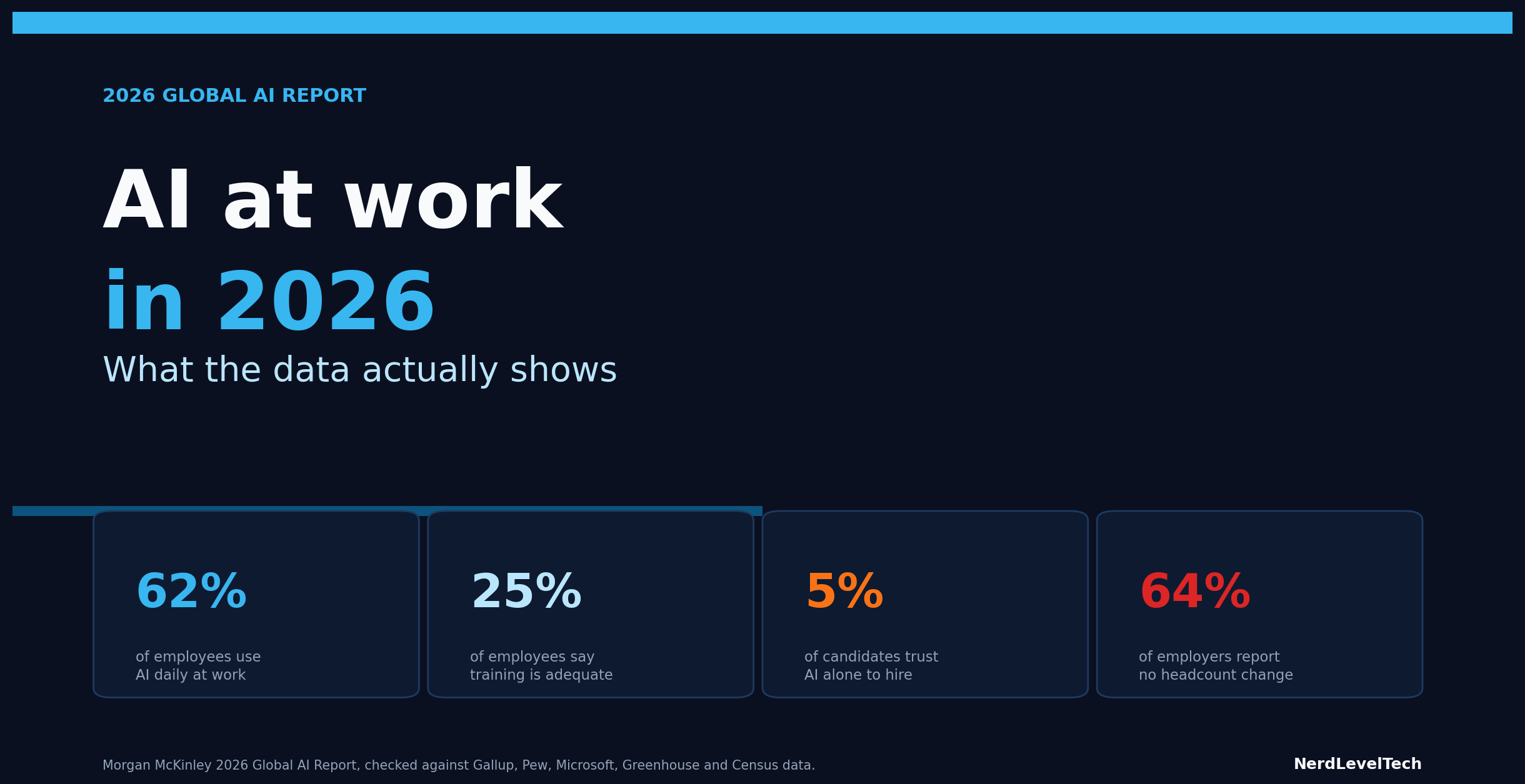
Table of contents
Morgan McKinley's 2026 Global AI Report surveyed 2,106 people across seven markets. It finds 62% of employees use AI daily at work, 48% of employees use personal accounts, and only 5% of candidates trust AI to make hiring decisions. This post compares that survey with five other datasets: Gallup, Microsoft, Pew, Greenhouse and the Census Bureau.
The report is a survey of a specific population, and its sample has limits. Its employer sample is small, its country-level employer samples are smaller, and one of its headline training figures does not match its own chart. The broad direction is consistent across the workplace surveys. The exact figures need caveats.
TL;DR
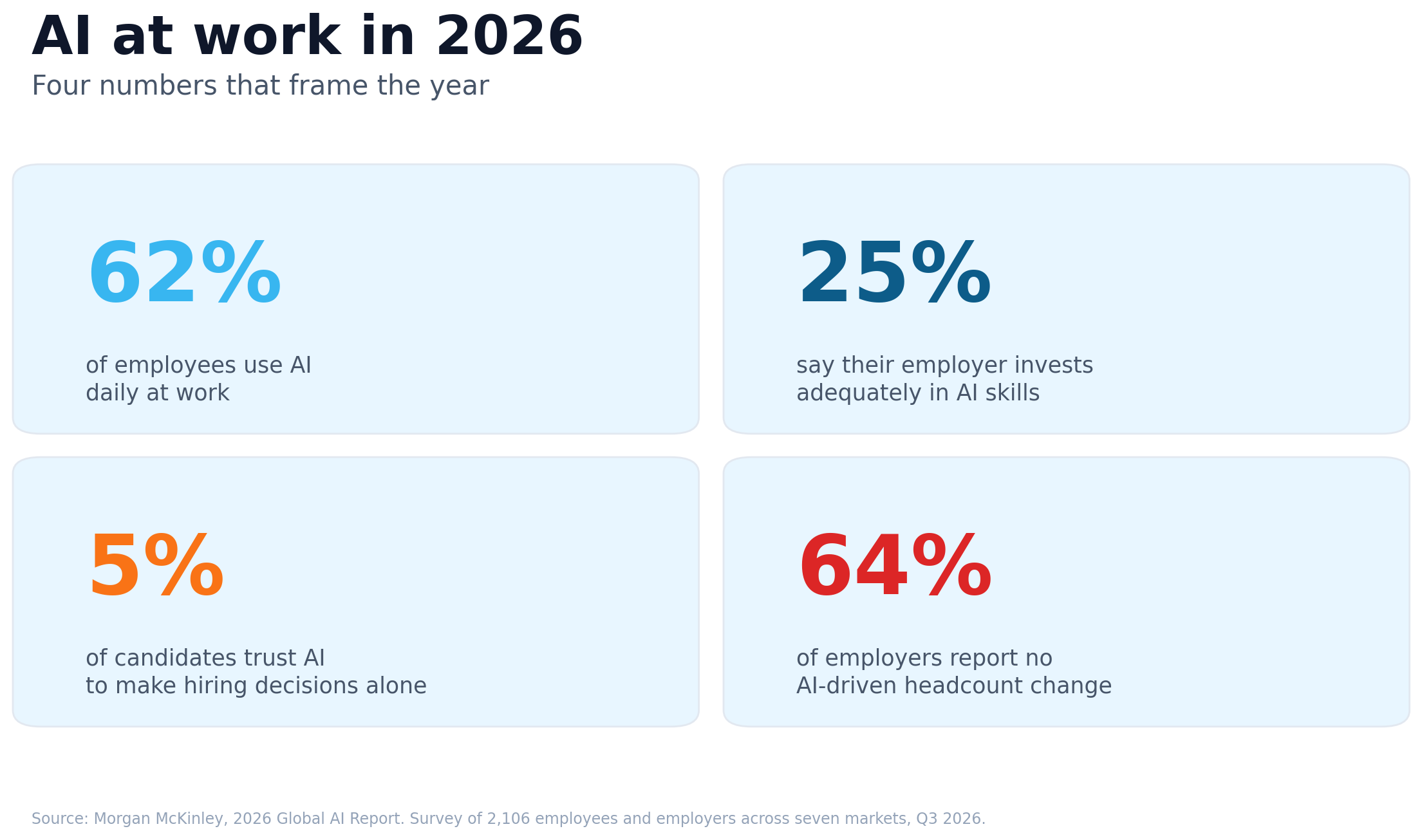
- Morgan McKinley's survey of 2,106 employees and employers in seven markets found 62% of employees use AI daily at work, but only 25% say their employer invests adequately in their AI skills.
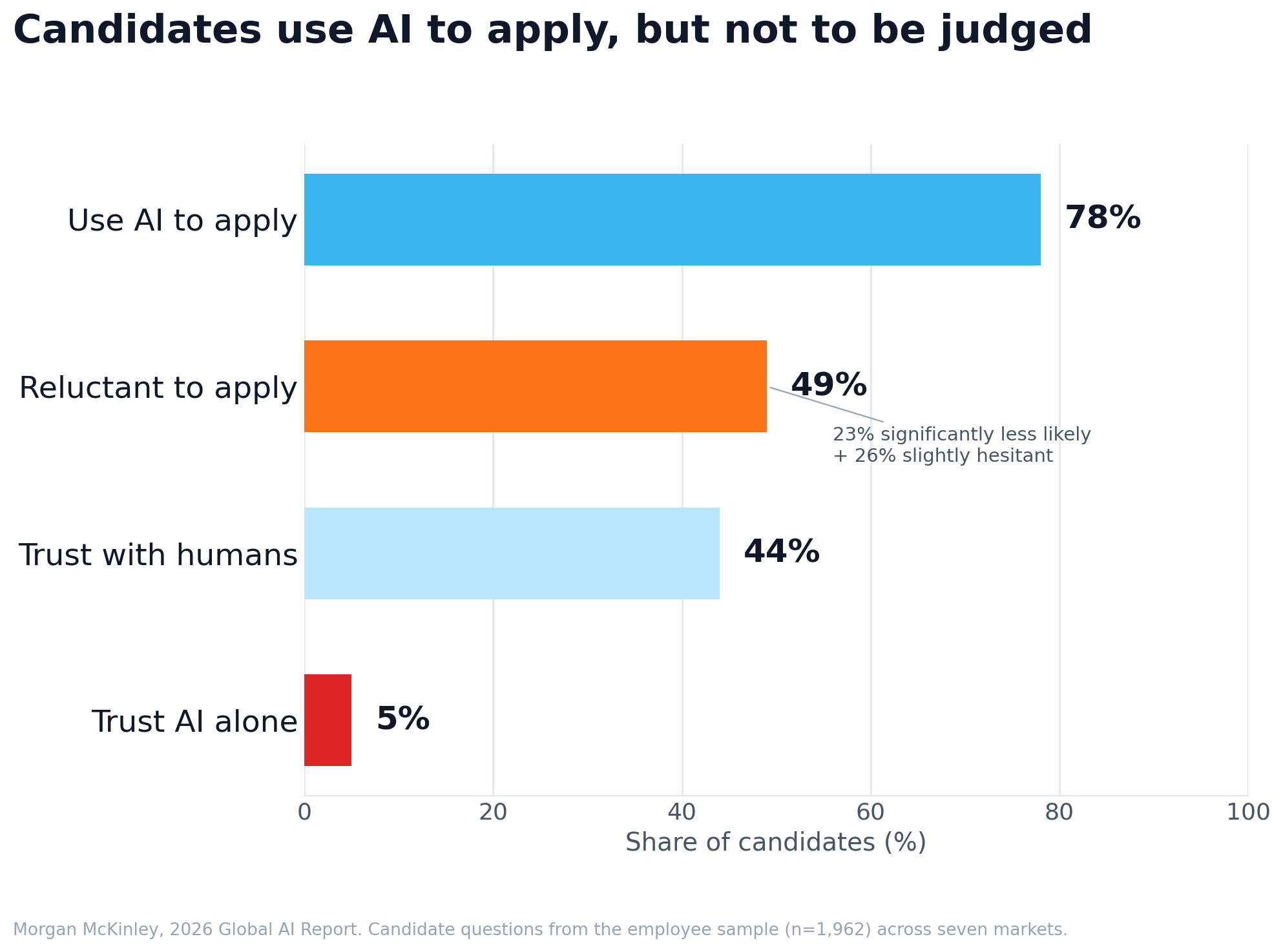
- Candidates use AI in their job search (78%) but do not trust it to decide. Only 5% trust AI alone, while 44% trust it only with human oversight. Adding the two hesitant groups, 49% say AI screening would make them reluctant to apply.
- 48% of employees use personal AI accounts for work. 48% of employers say their organization has a formal AI policy, while 40% of employees say they are aware of one. Adding the 18% who say there is no policy and the 16% who are unsure, 34% lack awareness.
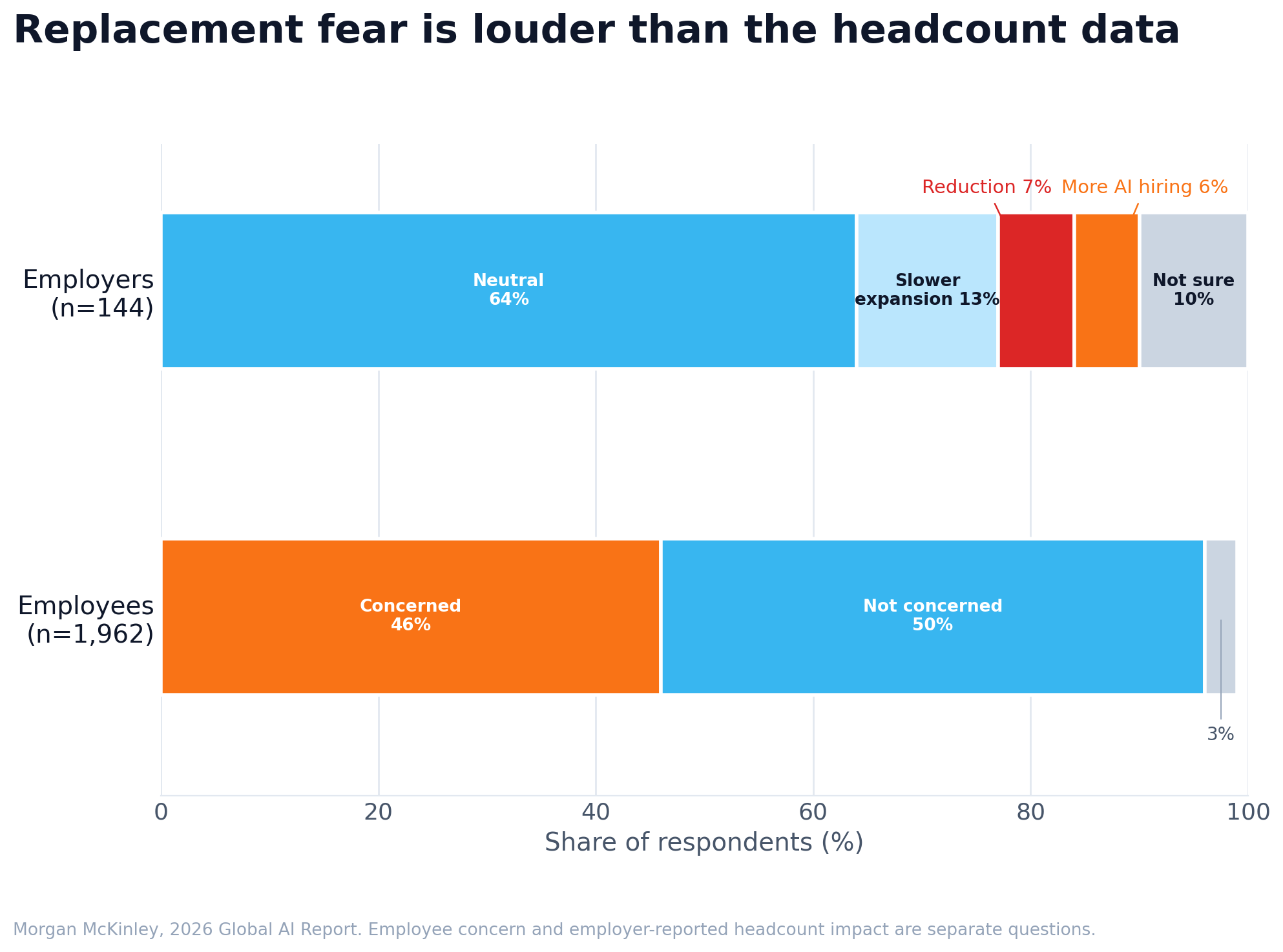
- 46% of employees worry AI could replace their job, while 64% of employers report no headcount impact and 7% report reductions.
- The report's country-level employer samples are small (Hong Kong n=6, Singapore n=11), so the regional split is a signal, not a settled map.
- The datasets disagree on the level of AI use because they measure different populations. The workplace surveys agree that adoption has outrun training, governance and trust.
What You'll Learn
- What the Morgan McKinley report measured, and where its sample limits the conclusions
- Why 62% daily use in one survey and 15% in another can both be true
- What the hiring trust gap looks like across independent surveys
- How personal AI accounts create a policy-awareness gap
- What workers and hiring teams can do about the gap
What the report measured
The report says the survey was launched in Q3 2026. The sample covers 1,962 employees and 144 employers. The report covers seven markets: Australia, Canada, Hong Kong, Ireland, Japan, Singapore and the UK. The employee sample is concentrated in Ireland (32%), Japan (19%) and the UK (17%). The employer sample is concentrated in Ireland (35%), the UK (19%), Japan (17%) and Australia (15%).1
Those weights matter. The employer sample is 144 employers in total. The country-level employer counts are 50 in Ireland, 28 in the UK, 23 in Australia, 23 in Japan, 11 in Singapore and 6 in Hong Kong. Canada was left out of the employer analysis. The report's note says the employer data for Canada "was not high enough to include." That is the first thing to check before repeating any country-level employer claim.
The report says the survey was distributed to its global database of clients and candidates, and that the findings "should be interpreted in the context of the survey sample." Keep that in mind when a 62% daily-use figure meets Gallup's 15%.
Why AI at work statistics do not match
| Source | Date | Sample | Unit | Headline |
|---|---|---|---|---|
| Morgan McKinley 2026 Global AI Report1 | Launched Q3 2026 | 2,106 (1,962 employees, 144 employers), 7 markets | Clients and candidates in Morgan McKinley's database | 62% of employees use AI daily at work |
| Gallup AI indicator2 | Data as of May 2026 | Gallup Panel sample of US employees | US employees | 15% use AI daily; 30% a few times a week or more |
| Microsoft 2026 Work Trend Index3 | February 18 to April 7, 2026 | 20,000 AI users, 10 markets | Knowledge workers who already use AI | 66% say AI allowed more time on high-value work |
| Pew Research global AI survey4 | Published September 17, 2026 | 37 countries | General public | 34 of 37 countries expect AI to cause net job loss |
| Greenhouse 2026 Candidate AI Interview Report5 | Published May 2026 | 2,950 active job seekers, 5 markets | Active job seekers | 63% of US seekers have been interviewed by AI |
| Census Bureau BTOS6 | December 14, 2025 to May 3, 2026 | US businesses | Firms | 17% to 20% of firms used AI in any business function |
These numbers are not competing answers to the same question. They are answers to different questions. Morgan McKinley asked employees in its database how often they use AI at work. Gallup surveyed a weighted sample of US employees from its panel. Microsoft asked people who already use AI. Census asked firms whether they use AI in any business function. Pew asked the public what they expect AI to do to jobs. Greenhouse asked active job seekers what happened in their interviews.
A 62% daily-use figure and a 15% daily-use figure can both be right. The first is a multi-market sample drawn from a recruitment firm's client and candidate database. The second is a Gallup Panel sample of US employees weighted to national demographics. If you put them in the same chart without labels, you get a fake trend.
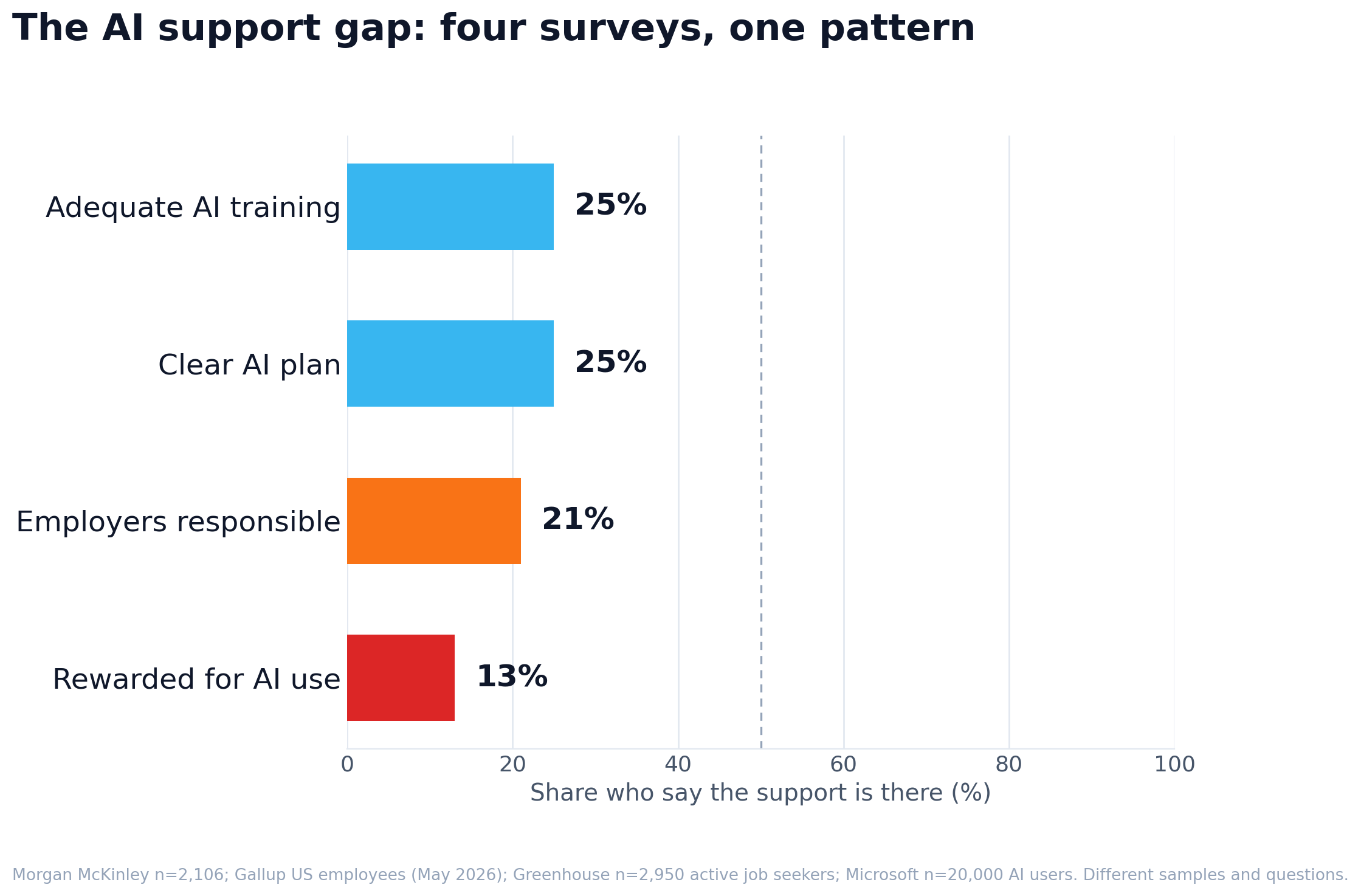
The more useful comparison is the level of support around use. On that question, the four workplace surveys move in the same direction.
| Question | Source | Number |
|---|---|---|
| Employees who say their employer invests adequately in AI upskilling | Morgan McKinley1 | 25% |
| US employees who say their organization has communicated a clear AI plan | Gallup2 | 25% |
| AI users who say they are rewarded for reinvention even when it does not immediately produce results | Microsoft3 | 13% |
| US candidates who believe most employers use AI responsibly and transparently | Greenhouse5 | 21% |
Four different questions, four different samples, one pattern: the people using the tools are ahead of the systems meant to support them.
AI use at work is normal; the training is not
Some 70% of employees say AI has made their work easier: 44% say somewhat easier and 26% say significantly easier. Another 8% say it has made their work more difficult, 11% say it has had little or no impact, and 11% do not use AI at work. The time shift is smaller than the headline. Some 27% say they spend more time on strategic planning or decision-making, 24% on reviewing or validating AI output, 10% on data analysis, and 9% on relationships. Another 14% say AI has not changed how they spend their time.1
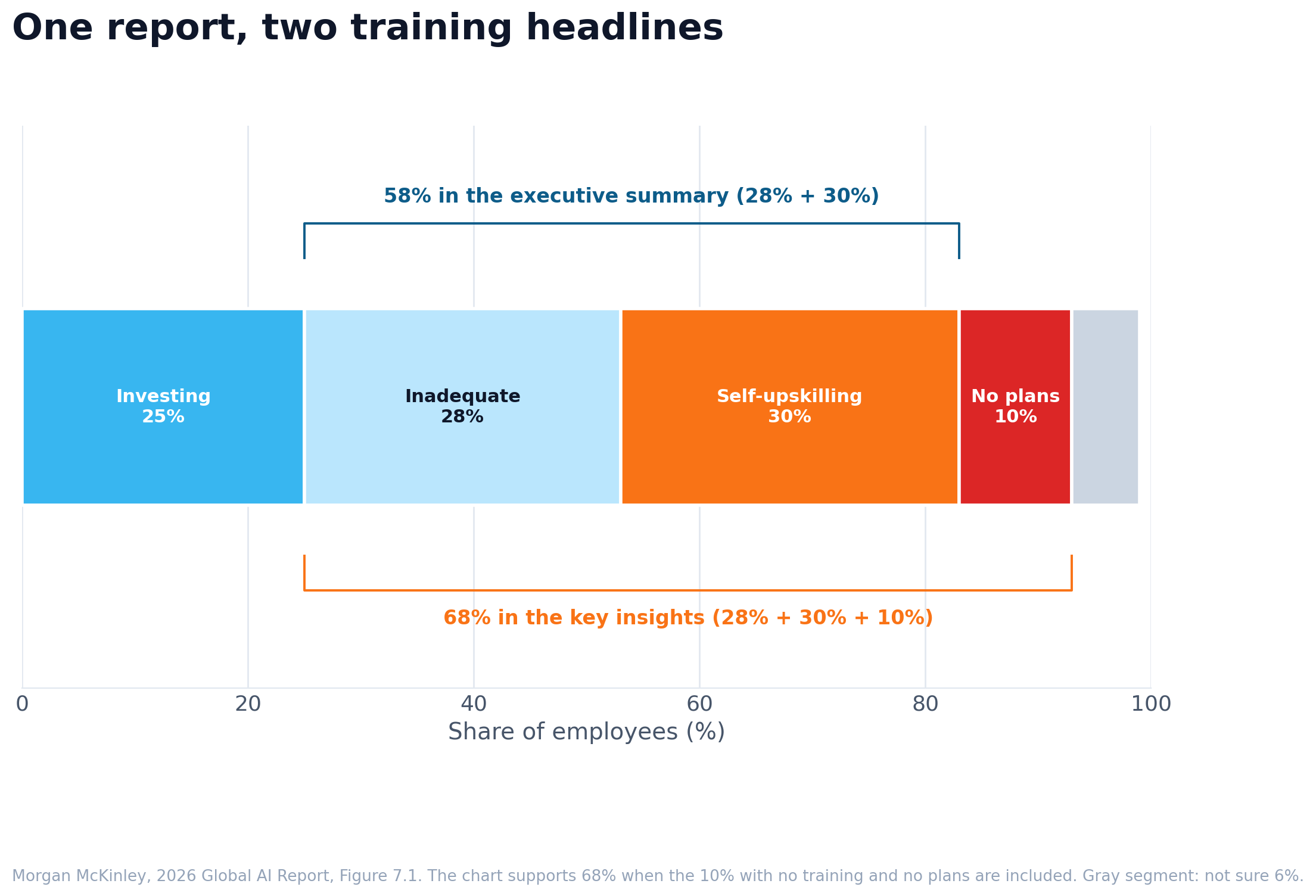
The report's training numbers deserve a careful read. Its chart gives 25% who say their employer is actively investing in their AI upskilling, 28% who say the training is available but inadequate, 30% who say there is no employer investment but they will upskill on their own time, 10% who say there is no investment and no plans, and 6% who are not sure. Add the 28%, 30% and 10% groups and you get 68% who receive inadequate or no training. The report's key-insights section uses 68%. Its executive summary uses 58%. The 58% matches the sum of the 28% and 30% groups. The 68% adds the 10% group. The chart is the primary breakdown, and the 25% who say their employer is actively investing is the direct answer to the training question.1
Employers are planning to spend more. Adding the two groups that expect an increase, 52% expect their AI training budget to rise, including 19% who expect an increase above 25%. But 19% do not allocate a dedicated budget, and 31% say they have no active AI upskilling strategy.
Gallup's US data shows the same shape. 47% of employees say their organization has integrated AI, but only 25% say it has communicated a clear plan for using it. Microsoft's 2026 Work Trend Index adds the incentive problem: only 13% of AI users say they are rewarded for reinvention regardless of outcome, and 26% say leadership is clearly and consistently aligned on AI.23
Microsoft's sample is limited to people who already use AI at work. It screened out respondents who said they never use AI or did not know, so its 66% high-value-work figure describes AI users, not everyone. Even in that group, only 13% say they are rewarded for reinvention regardless of outcome.
AI in hiring: candidates use it to get in, then refuse to be judged
On the candidate side, the report finds 78% use generative AI in some form during a job search. Some 59% use it for CVs or cover letters, 43% for interview preparation, 36% to apply to more roles, and 35% to optimize for applicant tracking systems. Candidates are using AI across the application process, including the ATS filter.1
Trust in the employer's AI is much weaker. Only 5% would trust a recruitment decision made by AI alone. Some 44% would trust AI only when a human is involved. Another 24% have limited trust, 22% do not trust AI in recruitment, and 5% are not sure. Adding the two hesitant groups, 49% say employer AI screening would make them reluctant to apply: 23% significantly less likely, 26% slightly hesitant but still applying. Another 15% say it would make them more likely to apply, and 36% say it would not affect their decision.
Employers see the same friction from the other side. Some 38% say candidate AI use has had no measurable impact on their process. Another 29% say it has made skills and backgrounds harder to verify. Some 27% say it has made it easier to screen out candidates. Another 9% say AI has increased application volumes and slowed them down. Only 2% automatically reject applications flagged as AI-generated, while 42% see candidate AI use as an acceptable efficiency tool and 14% use detection as data rather than a filter.
The Greenhouse 2026 Candidate AI Interview Report shows what that friction feels like to candidates. Some 63% of US job seekers in its survey had been interviewed by AI in the past 12 months. Another 38% had withdrawn from a process at least once because it included an AI interview. Some 57% believe companies should be legally required to disclose AI use in candidate evaluation. Among US candidates, 54% favor human interviewers and only 17% trust AI more. Just 21% believe most employers use AI responsibly and transparently. Across the five markets, 63% to 70% do not.5
Candidates are optimizing applications while employers are trying to verify them. Both sides are using AI in the same process. Candidates distrust AI screening, and employers say AI makes verification harder. The report recommends more practical skill verification, with structured assessments and practical evaluation.1
AI governance: the personal-account policy gap
Some 48% of employees use personal AI accounts for work at least occasionally: 20% daily, 11% regularly, 17% occasionally. Another 44% say they do not, and 8% say they do not use AI tools at work. AI chatbots appear in both the personal and work tool lists. Some 84% use AI chatbots in their personal life, 40% use writing or translation tools, and 34% use AI search. At work, 74% use chatbots, 42% use meeting or transcription tools, and 41% use document or presentation tools.1
The governance gap shows up when employers and employees describe the same policy. Some 48% of employers say their organization has a formal AI policy. Only 40% of employees say they are aware of one. Another 39% of employers say they have guidance without a formal policy, and 23% of employees say the same. Some 18% of employees say there is no policy or guidance, and 16% are not sure. Add those two groups and 34% of employees either lack a policy or do not know whether one exists.
That 34% is a derived figure, not a direct survey question. The report's landing page uses it, and the arithmetic is clear. It is still worth labeling as a sum, because the difference between "no policy" and "I do not know" matters. A policy employees do not know about cannot guide their behavior.
Trayc Keevans, Morgan McKinley's global director and head of research and foreign direct investment, told RTÉ: "Employees are developing AI skills on their own time and using personal accounts for work, even as employers report operational benefits." She said the next phase "will depend on whether organisations can turn that individual initiative into workforce capability, supported by meaningful training and governance that employees understand and can apply."7
Gallup's US data adds context. Only 25% of employees say their organization has communicated a clear plan for AI. Microsoft's data adds the pressure: 65% of AI users fear falling behind, and 45% say it feels safer to focus on current goals than to redesign work with AI. When the official guidance is thin, personal accounts and informal habits can fill the gap.23
Employers report gains as well as barriers. Adding the 41% who report a moderate improvement and the 14% who report a significant improvement, 55% say AI has improved operational performance. Efficiency and workflow speed are the main motivation, cited by 63%, while direct cost-cutting, budget optimization or future headcount reduction is cited by 7%. The top barrier is data privacy, cybersecurity and regulatory compliance, cited by 25%, followed by a lack of practical, tangible output that is visible or measurable (19%) and budget constraints (16%). Employers report operational gains, but governance is the constraint on scaling.1
AI job replacement fears vs. the headcount data
Some 46% of employees say they are concerned that AI could replace their job: 16% very concerned, 30% somewhat concerned. Another 50% are not concerned: 31% not very, 19% not at all. Some 3% are not sure. That is a substantial share, and it is higher than the employer headcount data would suggest.
Some 64% of employers say AI has had a neutral impact on headcount. Another 7% report a reduction, 13% say it has slowed planned expansion, 6% say it has increased hiring for specialist AI talent, and 10% are not sure. Looking ahead, 43% describe their approach as people-first, 30% as flexible, 5% as automation-first, 13% as too early to say, and 6% as not currently a focus.1
Graduate hiring is mixed. Some 27% expect no change, 13% expect a similar number of graduates with different skills, 11% expect fewer graduates as AI automates some entry-level work, 5% expect to delay or reduce graduate recruitment, 19% do not recruit graduates, 18% are not sure, and 7% expect to recruit more.
Pew's 37-country survey shows the perception gap is not a Morgan McKinley artifact. In 34 of 37 countries, people tend to believe AI will lead to fewer jobs rather than more. A 37% median is more concerned than excited, while a 41% median are equally concerned and excited. The fear is global. The headcount data in this report is more limited.4
None of this proves AI will not displace jobs. The 7% who report reductions and the 13% who report slower expansion are real. The point is that the aggregate fear is running ahead of the aggregate evidence in this sample. For the 7% who report reductions, the aggregate number is not the relevant one.
AI at work by region: read the sample sizes
| Market | Candidates significantly less likely to apply if AI screening is used | Candidates who do not trust AI in recruitment | Employers not using AI in hiring | Employer sample |
|---|---|---|---|---|
| Ireland | 35% | 32% | 47% | 50 |
| UK | 28% | 27% | 55% | 28 |
| Australia | 24% | 26% | 14% | 23 |
| Global | 23% | 22% | 36% | 144 |
| Singapore | 13% | 14% | 33% | 11 |
| Japan | 11% | 9% | 21% | 23 |
| Hong Kong | 10% | 9% | 0% | 6 |
| Canada | 10% | 25% | not reported | excluded |
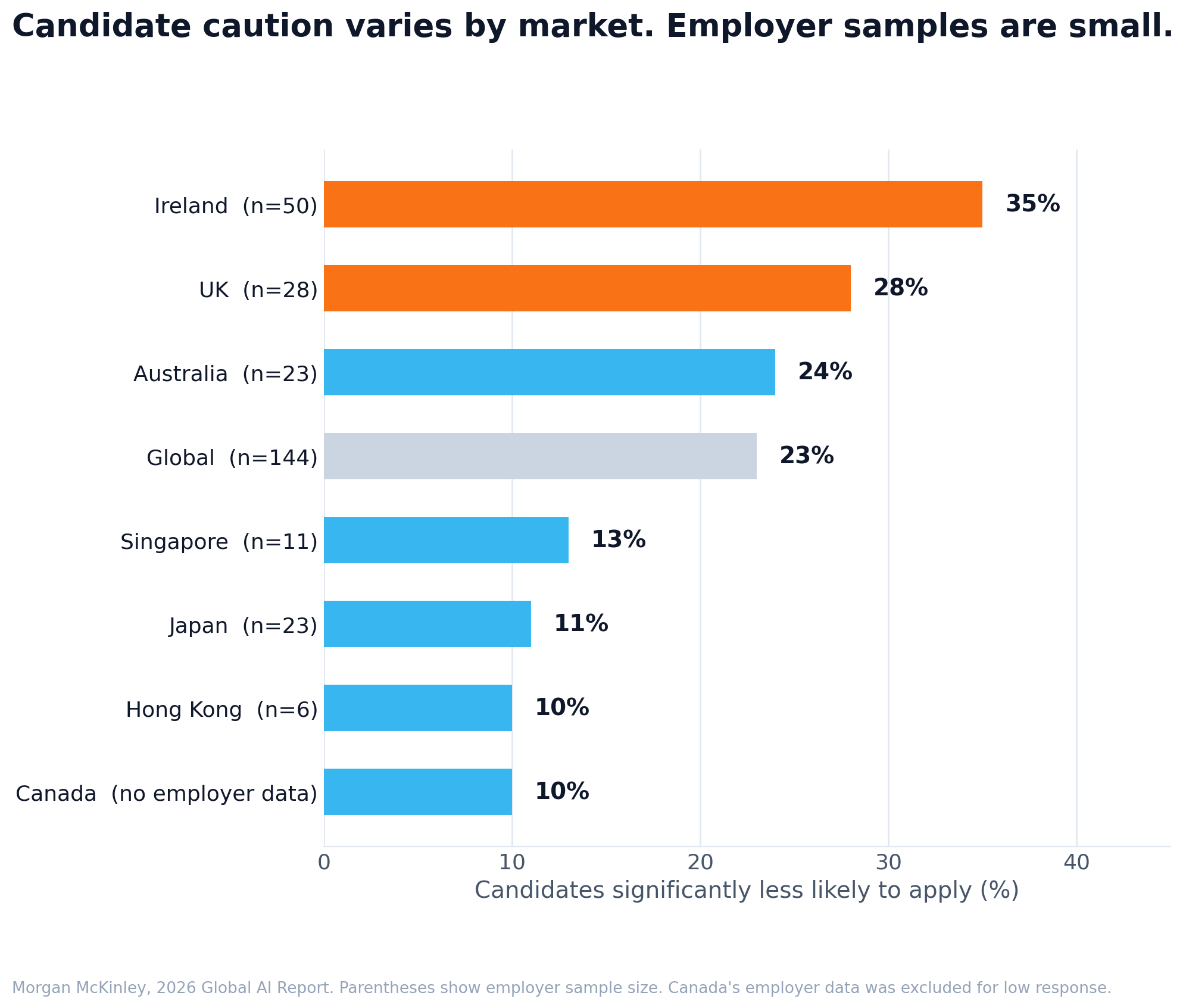
Canada's candidate row is based on 33 respondents. The report warns that this base is small, which is why we list it without a ranking claim.1
The candidate side is consistent enough to take seriously. Ireland (35%) and the UK (28%) show more resistance than the global average (23%). Singapore (13%), Japan (11%) and Hong Kong (10%) show less. The employer side is much thinner. The Hong Kong 0% is six employers. The Singapore 33% is 11. The Australian 14% is 23. Those numbers can support a hypothesis about local hiring norms. They cannot rank markets.1
The report's own note says employer respondent volumes are significantly lower than employee volumes. That is the correct caveat, and it should travel with every country-level employer claim. A safe conclusion is that candidate expectations differ by market and are worth testing locally. A less safe conclusion is that Asia is uniformly comfortable with AI hiring and Europe is uniformly resistant.
What this means for workers
The figures in this section come from the Morgan McKinley report unless another source is named.1
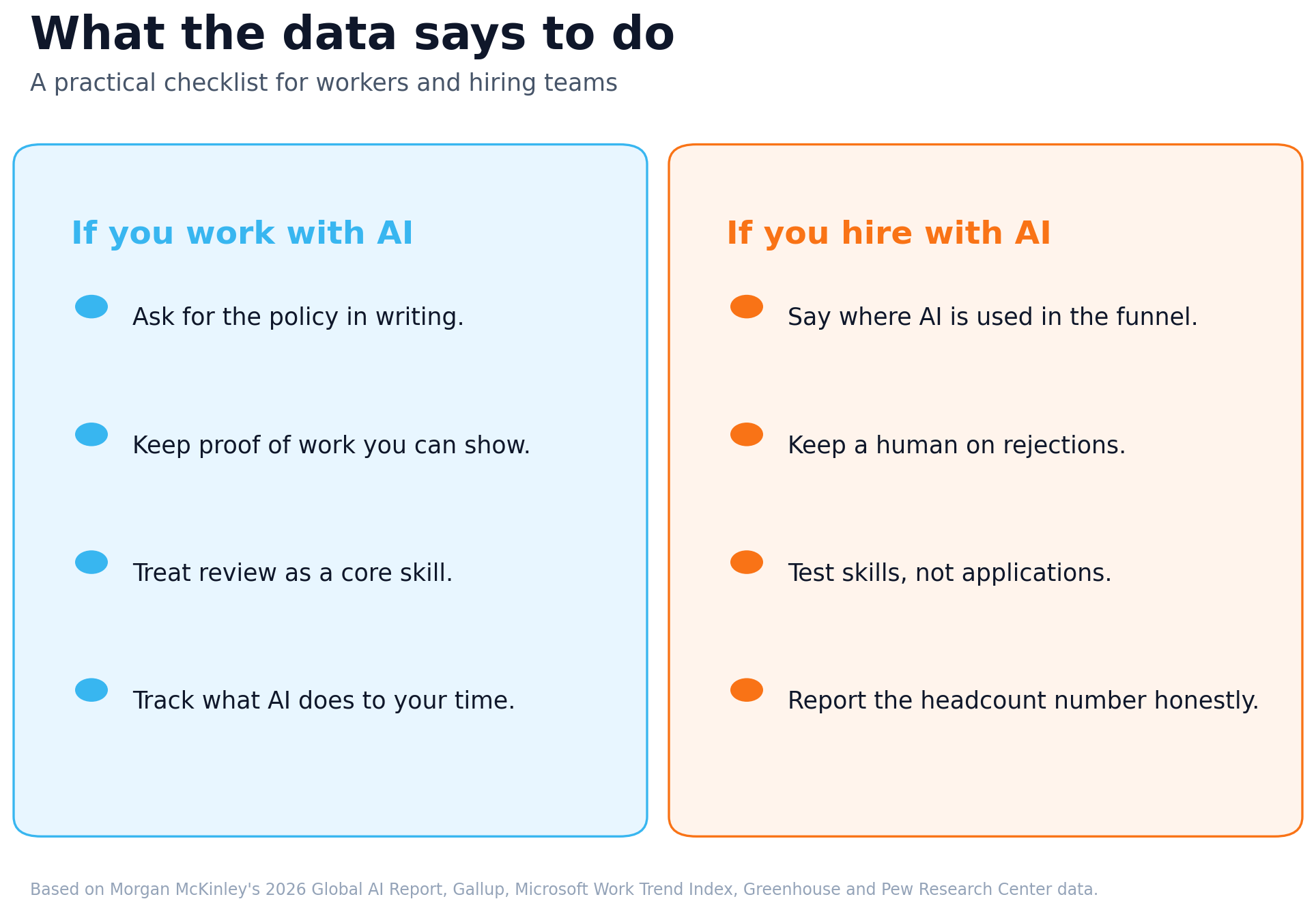
- Treat review as a skill. Some 24% of employees say they spend more time validating AI output. Microsoft's respondents rank quality control (50%) and critical thinking (46%) as the human skills that matter more as AI takes on work.3 The ability to catch a confident wrong answer is now part of the job.
- Ask for the policy in writing. Some 34% of employees either say their organization has no AI policy or do not know whether one exists. If you use a personal account for work, you are taking on a data-handling risk your employer may not have approved.
- Keep proof of work. Some 29% of employers say AI makes skills harder to verify. A portfolio, a repository, a test you can walk through, or a reference who saw you do the work is more useful than a polished application.
- Do not optimize only for the filter. Some 35% of candidates optimize CVs for ATS algorithms, while 49% say they would be reluctant to apply to an employer that uses AI screening. The same tool can help you get in and make the process feel less trustworthy.
- Measure what AI does to your time. Some 27% say they spend more time on strategic planning, 24% on validation, and 14% say nothing changed. If AI is only speeding up output, you may be missing the part of the shift that compounds.
What this means for hiring teams
The figures in this section come from the Morgan McKinley report unless another source is named.1
- Say where AI is used. Some 57% of candidates in Greenhouse's survey want legal disclosure. Only 21% of US candidates believe most employers use AI responsibly.5 Silence is now a candidate-experience problem.
- Keep a human on consequential decisions. Only 5% of candidates trust AI alone, while 44% trust it with human oversight. Some 40% of employers say they keep human oversight for every rejection. That is a reasonable minimum.
- Test skills, not applications. Some 29% of employers say AI makes verification harder. Structured assessments and work samples are more useful than another detection tool.
- Close the policy gap. Some 48% of employers say they have a formal policy, but only 40% of employees are aware of one. Publish it, train on it, and check that people can repeat the rule.
- Report the headcount number honestly. Some 64% of employers say neutral, 7% say reduction, 13% say slower expansion. The people in the 7% need a different message from the people in the 64%.
Our read
In Morgan McKinley's sample, more than half of employees use AI every day and one in four say their employer invests adequately in their skills. In Greenhouse's sample, 21% of US candidates believe employers use AI responsibly.15 For planning, the 25% training figure and the 21% trust figure are more useful than the 62% headline on its own.
The report's biggest weakness is precision. It gives two different training figures, it derives a policy-awareness number from two separate answers, and its country-level employer samples are too small to support the regional story that some coverage will pull from it. The report says this last part itself. The weakness is worth naming because the direction is strong enough without overclaiming.1
Four workplace surveys point in the same direction on support. Morgan McKinley, Gallup, Microsoft and Greenhouse asked different people different questions, and their answers on training, planning, rewards and trust all sit below half. Pew and the Census Bureau add context on public concern and firm-level adoption. The four workplace surveys do not agree on the level of AI use. Taken together, they point to support systems, training, policy, verification and incentives that have not caught up with the tools.123456 That is the gap to budget for in 2027.
Related reads
- AI Job Market Trends: Skills, Salaries, and the Future of Work
- AI Career Roadmap 2026: Skills, Tools & Real-World Pathways
- Stanford AI Index 2026: US-China Gap Shrinks to 2.7 Points
References
Frequently Asked Questions
What is the Morgan McKinley 2026 Global AI Report?
It is a survey of 2,106 people, 1,962 employees and 144 employers, across seven markets, launched in Q3 2026. It covers AI use at work, AI in recruitment, upskilling, governance and workforce planning.
How many employees use AI daily at work?
In Morgan McKinley's sample, 62% use AI daily and another 15% use it weekly. Gallup's US sample finds 15% daily, with 30% using it a few times a week or more. The difference comes from the samples and the question wording, not from one survey being wrong.
Do candidates trust AI in hiring?
Only 5% would trust a recruitment decision made by AI alone. Some 44% would trust AI with human decision-making. Adding the two hesitant groups, 49% say AI screening would make them reluctant to apply. Greenhouse's survey finds 54% of US candidates favor human interviewers and only 17% trust AI more.
How many employees use personal AI accounts for work?
Some 48% use personal AI accounts at least occasionally. Some 34% either say their organization has no AI policy or are not sure whether it has one. That 34% is the sum of 18% who say there is no policy and 16% who are unsure.
Does AI reduce headcount?
In this survey, 64% of employers report a neutral impact, 7% report a reduction and 13% report slower planned expansion. Some 46% of employees are concerned about replacement. The fear is more widespread than the aggregate headcount data, but the 7% is real for the people affected.
Footnotes
-
2026 Global AI Report, Morgan McKinley, September 2026. Survey of 2,106 respondents across seven markets. All Morgan McKinley figures in this post come from the report PDF linked on that page. ↩ ↩2 ↩3 ↩4 ↩5 ↩6 ↩7 ↩8 ↩9 ↩10 ↩11 ↩12 ↩13 ↩14 ↩15 ↩16 ↩17 ↩18 ↩19 ↩20 ↩21 ↩22
-
Artificial Intelligence, Gallup, published January 2026, updated April 2026, data as of May 2026. US employee AI use, manager support and strategy data. ↩ ↩2 ↩3 ↩4 ↩5 ↩6
-
2026 Work Trend Index Annual Report, Microsoft, May 2026. Survey of 20,000 AI users in 10 markets by Edelman Data x Intelligence, February 18 to April 7, 2026. ↩ ↩2 ↩3 ↩4 ↩5 ↩6
-
Globally, More People Expect AI to Cause Job Loss Than Growth, Pew Research Center, September 17, 2026. 37-country survey on AI attitudes. ↩ ↩2 ↩3
-
2026 Candidate AI Interview Report, Greenhouse, May 2026. Survey of 2,950 active job seekers in the US, UK, Ireland, Germany and Australia. ↩ ↩2 ↩3 ↩4 ↩5 ↩6 ↩7
-
Large Firms With at Least 20 Employees Biggest AI Users, U.S. Census Bureau, May 26, 2026. Business Trends and Outlook Survey data from December 14, 2025 to May 3, 2026. ↩ ↩2
-
AI job replacement fears remain high - report, RTÉ, September 29, 2026. Confirms publication date, Irish recruitment findings and quotes from Trayc Keevans. ↩
- AI at work
- future of work
- AI in hiring
- AI governance
- AI upskilling
- workplace AI
- Morgan McKinley
- AI adoption 2026
Free newsletter
Stay on the Nerd Track
One email a week: a Thursday issue with one system teardown, three signals, one workflow, one job and one Arabic takeaway.