Salesforce Will Meter AI Agent Calls: What to Do
October 7, 2026
Salesforce plans to charge Flex Credits for every successful call a registered AI agent makes into Salesforce, whether over MCP or a direct API. The rate is still "TBA" and agent usage is not metered yet. Salesforce is targeting November for the release, and will give 30 days' notice before metering begins.1
The Agentic Edge: AI agents and automation, explained for the people who decide, fund and ship.
TL;DR
Outside AI agents that connect to Salesforce, such as tools built on Claude or ChatGPT, will need to be registered with their own identity. Once registered, each successful call they make counts as a "Headless Platform Interaction" and draws down Flex Credits.12
The price per call is not published yet. That makes now a good moment to count your agents, check your renewal date and put a budget owner on agent usage.
What happened
On September 17, 2026, Salesforce published a help article titled "Understand AIforce Impact" (article 005360285).1 AIforce is the name for what Salesforce first announced at its TDX 2026 event as "Headless 360". It decouples the Salesforce platform from the browser so agents can act on any surface.1
The article says: "Targeting November, Salesforce will be releasing a new set of security controls, agentic registration, and a new billing model as part of the Headless Toolkit."1 Note the word "targeting". It is a plan, not a fixed launch date.
Agents get their own identity
As launched, Salesforce's hosted MCP servers run an agent as the person it helps. When they became generally available on April 29, 2026, Salesforce said: "Every transaction runs as the authenticated user, without anonymous service accounts or a new security model to learn."3
The new model changes that. "Registration carves out a discrete identity for each agent instead of letting it operate under the identity of the person it assists," the help article says.1 Admins can give that agent a narrower set of permissions than a human user gets. Salesforce says the same registration step makes the agent's activity "visible, governable, and billable."1
MCP, in one line: the Model Context Protocol "is an open-source standard for connecting AI applications to external systems."4 Think of it as a standard plug that lets tools like ChatGPT or Claude reach into business software.
Every agent call goes on the meter
Flex Credits, in one line: Salesforce's pricing page calls them "a new unit of payment for Agentforce", listed at $500 per 100,000 credits, or half a cent per credit.5
Once an agent is registered, every successful call it makes to Salesforce, over MCP or a direct API, counts as a Headless Platform Interaction (HPI).12 HPIs are tracked in Digital Wallet, the place Salesforce shows Flex Credit consumption.15
The multiplier, meaning how many credits one HPI costs, is listed as "TBA". Until a number is added, "agentic usage isn't metered." Salesforce will give 30 days' notice when the multiplier is added and metering begins.12
For scale only: the same pricing page says Salesforce's own Agentforce actions are 20 Flex Credits each, or 10 cents at list price.5 The HPI rate is a separate, unpublished number, so do not use the Agentforce figure to forecast HPI costs.
Who has to do what, and when
According to the help article:1
- New customers buying on or after the publication date must register every agent that uses Salesforce APIs within three months of Salesforce's notice that Agentic Identity is available.
- Existing customers using agents with APIs must register them and migrate their connections to the new billing model at renewal.
- Anyone using a Salesforce MCP server, new or existing, must register those agents within three months of notice from Salesforce.
- Traditional integrations are untouched: "The pricing and security options for traditional integrations stay exactly as they are today."
- Sandboxes, scratch orgs and Developer Edition orgs are not metered. Only active production orgs are.
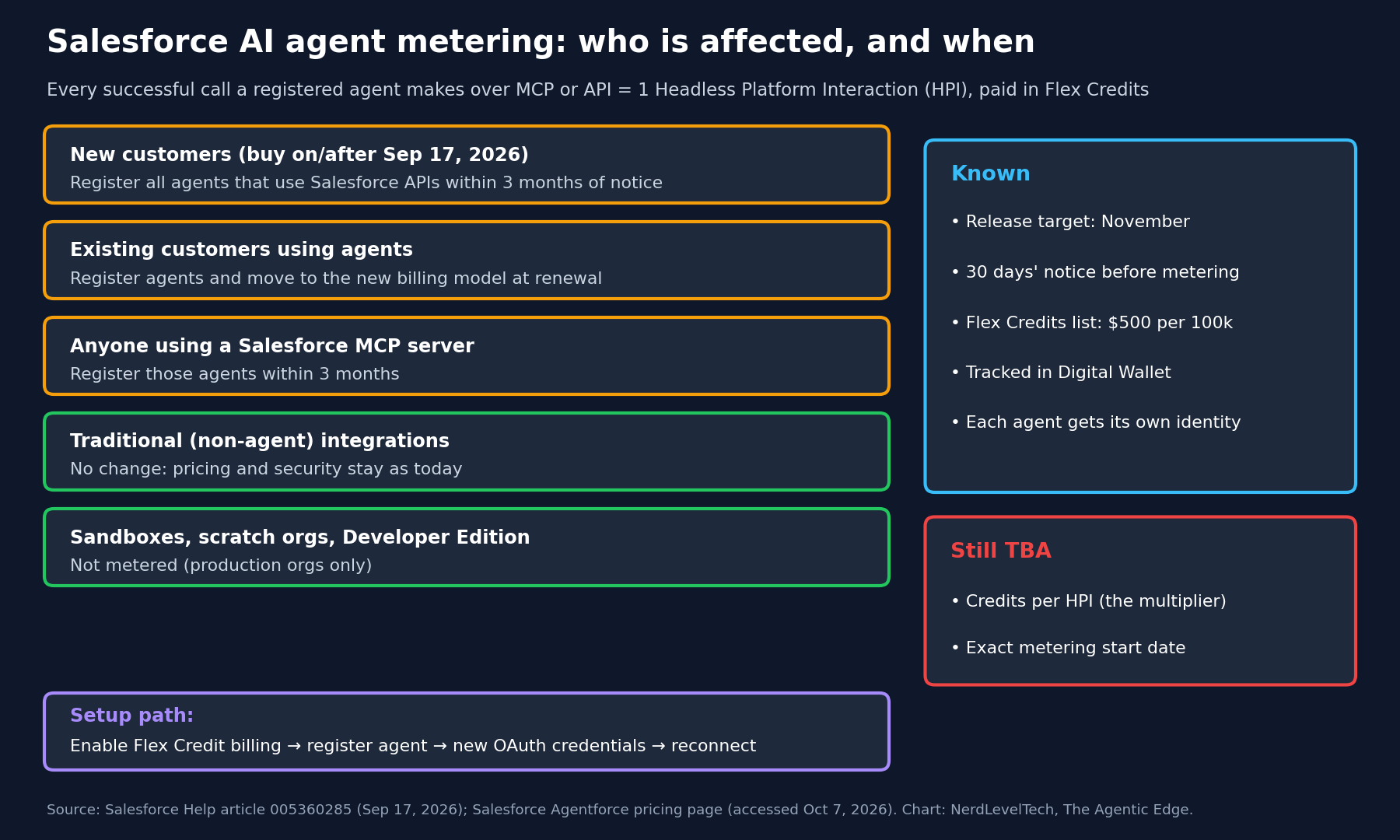
Figure: who is affected and when, built from Salesforce Help article 005360285. Our summary, not a Salesforce graphic.
Why it matters
The short version: your agent costs could soon have two meters, not one. As Salesforce Ben notes, customers bringing tools such as Claude or ChatGPT into Salesforce "will already be paying those providers." Flex Credits add a second cost on the Salesforce side.2
SF Ben Technical Content Writer Tim Combridge put it plainly: "Organizations will need to know what they're looking to achieve with their agents, and estimate the cost of running them before they can make a decision on whether or not to proceed."2
For executives
Our read: this is a pricing signal, not just a Salesforce footnote. When agents get their own identity, software vendors can count them, govern them and bill them like a new kind of user.
Budget for agent usage as a variable cost line, owned by someone. Unused Flex Credits "do not roll over into subsequent subscription terms", so over-buying has a real cost too.5
For product managers
If your product or internal tool calls Salesforce through an AI agent, each call may soon carry a price. Reporting Salesforce's comments, SF Ben writes that "the cost per interaction does not vary, but the number of interactions charged depends entirely on the third-party agent's behavior and the specific implementation."2
So an agent design that makes ten calls where two would do would cost more once metering starts. On the plus side, Salesforce told SF Ben that registration brings "complete end-to-end visibility into agent actions, including the ability to revoke agent access at any time."2
For project and delivery leads
Registration is real work with a deadline. Your org must first be enabled for Flex Credit billing, through Salesforce Foundations ("currently available at $0") or another qualifying product. Then each agent is registered with scoped permissions and reconnected using new OAuth credentials, the login details an app presents to Salesforce.1
That touches admins, security, integration owners and any outside vendor whose agent connects to your org. Plan it like a small migration, not a settings change.
What to do this week
- Inventory your agents. List every AI tool or agent that reads or writes Salesforce data, including vendor tools and MCP connections. Note who owns each one.
- Check your renewal date. Existing customers migrate at renewal, so that date sets your clock.1
- Name a budget owner. Put agent usage on a cost line with one accountable person, before the multiplier lands.
- Ask your account team for the HPI multiplier and the date it will be announced. Get the answer in writing.
- Separate agent work from integrations. Traditional integrations keep today's terms, so know which connections are which.1
Questions to ask your team or vendor
- Which of our agents call Salesforce today, and which run as a human user's identity?
- Do we have Flex Credit billing enabled, and through which SKU?
- When is our renewal, and what does the migration require before then?
- How many calls does each agent make per task, and can we reduce them?
- Which outside vendors run agents against our org, and who pays their HPI usage?
- Who approves an agent's permission set, and who reviews it each quarter?
- What happens to an agent's work if registration slips past the three-month window?
Risks and what we don't know yet
The price. The HPI multiplier is "TBA".1 Until it is published, there is no reliable way to calculate a cost per agent call. Treat any estimate you see as a guess.
The date. Salesforce's wording is "Targeting November".1 Release plans can move, and metering only starts after the 30-day notice.
The edge cases. The help article does not spell out every scenario, for example how failed calls, retries or very high-volume agents are handled. Only "successful" calls are described as metered.1 Ask before you assume.
The names. The branding has already changed: Salesforce now calls this work AIforce, after first announcing it as "Headless 360".1 Anchor your contracts and questions to the help article number, 005360285, rather than product names.
Our view: the identity change is the easy part to welcome. Tim Combridge called the Agentic Identity framework "a really good step in the right direction."2 The open question is the bill.
Bottom line
Salesforce is turning outside AI agents into registered, metered identities on its platform. The rate is unknown, but the direction is clear.
Count your agents, find your renewal date and assign a budget owner now, while the change is still cheap to plan for.
Related reads
- Enterprise MCP Servers: The 2026 Agent Action Layer covers how Salesforce, ServiceNow and Docusign opened their platforms to outside agents.
- Microsoft Agent 365 Goes GA: AI Agent Control Plane 2026 shows another vendor treating agents as managed identities.
- AI Agent Kill Switches: Can You Actually Stop One in 2026? explains why you need to be able to revoke an agent's credentials and tool access.
- AI Decision Models: Jev, Laya, Clef and More covers cheap, fast models built for the small yes-or-no judgments inside a workflow.
Not financial or legal advice. Confirm terms with your Salesforce account team.
References
Footnotes
-
Understand AIforce Impact — Salesforce Help, Knowledge Article 005360285, published September 17, 2026. Source for the November target, agent registration and identity, Headless Platform Interaction metering, Digital Wallet, the "TBA" multiplier and 30-day notice, the three-month registration rule, migration at renewal, production-only metering, unchanged traditional integrations, the "visible, governable, and billable" and "agentic usage isn't metered" wording, the AIforce/Headless 360 naming, and the setup steps including Salesforce Foundations at $0. ↩ ↩2 ↩3 ↩4 ↩5 ↩6 ↩7 ↩8 ↩9 ↩10 ↩11 ↩12 ↩13 ↩14 ↩15 ↩16 ↩17 ↩18 ↩19 ↩20 ↩21 ↩22 ↩23 ↩24 ↩25
-
Salesforce Will Charge Flex Credits for Agentic MCP and API Calls — Thomas Morgan, Salesforce Ben, September 24, 2026. Source for the Tim Combridge quotes, the "will already be paying those providers" line, Salesforce's statement on end-to-end visibility, its report of Salesforce's per-interaction comments, and independent confirmation of the metering details. ↩ ↩2 ↩3 ↩4 ↩5 ↩6 ↩7 ↩8 ↩9
-
Salesforce Hosted MCP Servers Are Now Generally Available — Ross Belmont, Salesforce Developers Blog, April 29, 2026. Source for the GA date and the "runs as the authenticated user" quote. ↩
-
What is the Model Context Protocol (MCP)? — modelcontextprotocol.io. Source for the MCP definition. ↩
-
Salesforce Agentforce Pricing — Salesforce, accessed October 7, 2026. Source for the Flex Credits definition, the $500 per 100k credits list price, "Agentforce actions are 20 Flex Credits", Digital Wallet consumption tracking, and the no-rollover rule. ↩ ↩2 ↩3 ↩4 ↩5