JEPA and World Models: A Hype Check for Leaders
October 7, 2026
JEPA, short for Joint Embedding Predictive Architecture, is an approach to AI that Yann LeCun first proposed in 2022. Instead of predicting the next word or pixel, it learns abstract representations of how the world works.1 It is one approach to building "world models", a term getting a lot of attention right now. For most businesses, it is a research trend to watch, not a product to buy.
The Agentic Edge: AI agents and automation, explained for the people who decide, fund and ship.
TL;DR
World models are AI systems meant to predict how the world will change, so an agent can plan before it acts.2 LeCun's startup, AMI Labs, raised $1.03 billion in March 2026 to build world models, and JEPA is LeCun's proposed approach.1
Six months on, AMI says it is "not talking publicly about any product plans or timeline."3 Meta's open V-JEPA 2 model is one concrete JEPA model you can use today, and its showcase demo is robot planning.2 Learn the idea now; do not budget for it yet.
What happened
The buzz comes from a big funding round, new research, and a lot of open questions about products.
The money. On March 10, 2026, Advanced Machine Intelligence Labs (AMI) announced a $1.03 billion (€890 million) seed round. It is based in Paris, with Alexandre LeBrun as CEO and Yann LeCun as executive chairman.14
The plan. LeCun said AMI would spend its first year on research and development. He told AFP it plans to begin talks with corporate partners within one to two years, and aims for "fairly universal intelligent systems" within three to five years.1
The latest research. On September 17, 2026, researchers posted JEPA-Anything, a preprint testing one JEPA-style approach across seven domains, from vision and biology to weather.5 Against matched JEPA baselines, the authors report improved metrics on all 10 dynamics tasks they tested.5 A preprint is a paper shared before peer review.
The status check. On September 20, TechCrunch asked AMI co-founder Michael Rabbat what the company is working on. His reply by email: "We're still in a research and building phase, so we're not talking publicly about any product plans or timeline."3
What JEPA actually is, in plain English
Today's chatbots, built on large language models (LLMs), learn by predicting the next word. JEPA takes a different route. It learns an abstract picture of a situation and makes its predictions at that level, "ignoring unpredictable surface detail."1
Meta's first JEPA model, I-JEPA, released June 13, 2023, worked this way on images. It compared "abstract representations of images (rather than comparing the pixels themselves)."6
World model, in one line: in Meta's framing, a world model lets an AI understand what it sees, predict how the world will evolve, and plan actions toward a goal.2
What has actually shipped
Meta released V-JEPA 2 on June 11, 2025. It is a 1.2 billion-parameter model trained on "more than 1 million hours of video", plus "only 62 hours of robot data".2
Meta reports that, when given visual subgoals, V-JEPA 2 "achieves success rates of 65% – 80% for pick-and-placing new objects in new and unseen environments."2 The code and model checkpoints are available "for commercial and research applications."2
That is real progress. It is also a robot picking up objects, not a tool your finance or sales team can use on Monday.
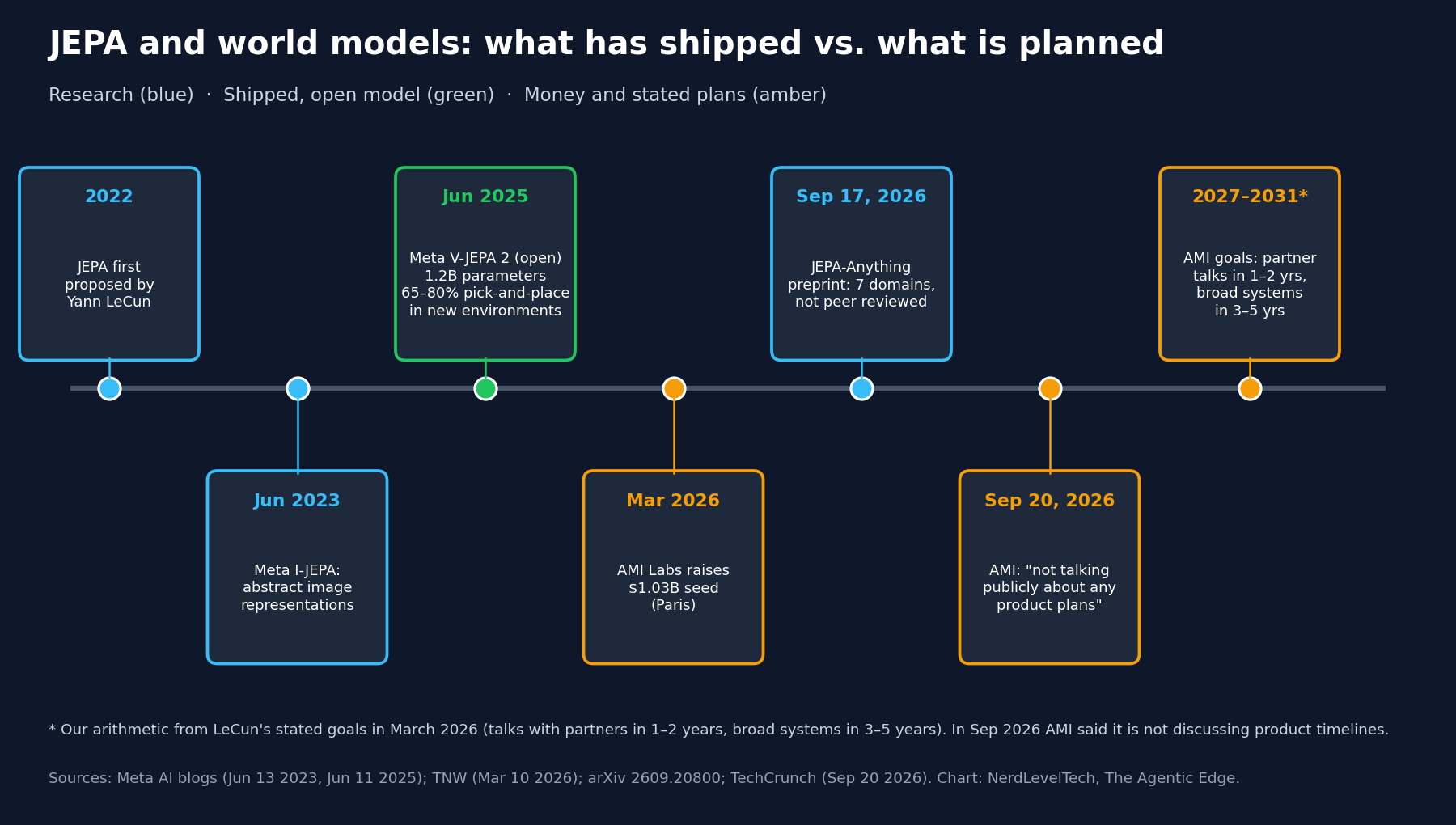
Figure: what has shipped versus what is planned. Built from Meta, TNW, TechCrunch and arXiv sources cited below.
Why it matters
The honest answer for most organizations: not much yet, but it is worth understanding.
Even AMI's CEO saw the hype coming. In March, Alexandre LeBrun told TechCrunch: "My prediction is that 'world models' will be the next buzzword. In six months, every company will call itself a world model to raise funding."4
For executives
Expect vendors to start calling their products "world models". Our read: treat the label as a reason to ask questions, not a reason to buy.
Our further read: if world models deliver, the earliest wins are likely to be physical, such as robots, manufacturing and anything that plans in the real world. TechCrunch reports AMI has already explored manufacturing, biomedicine and robotics.3
For product managers
Nothing here changes this quarter's roadmap for software products. Popular assistants such as ChatGPT, Claude and Gemini are built on large language models.1
Keep a watch item instead. If your product touches video, sensors, robotics or physical operations, track V-JEPA 2 and the first commercial world-model releases.
For project and delivery leads
No delivery plan should depend on a world-model product yet. LeCun's stated plan, as of March 2026, puts talks with corporate partners one to two years out.1
If someone proposes a world-model pilot, scope it as research, with a small budget and a clear stop date.
What to do this week
- Learn the vocabulary. Know what JEPA and world models mean, so you can spot misuse of the terms in vendor pitches.
- Audit vendor claims. If a vendor says "world model", ask which model, whether it is shipped, and what it was tested on.
- Map the physical work. List processes that involve robots, video, sensors or physical planning. That is where world models would land first.
- Assign a watcher. Have one person track AMI Labs, Meta's V-JEPA line and major vendor announcements each quarter.
- Keep your agent plans on LLMs. Do not pause current AI agent work waiting for a new architecture.
Questions to ask your team or vendor
- Is this a world model in the JEPA sense, or a video or 3D generator using the same buzzword?
- Is it a shipped product, an open research model, or a demo?
- What data was it trained and tested on, and does that look like our work?
- Who owns the outputs, and what does the license allow commercially?
- What would we stop doing, or do differently, if it worked?
- What is the smallest experiment that would teach us something?
Risks and what we don't know yet
Timing. AMI says it is not discussing product plans or timelines.3 Its own public goal is three to five years away.1
Research is not product. JEPA-Anything is a preprint. Its results are reported by its authors, and its arXiv page lists no peer-reviewed publication.5
Narrow proof so far. V-JEPA 2's robot result is pick-and-place with visual subgoals, at success rates of 65% to 80%.2 It is not evidence of general business value.
Buzzword drift. "World model" is already used for different things. World Labs' Marble, for example, is demonstrated mainly on media creation and explorable 3D environments.3 Ask what is meant every time.
Our view: JEPA is a serious idea from a serious researcher, backed by serious money. Today it belongs on a watch list, not in a budget.
Bottom line
JEPA and world models are a real research direction, not just hype. But nothing a typical business can buy has shipped yet.
Learn the terms, question every "world model" pitch, and keep building on the AI you can use today.
Related reads
- Gemini Omni: Google's World Model for Video (2026) covers a video-focused product that also uses the "world model" label.
- Meta Muse Spark: Benchmarks and Strategy (2026) covers Meta's AI strategy around the time LeCun left to found AMI Labs.
- Salesforce Will Meter AI Agent Calls: What to Do covers a cost change for the LLM-based agents many companies run today.
Not investment advice.
References
Footnotes
-
Yann LeCun just raised $1bn to prove the AI industry has got it wrong — Ana-Maria Stanciuc, TNW, March 10, 2026. Source for the JEPA definition and 2022 origin, ChatGPT, Claude and Gemini as large language models, the $1.03 billion (€890 million) round announced March 10, 2026, Paris HQ, LeBrun as CEO and LeCun as executive chairman, the first-year R&D focus, and the one-to-two-year and three-to-five-year goals LeCun gave AFP. ↩ ↩2 ↩3 ↩4 ↩5 ↩6 ↩7 ↩8 ↩9 ↩10
-
Introducing the V-JEPA 2 world model and new benchmarks for physical reasoning — Meta AI, June 11, 2025. Source for the world model definition, the 1.2 billion parameters, training data, robot results and the commercial and research availability. ↩ ↩2 ↩3 ↩4 ↩5 ↩6 ↩7 ↩8 ↩9
-
World model companies are keeping a lot of secrets — Russell Brandom, TechCrunch, September 20, 2026. Source for the Michael Rabbat quote, AMI's work in manufacturing, biomedicine and robotics, and World Labs' Marble as a world model product focused on media and 3D environments. ↩ ↩2 ↩3 ↩4 ↩5 ↩6
-
Yann LeCun's AMI Labs raises $1.03B to build world models — Anna Heim, TechCrunch, March 9, 2026 (Pacific time). Source for the Alexandre LeBrun quote and confirmation of the $1.03 billion round. ↩ ↩2
-
JEPA-Anything: Learning Predictive Models across Different Worlds — Taoyong Cui et al., arXiv preprint 2609.20800, submitted September 17, 2026. Source for the seven domains and the 10-task result against matched JEPA baselines. ↩ ↩2 ↩3
-
I-JEPA: The first AI model based on Yann LeCun’s vision for more human-like AI — Meta AI, June 13, 2023. Source for how I-JEPA compares abstract representations rather than pixels. ↩