OpenAI Models and Codex on Google Cloud: What to Do
Google says three OpenAI models are rolling out in private preview to select enterprise customers. See how Azure and AWS compare on price and status.

Table of contents
Google says three OpenAI models, GPT-6 Astra, GPT-6.1 Sol and GPT-6 Luna, are rolling out in private preview to select enterprise customers on Google Cloud, and that Codex tools can connect, but we found no line saying whether that is limited to the preview. OpenAI's post, also dated October 21, 2026, says general availability is planned in the coming weeks. Neither post gives a Google Cloud price or region.12
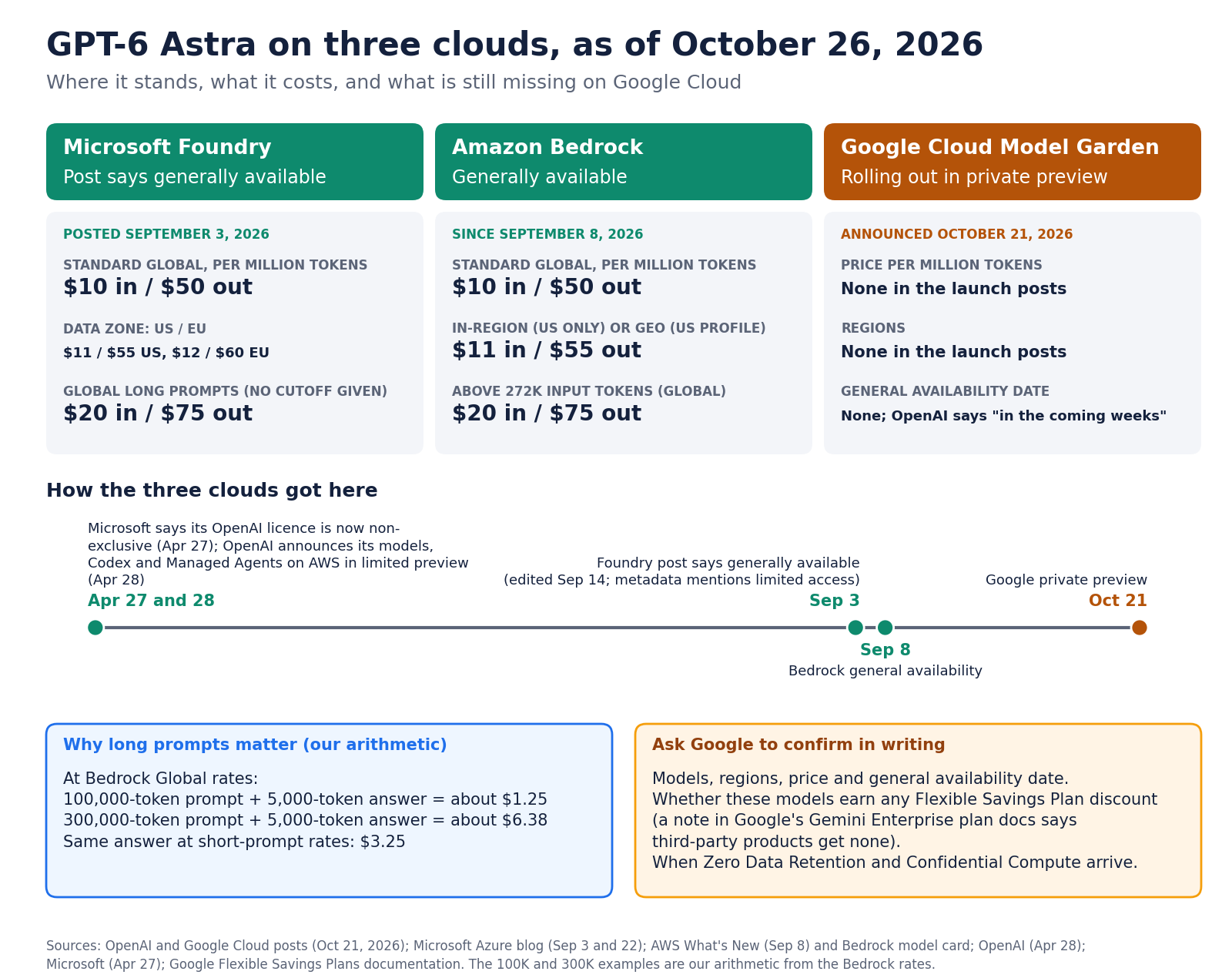
GPT-6 Astra lists at $10 per million input tokens and $50 per million output tokens at standard Global rates on Microsoft Foundry and Amazon Bedrock, and at the same standard price on OpenAI's API, with a 1,050,000-token context window on Bedrock (see our GPT-6 Astra model page).345
The Agentic Edge: AI agents and automation, explained for the people who decide, fund and ship.
TL;DR
Google says OpenAI's models are rolling out in private preview on Google Cloud and that Codex can connect "starting today," but we found no line saying whether the Codex connection is limited to preview customers. Our read: the change is in how companies buy these models, not in what the models can do. Google's post says the usage is bought through Google Cloud Marketplace, appears on a single Google Cloud invoice and draws down existing cloud commitments, while OpenAI's post says enterprises "will be able to" draw them down.12 Neither company's post gives a Google Cloud price or region list, and OpenAI's only timing for general availability is "in the coming weeks."126
Plan around the idea now and ask for the missing details before you budget. This week, find out whether your company has a Google Cloud commitment, price one real workload on a cloud where GPT-6 Astra is already generally available, and ask Google to put the price, regions and data terms in writing.
What happened
What did OpenAI and Google announce on October 21?
OpenAI's post says its frontier models and Codex agentic workflows are coming to Google Cloud's Model Garden, that customers will be able to purchase the models through Google Cloud Marketplace, and that enterprises with Google Cloud spend commitments will be able to draw down their commitments for these purchases. It says general availability is planned "in the coming weeks," that OpenAI models will soon be available in Google Antigravity and the Gemini Agent, and that Microsoft remains OpenAI's primary cloud partner. The OpenAI post we read names no models, regions or prices.1
Google's post, written by Michael Gerstenhaber, a Google Cloud vice president of product management for Gemini, names three models: GPT-6 Astra, GPT-6.1 Sol and GPT-6 Luna. It says they are "rolling out now in private preview to select enterprise customers" in Model Garden, and links a form for customers to express interest.2 OpenAI's post links its own request-access form.1 The Next Web reports the same status and gives no per-token prices or regions.6
Two product terms help here. Model Garden is a single place on Google Cloud to discover, customize and deploy models from Google and its partners. Google's page calls it "Model Garden in Gemini platform," and its page metadata uses the name Gemini Enterprise Agent Platform, formerly Vertex AI.7 OpenAI's page title calls Codex an "AI Coding Partner," and the page offers it in ChatGPT, as a cloud service, as a code-editor extension and as a command-line tool.8 Google's post also names Codex desktop workflows.2
What can you do today, and what is still "coming soon"?
Google's October 21 post says that "starting today" customers can build with the models through its APIs and connect local Codex command-line and desktop workflows to its Gemini platform for inference.2 The same post calls the models a private preview for select enterprise customers, and we did not find a line saying whether the API access or the Codex connection is limited to them, so confirm with your Google account team before you plan on either.
Google lists several items as coming soon: OpenAI models in Gemini for business and in Google Antigravity, Zero Data Retention, and Confidential Compute.2 Our gloss: Zero Data Retention generally means the provider keeps no copy of your prompts or outputs, and Confidential Compute means processing in protected hardware, so ask Google for its exact definitions. OpenAI's post names "the Gemini Agent" where Google's names "Gemini for business." We could not tell whether those are the same destination, so ask Google.12 Google also says prompts, context and outputs stay inside the customer's designated data perimeter and are never used to train foundation models. That is Google's own statement.2
How does Google compare with Azure and AWS?
| Where | GPT-6 Astra status | Date | Standard price per million tokens (input / output) | Notes | Source |
|---|---|---|---|---|---|
| OpenAI's own API | Priced on OpenAI's Astra page, which describes the launch as rolling out to a limited set of organizations | No launch date on the page | $10 / $50 | 2x input and 1.5x output above 272,000 input tokens per OpenAI's developer docs, which is $20 / $75 by our arithmetic. The Astra page names Azure and AWS Bedrock as other channels | 39 |
| Microsoft Foundry | Post says generally available for all customers, but its metadata mentions a Limited Access Program | Posted September 3, 2026, modified September 14 | $10 / $50 (Global) | $11 / $55 for US Data Zone, $12 / $60 for EU Data Zone, and $20 / $75 for long prompts (Global, no token threshold given) | 410 |
| Amazon Bedrock | Generally available | September 8, 2026 | $10 / $50 (Global) | $11 / $55 In-Region or Geo, and $20 / $75 Global above 272,000 input tokens. The model card lists In-Region only in two US Regions and Geo only for US and Canadian Regions | 115 |
| Google Cloud Model Garden | Rolling out in private preview, select enterprise customers | Announced October 21, 2026 | No price published in the posts we read | No regions in the posts. OpenAI says general availability is planned in the coming weeks, with no date | 126 |
⚠ Prices change frequently. The values above are for illustration only and may be out of date. Always verify current pricing directly with the provider before making cost decisions: Anthropic · OpenAI · Google Gemini · Google Vertex AI · AWS Bedrock · Azure OpenAI · Mistral · Cohere · Together AI · DeepSeek · Groq · Fireworks AI · Perplexity · xAI · Cursor · GitHub Copilot · Windsurf.
OpenAI's April 28 post announced its models, Codex and Managed Agents on AWS as a limited preview, and AWS announced Astra as generally available on Bedrock on September 8.1211 Google is the only one of the three where the sources we read describe Astra as still in private preview. Cautious wording appears elsewhere too: OpenAI's Astra page describes its launch as rolling out to a limited set of organizations, and Foundry's page metadata mentions a Limited Access Program.34 Price is not yet a point of comparison, because the Google and OpenAI posts give no Google Cloud price. Foundry's US Data Zone rate and Bedrock's In-Region and Geo rates sit 10% above their Global rates, and Foundry's EU Data Zone rate sits 20% above (our arithmetic from the published rates).4510 OpenAI's API, Foundry and Bedrock all charge more for long prompts, and the data-zone premiums carry into those long-prompt rates, for example $24 / $90 at Foundry's EU Data Zone, so the number on the price list is not always the number on the invoice.109
Here is our arithmetic from Bedrock's published Global rates. A job with a 100,000-token prompt and a 5,000-token answer costs about $1.25, which is $1.00 for input plus $0.25 for output. Push the prompt to 300,000 tokens and Bedrock applies its long-context rates of $20 and $75 to the entire request, so the same answer costs about $6.38 instead of the $3.25 it would cost at the short-prompt rates, which stop applying above 272,000 input tokens.5
Why it matters
For executives
Our read: this news is about procurement more than technology. If your company already commits spend to Google Cloud, Google's post says OpenAI usage "draws down existing cloud commitments" and appears on a single invoice.2 Our read: that could simplify vendor reviews, security questionnaires and contracts.
Read the discount terms before you count on savings. Google's launch post says the usage counts toward Flexible Savings Plans "across model providers" and links the plans to an August 26 Google blog post on flexible billing and cost controls for agents, whose Flexible Savings Plans section covers Gemini Enterprise and which, in the text we read, does not address third-party models.213 A note in the Gemini Enterprise pricing section of Google's plan documentation says "Third-party products don't get any discounts from the FSP," while the same page says the plans cover "participating third-party (3P) foundation models," that third-party model spend under a plan draws down an enterprise commitment, subject to Marketplace drawdown rules and the contract caps in your agreement, and that a Private Offer can carry its own discounted price. Our reading: the spend may count toward your commitment without earning the plan's discount. The page does not mention OpenAI or Model Garden, and neither it nor Google's launch post says whether these models earn the discount, so ask Google in writing.14
Also weigh dependence. Microsoft's April 27 post says its OpenAI licence is now non-exclusive and runs through 2032, that OpenAI can serve its products on any cloud provider, and that OpenAI products will ship first on Azure unless Microsoft cannot and chooses not to support the necessary capabilities.15 Our inference: new OpenAI features may reach Google Cloud later than Azure, so ask Google what it commits to on timing.
For product managers
If your product uses OpenAI models, your customers on Google Cloud may start asking for a version that runs inside their own cloud account. Our read: expect procurement-driven requests such as "can we run this on our Google Cloud account?"
Design your model calls so the cloud is a setting, not a rewrite, and test your prompts on each cloud you plan to support. Prices already differ by tier and region: Foundry's US Data Zone and Bedrock's In-Region and Geo rates sit 10% above their Global rates, and Foundry's EU Data Zone sits 20% above.4510
For project and delivery leads
Add the Google route to your RAID log (risks, assumptions, issues, dependencies) as a dependency with the status "private preview, no date." Do not put a customer-facing launch date on it.
Our read: plan the build against a cloud where GPT-6 Astra is already generally available and treat Google as a later switch if its price and regions work for you. Allow lead time for procurement, security review and a data-residency check.
What to do this week
- Find your commitment. Ask finance or IT whether your company has a Google Cloud spend commitment, who owns it and when it renews. That tells you whether the Marketplace route matters to you at all.
- Ask Google for the missing facts in writing. Models, regions, price per million tokens, how to join the private preview and the general availability date. Google's post links a form to express interest, and OpenAI's links a request-access form.12
- Price one real workload. Pick a job you run or plan to run, estimate its typical prompt and answer length, and price it at the Foundry and Bedrock rates in the table, including the long-prompt tier. Ask Microsoft where its long-prompt tier starts, because its posts give no threshold. Reuse the same numbers when Google publishes its price.
- Check the data terms against your contract. Google says Zero Data Retention and Confidential Compute are "coming soon."2 A vendor's blog post is a promise to verify, not your contract.
- Keep a fallback. Do not build anything customer-facing on a preview route. Keep the workload portable between clouds until Google confirms price, regions and general availability.
Questions to ask your team or vendor
- Is our company in the private preview, and if not, how do we apply and how long does it take?
- Once this is generally available, which models, in which regions, at what price per million tokens?
- Do these models draw down our Google Cloud commitment, and do they earn any plan discount, given that a note in Google's Gemini Enterprise plan documentation says third-party products get none?
- When will Zero Data Retention and Confidential Compute be available, and what happens to our prompts until then?
- Will new OpenAI models reach Google Cloud at the same time as Azure, or later?
- When our developers point Codex at Google's platform, what is logged, where, and who can see it?
- Who owns and monitors the agents our developers build with these tools? Our guides to agent spend caps and AI agents as insiders cover the controls.
Risks and what we don't know yet
Status is easy to misread. Google calls the models a private preview for select enterprise customers and also says Codex connects "starting today," while OpenAI says general availability is planned in the coming weeks. OpenAI's sentence does not say which models, customers or regions that covers, and none of the sources we read gives a date.126
No price and no regions. Neither OpenAI's post nor Google's gives them, and The Next Web likewise reports none.126 Until Google publishes them, any cost comparison across clouds is incomplete.
The plan discount may not apply. A note in Google's Gemini Enterprise plan documentation says third-party products get no discount from the Flexible Savings Plan, although the same page covers participating third-party foundation models and lets a Private Offer carry its own price. The page does not mention OpenAI, so whether these models earn the discount is unconfirmed.14
Data terms are vendor claims. The data-perimeter and no-training statements come from Google's post, and Zero Data Retention and Confidential Compute are still listed as coming soon.2 We found no hands-on test of the models on Google Cloud in the sources we read.
Destination names differ. OpenAI says the models are coming to the Gemini Agent, and Google says Gemini for business. Google's October 8 announcement describes the Gemini agent as a single agent for work that today works across Gemini and Claude models from Anthropic, with other models mentioned for the future. The article text does not mention OpenAI, and it predates the announcement.16 Do not assume OpenAI models will be a default in either.
Possible lag behind Azure. Microsoft's April 27 post says OpenAI products will ship first on Azure, with one stated exception.15 The record so far is mixed: Microsoft's September 3 Astra post now says generally available (it was modified September 14, so we cannot tell what it said on day one) and AWS announced general availability on September 8, while Microsoft and AWS each announced GPT-6 Sol and GPT-6 Luna as generally available on September 22 and GPT-6.1 Sol, the version Google names, on September 29.41110171819 Whether any gap will open for Google Cloud customers is our inference, not something either company has said.
This post is for general information and is not legal, financial or procurement advice.
Bottom line
OpenAI's models and Codex are heading to Google Cloud, and Google says usage is bought through Marketplace, appears on one invoice and draws down existing commitments. Our read: that makes buying simpler but does not yet tell you the price, the regions or the date. Until Google publishes them, build on a cloud where GPT-6 Astra is already generally available and keep Google as an option.
For related decisions, see our guides to AI agents getting work email in Gemini and Copilot and Google Antigravity 2.0.
Frequently Asked Questions
Is OpenAI available on Google Cloud?
Not generally yet. Google says GPT-6 Astra, GPT-6.1 Sol and GPT-6 Luna are rolling out in private preview to select enterprise customers in Model Garden, and OpenAI says general availability is planned in the coming weeks. If you want access, Google's post links a form to express interest, and OpenAI's links a request-access form.
Can I use Codex with Google Cloud?
Google's October 21 post says customers can connect local Codex command-line and desktop workflows to its Gemini platform for inference "starting today." The same post describes the models as a private preview for select customers, and we did not find a line saying whether the Codex connection is limited to them, so confirm with Google that your company is eligible.
How much does GPT-6 Astra cost on Google Cloud?
Google has not published a price in the posts we read. On other clouds, Astra lists at $10 per million input tokens and $50 per million output tokens at standard Global rates, with higher rates for long prompts and regional placement.
What is Google Cloud Model Garden?
Model Garden is a single place to discover, customize and deploy models from Google and Google's partners. Google's page metadata calls the surrounding platform the Gemini Enterprise Agent Platform, formerly Vertex AI. The page lists Anthropic's Claude family among its partner models. The page text we read on October 26 did not name OpenAI models, though it shows only a sample of the catalogue, so that is weak evidence either way. For how Google's agent hosting compares with AWS and Alibaba, see our managed agent runtimes guide.
Does OpenAI on Google Cloud replace Azure?
Not according to the statements we read. OpenAI says Microsoft remains its primary cloud partner. Microsoft's April 27 post, written before the Google announcement, says its licence is non-exclusive and runs through 2032, and that OpenAI products will ship first on Azure with one stated exception. Microsoft's Foundry post says GPT-6 Astra is generally available, and AWS announced general availability on Bedrock.
Can I pay for OpenAI models with my Google Cloud commitment?
Possibly, but confirm it for your account. Google's post says the usage is bought through Google Cloud Marketplace, appears on one invoice and "draws down existing cloud commitments," in the present tense. OpenAI's post puts it in the future, saying enterprises "will be able to" draw them down, and neither says which customers can do it today. Google's Gemini Enterprise plan documentation adds that third-party model spend under a plan draws down an enterprise commitment, subject to Marketplace drawdown rules and the caps in your enterprise agreement, and a note in it says third-party products get no discount from the Flexible Savings Plan. The page does not mention OpenAI, so get the terms in writing.
Footnotes
-
OpenAI models are coming to Google Cloud, OpenAI, October 21, 2026. Source for the Model Garden and Codex plans, Marketplace purchase and commitment drawdown, "in the coming weeks" general availability, Antigravity and Gemini Agent, and the Microsoft statement. ↩ ↩2 ↩3 ↩4 ↩5 ↩6 ↩7 ↩8 ↩9 ↩10 ↩11 ↩12 ↩13
-
Google Cloud expands model choice and flexibility, bringing OpenAI models to customers, Michael Gerstenhaber, Google Cloud Blog, October 21, 2026. Source for the three model names, the private preview status, Codex connection, billing, data terms and coming-soon items. ↩ ↩2 ↩3 ↩4 ↩5 ↩6 ↩7 ↩8 ↩9 ↩10 ↩11 ↩12 ↩13 ↩14 ↩15 ↩16 ↩17 ↩18 ↩19 ↩20 ↩21
-
GPT-6 Astra: A new generation of intelligence, OpenAI (page undated, with update notices dated September 22 and 29, 2026), accessed October 26, 2026. Source for the $10 and $50 API price. The page names Azure and Amazon Bedrock as channels. ↩ ↩2 ↩3
-
GPT-6 Astra: Frontier intelligence for work, now generally available in Microsoft Foundry, Steve Sweetman and Naomi Moneypenny, Microsoft Azure Blog, September 3, 2026. Source for Foundry's status and the Global and US Data Zone prices. The page is dated September 3 and its metadata shows it was modified September 14, 2026, so we cannot tell which wording it carried on day one. Its HTML title says "now available," its visible headline says "now generally available," its meta description mentions a rollout through a Limited Access Program, and its body says generally available for all customers. We follow the body for the current status. ↩ ↩2 ↩3 ↩4 ↩5 ↩6 ↩7 ↩8
-
GPT-6 Astra - Amazon Bedrock, Amazon Bedrock User Guide (model card), accessed October 26, 2026. Source for the 1,050,000-token context window, the Global, In-Region and Geo prices and the 272,000-token long-context threshold applied to the entire request. ↩ ↩2 ↩3 ↩4 ↩5 ↩6
-
OpenAI brings GPT-6 Astra and Codex to Google Cloud, a rival's platform, Ana Maria Constantin, The Next Web, October 21, 2026. Secondary report that mostly restates the two companies' announcements and adds analyst comment, with no prices or regions given. ↩ ↩2 ↩3 ↩4 ↩5 ↩6
-
Model Garden in Gemini platform, Google Cloud product page, accessed October 26, 2026. Source for the definition, the page title, the platform name in the page metadata and the partner models named in the page text. ↩ ↩2
-
Codex | AI Coding Partner from OpenAI, OpenAI product page, accessed October 26, 2026. Source for how Codex is described and used. ↩
-
GPT-6 Astra Model | OpenAI API, OpenAI Developers, accessed October 26, 2026. Source for the long-context rule: prompts above 272K input tokens are priced at 2x input and 1.5x output for the full request. ↩ ↩2
-
GPT-6 Astra, Sol, and Luna: For production agents in Microsoft Foundry, Naomi Moneypenny, Microsoft Azure Blog, September 22, 2026. Source for the EU Data Zone price and for Sol and Luna joining Foundry's generally available lineup. ↩ ↩2 ↩3 ↩4 ↩5
-
OpenAI GPT-6 Astra is now generally available on Amazon Bedrock, AWS What's New, September 8, 2026. Source for Bedrock general availability. ↩ ↩2 ↩3 ↩4
-
OpenAI models, Codex, and Managed Agents come to AWS, OpenAI, April 28, 2026. Source for the limited preview on AWS. ↩
-
FinOps for the AI era: New flexible billing and cost controls for agents, Michael Gerstenhaber and Pravir Gupta, Google Cloud Blog, August 26, 2026. The page Google's launch post links for Flexible Savings Plans. It describes 10% and 20% discounts for Gemini Enterprise usage and, in the text we read, does not address third-party models. ↩
-
Flexible Savings Plans, Google Cloud documentation (page shows last updated October 22, 2026), accessed October 26, 2026. Source for the note that third-party products get no discount from the plan, the wording on participating third-party foundation models, and third-party model spend under a plan drawing down an enterprise commitment, subject to Marketplace drawdown rules and contract caps. ↩ ↩2 ↩3
-
The next phase of the Microsoft-OpenAI partnership, The Official Microsoft Blog, April 27, 2026. Source for the non-exclusive licence, the 2032 date, any-cloud serving and shipping first on Azure. ↩ ↩2 ↩3
-
Welcome to Gemini at Work 2026: Introducing the Gemini agent, Thomas Kurian, Google Cloud Blog, October 8, 2026. Source for the description of the Gemini agent and its Claude support. ↩
-
OpenAI GPT-6 Sol and GPT-6 Luna are now generally available on Amazon Bedrock, AWS What's New, September 22, 2026. Source for Sol and Luna general availability on Bedrock. ↩
-
Introducing GPT-6.1 Sol in Microsoft Foundry: Advanced intelligence, optimized for production agents, Naomi Moneypenny, Microsoft Foundry Blog, September 29, 2026. Source for GPT-6.1 Sol general availability on Foundry. ↩
-
OpenAI GPT-6.1 Sol is now generally available on Amazon Bedrock, AWS What's New, September 29, 2026. Source for GPT-6.1 Sol general availability on Bedrock. ↩
- ai for business
- ai agents
- the agentic edge
- OpenAI on Google Cloud
- Codex
- GPT-6 Astra
- Google Cloud Model Garden
- cloud AI
- AI procurement
Free newsletter
Stay on the Nerd Track
One email a week: a Thursday issue with one system teardown, three signals, one workflow, one job and one Arabic takeaway.