Hy-MT3 vs Qwen3.8 vs Haiku 5.5: Arabic Translation Test
A 1,432-word AI-agent article translated into Arabic by local Hy-MT3, Qwen3.8 and Claude Haiku 5.5: COMET scores, glossary control and the measured cost.

جدول المحتويات
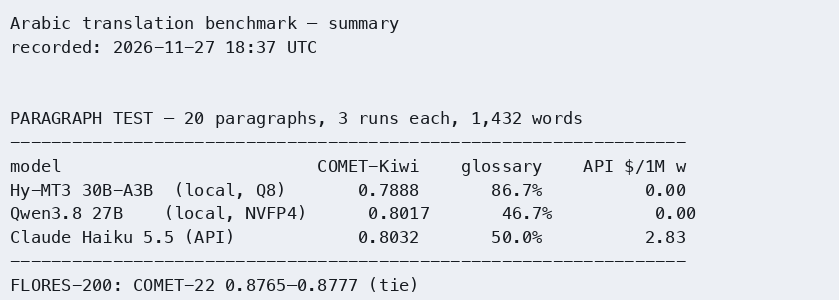
A local translation model with 3 billion active parameters1 followed a 12-term Arabic glossary in 86.7% of required term occurrences. Claude Haiku 5.5, called through the paid API, followed the same glossary in 50.0%. On raw paragraph quality the API model still led by 0.014 COMET-Kiwi points, a small but statistically significant gap. The local model cost $0 in API fees. The 60 Haiku generations of the article (three per paragraph) cost 1.2 cents.
That is the short version of a test I ran on a 96GB M3 Ultra: 20 full paragraphs from Wikipedia's AI agent article, translated into Modern Standard Arabic by three models, three times each, with the same glossary in every prompt. Then 200 FLORES-200 sentences and 40 product strings to check whether the result survives a standard benchmark and a production-format test.
The result is a split verdict, not a win for either side: Haiku scores slightly higher on the raw-quality metric, while Hy-MT3 follows a terminology brief much more reliably. If you are localizing a product with a glossary, that difference matters more than 0.014 COMET.
TL;DR
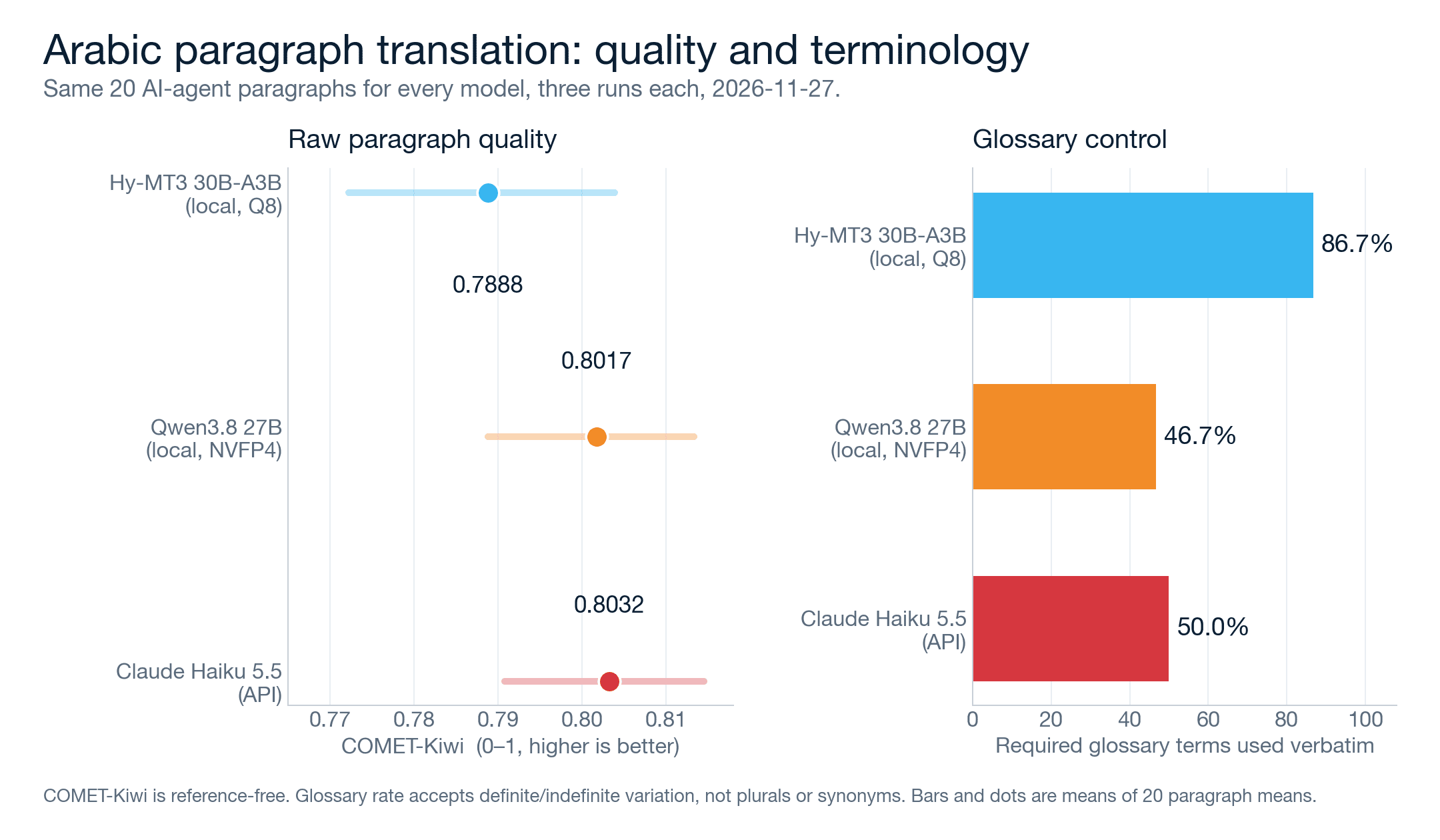
- Raw paragraph quality (COMET-Kiwi, 0 to 1): Claude Haiku 5.5 0.8032, Qwen3.8 0.8017, Hy-MT3 0.7888. Qwen is statistically tied with Haiku, while Hy-MT3 is 0.0144 lower (paired bootstrap, p = 0.004).
- Glossary control (strict term match): Hy-MT3 86.7%, Claude 50.0%, Qwen 46.7%. Hy-MT3 used every required term in 79% of paragraphs, while the other two did so in 26%.
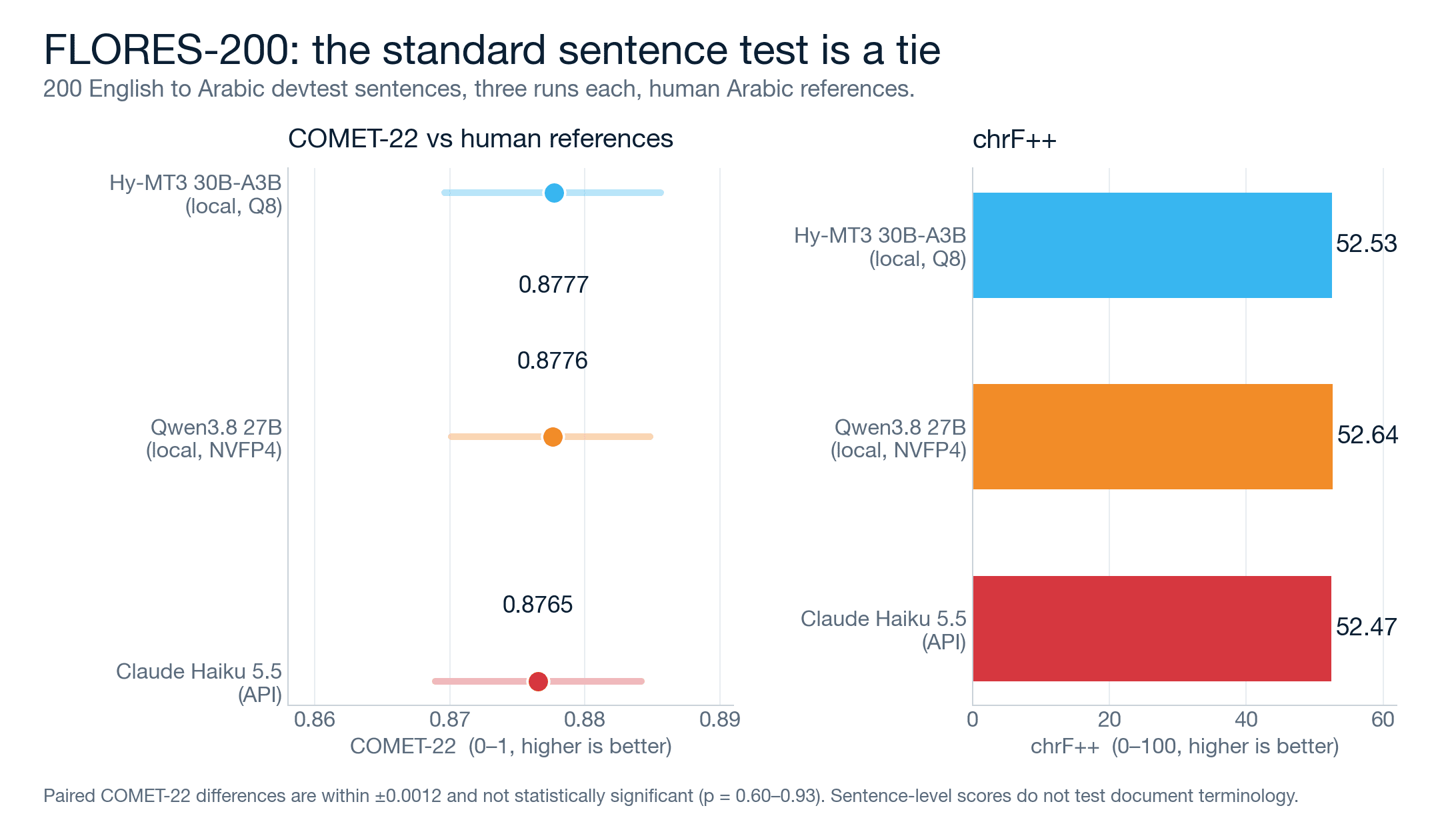
- FLORES-200 sentence benchmark: all three landed within 0.2 chrF++ points (52.5 to 52.6) and within 0.0012 COMET-22 (0.8765 to 0.8777). A sentence-level benchmark would call this a tie.
- Cost: Haiku translated the 1,432-word article for $0.012 (three runs), which works out to $2.83 per 1M source words. Both local models charged $0 in API fees.
- Sampling parity: both local models ran greedy at
temperature 0. Haiku 5.5 rejectstemperature,top_p,top_kandseed, so its three runs are samples from its default distribution. The parameter matrix is below. - Runtime gotchas: the Qwen3.8-27B-FP8 checkpoint cannot run on Metal. The runnable build is Ollama's NVFP4 tag. Hy-MT3 needs a llama.cpp build with the
hy_v3architecture (1.1.0 here). - Every prompt, output, score and log is in the benchmark pack index (zip).
What I tested
| Item | Value |
|---|---|
| Host | Mac Studio, Apple M3 Ultra, 96GB unified memory, macOS 15.7.4 |
| Date | 2026-11-27 |
| Hy-MT3 | Hy-MT3-30B-A3B-Q8_0.gguf (32.79GB), llama.cpp 1.1.0 (build 12774), Metal, 8,192 context |
| Qwen3.8 | qwen3.8:27b-mlx local build in Ollama 0.40.16, NVFP4, 18GB tag, 8,192 context2 |
| Claude | claude-haiku-5-5 through the Messages API, thinking disabled3 |
| Article test | 20 paragraphs, 1,432 English words, 3 runs each = 60 outputs per model |
| Standard test | FLORES-200 English to Arabic devtest, 200 sentences, 3 runs each = 600 outputs per model |
| String test | 40 product strings (UI, docs, errors, legal, release notes), 3 runs each = 120 outputs per model |
| Total | 780 generations per model, 2,340 requests |
| Decoding | temperature 0 for both local models; Haiku 5.5 rejects temperature, top_p, top_k and seed |
Parameter parity
The prompts and the decoding policy were held constant where the runtime allowed it:
| Parameter | Local models | Haiku 5.5 |
|---|---|---|
| Prompt text per test | identical | identical |
| System prompt | none | none |
| Thinking | off | off |
| Temperature | 0 (greedy) | rejected |
| top_p / top_k | defaults, not set | rejected |
| Seed | not set | not accepted |
| Max output | 2,048 | 2,048 |
| Stop sequences | none | none |
| Repetitions | 3 | 3 |
| Quantization | Q8_0 / NVFP4 | vendor |
| Context | 8,192 | 1M |
The local models ran greedy. At temperature 0, top_p and top_k do not change the argmax, even though llama.cpp and Ollama have different defaults. Haiku 5.5 rejects temperature, top_p, top_k and seed, so its three runs are samples from its default distribution. That is the one sampling asymmetry in the test, and it is why every comparison below uses three runs and a paired test.
The models are not the same shape, and that is the point of the test: a 30B-A3B translation specialist at Q8, a 27B dense generalist at 4-bit, and a hosted small model. The quantization difference is a real confound. It is also what you can actually run on this machine today. The FP8 Qwen checkpoint is in the archive, but it cannot execute here (more below).
Why paragraphs, not sentences
Sentence-level translation is the easy demo. A model can translate "The server returned an error" correctly and still fail a product launch, because the failure modes that reach users are different:
- Terminology drift. The same English term gets different Arabic renderings across a document.
- Names and formats. A team decides that product names stay in Latin script, and the model transliterates half of them.
- Cohesion. A pronoun points at the wrong noun two sentences later, or a paragraph starts with "This layer..." after the previous paragraph was translated as a list.
- Instruction following. The glossary says "agent harness = إطار تشغيل الوكيل"; the model prefers "هيكل الوكيل".
A 20-word string cannot test any of that. So the main test is 20 paragraphs from a real technical article, each translated as a unit, with a 12-term glossary in the prompt. The article is Wikipedia's AI agent, revision 1387610875 (2026-11-24), CC BY-SA 4.0.4 It covers definitions, history, the agent harness, orchestration, applications, benefits, concerns, security incidents and financial risk, the kind of text a developer-education site actually localizes.
The 40-string test stays as a secondary check because placeholders, code spans and CLI messages are where production pipelines break. It is not the headline.
Results: raw paragraph quality
I scored every output with COMET-Kiwi, a reference-free quality-estimation model from the WMT22 metrics task.5 Scores are 0 to 1. Higher is better. The table reports the mean of the 20 paragraph means, so a long paragraph cannot outvote a short one. The 95% confidence intervals are 0.7908 to 0.8145 for Haiku, 0.7888 to 0.8133 for Qwen and 0.7722 to 0.8039 for Hy-MT3.
| Model | COMET-Kiwi | vs Haiku |
|---|---|---|
| Haiku 5.5 | 0.8032 | n/a |
| Qwen3.8 | 0.8017 | -0.0015 (p = 0.73) |
| Hy-MT3 | 0.7888 | -0.0144 (p = 0.004) |
Two things are true at once. Qwen3.8 is statistically indistinguishable from Haiku on this metric. Hy-MT3 is measurably behind, but by about 1.4 points on a 100-point scale. The confidence intervals overlap. The paired test is what separates them because every model translated the same 20 paragraphs.
A multilingual embedding check (Qwen3-Embedding 8B, cosine similarity between source and translation) put all three within 0.007 of each other (0.826 to 0.832). That is a coarse semantic check, not a translation metric. It agrees that nobody catastrophically lost the meaning.
Results: glossary control is where the local model wins
Every prompt included the same 12-term glossary: AI agent, agentic AI, large language model, tool use, agent harness, orchestration, prompt injection, sandbox, guardrail, evaluation, observability and human in the loop. I counted a term as used when its required Arabic rendering appeared with the ordinary definite/indefinite variation (وكيل ذكاء اصطناعي / وكيل الذكاء الاصطناعي). Pluralization and synonyms did not count as strict matches.
| Model | Strict rate | All terms |
|---|---|---|
| Hy-MT3 | 86.7% | 79.0% |
| Haiku 5.5 | 50.0% | 26.3% |
| Qwen3.8 | 46.7% | 26.3% |
The gap is not marginal. A paired bootstrap over the 19 paragraphs that contain at least one glossary term gives Hy-MT3 a +51 percentage-point advantage over Haiku (95% CI 31 to 71 points, p < 0.001) and +49 percentage points over Qwen. This is the dimension a translation model is trained for, and it shows.
Not every glossary term appeared in the selected paragraphs. The 90 required occurrences are the ones that did: Hy-MT3 matched 78, Haiku 45 and Qwen 42. The misses are informative:
- Hy-MT3 missed large language model six times (usually pluralized), sandbox three times and AI agent three times. It kept the glossary term in 78 of 90 chances.
- Claude missed AI agent 33 times, usually by writing وكيل الذكاء الاصطناعي in a plural or a different construction, plus five LLM misses, four sandbox misses and three agentic AI misses.
- Qwen missed AI agent 39 times, often preferring الوكيل الذكي or وكيل ذكي over the glossary's وكيل ذكاء اصطناعي.
That last choice is the clearest quality difference in the test. الوكيل الذكي الاصطناعي is a calque that reads like "the smart artificial agent"; the glossary term is the one an Arabic editor would expect. Qwen also produced a visible grammar error in the string test: ينتهي تجربتك المجانية uses a masculine verb with a feminine subject. The correct form is تنتهي تجربتك المجانية. COMET-Kiwi was not run on the string set, so that error sits outside the paragraph score, a useful reminder that one metric is not an editor.
The same paragraph, three ways
The first sentence of the article is a clean comparison. The source:
An AI agent is an artificial intelligence program that can make decisions, pursue goals, and take actions independent of humans.
| Model | Arabic output |
|---|---|
| Hy-MT3 | وكيل ذكاء اصطناعي هو برنامج ذكاء اصطناعي يمكنه اتخاذ القرارات، وتحقيق الأهداف، والقيام بأفعال بشكل مستقل عن البشر. |
| Qwen3.8 | الوكيل الذكي الاصطناعي هو برنامج ذكاء اصطناعي قادر على اتخاذ القرارات، ومطاردة الأهداف، واتخاذ الإجراءات بشكل مستقل عن البشر. |
| Haiku 5.5 | يُعدّ وكيل الذكاء الاصطناعي برنامجًا للذكاء الاصطناعي قادرًا على اتخاذ القرارات، وتحقيق الأهداف، وتنفيذ الإجراءات بشكل مستقل عن البشر. |
All three are understandable. The measurable differences: Hy-MT3 uses the glossary term exactly; Qwen uses a different construction and translates "pursue goals" as مطاردة الأهداف ("chasing goals"); Haiku uses the definite form and a more formal sentence opener. This is the kind of difference a glossary and a style guide exist to settle.
Results: FLORES-200 says it is a tie
FLORES-200 is the standard sentence-level benchmark: 1,012 human-translated devtest sentences per language, 200 languages. I sampled 200 English sentences with a fixed seed and scored the Arabic outputs against the human references with COMET-22, chrF++ and BLEU.6
| Model | COMET-22 | chrF++ | BLEU |
|---|---|---|---|
| Haiku 5.5 | 0.8765 | 52.47 | 22.94 |
| Qwen3.8 | 0.8776 | 52.64 | 24.06 |
| Hy-MT3 | 0.8777 | 52.53 | 23.24 |
All three paired COMET-22 differences are within ±0.0012 and not statistically significant (p = 0.60 to 0.93). On a standard sentence benchmark, the three models are effectively tied. That is exactly why the paragraph test exists: the benchmark asks "did the sentence survive?", while a localization pipeline asks "did the document stay consistent?" The two questions have different answers here.
Results: production constraints
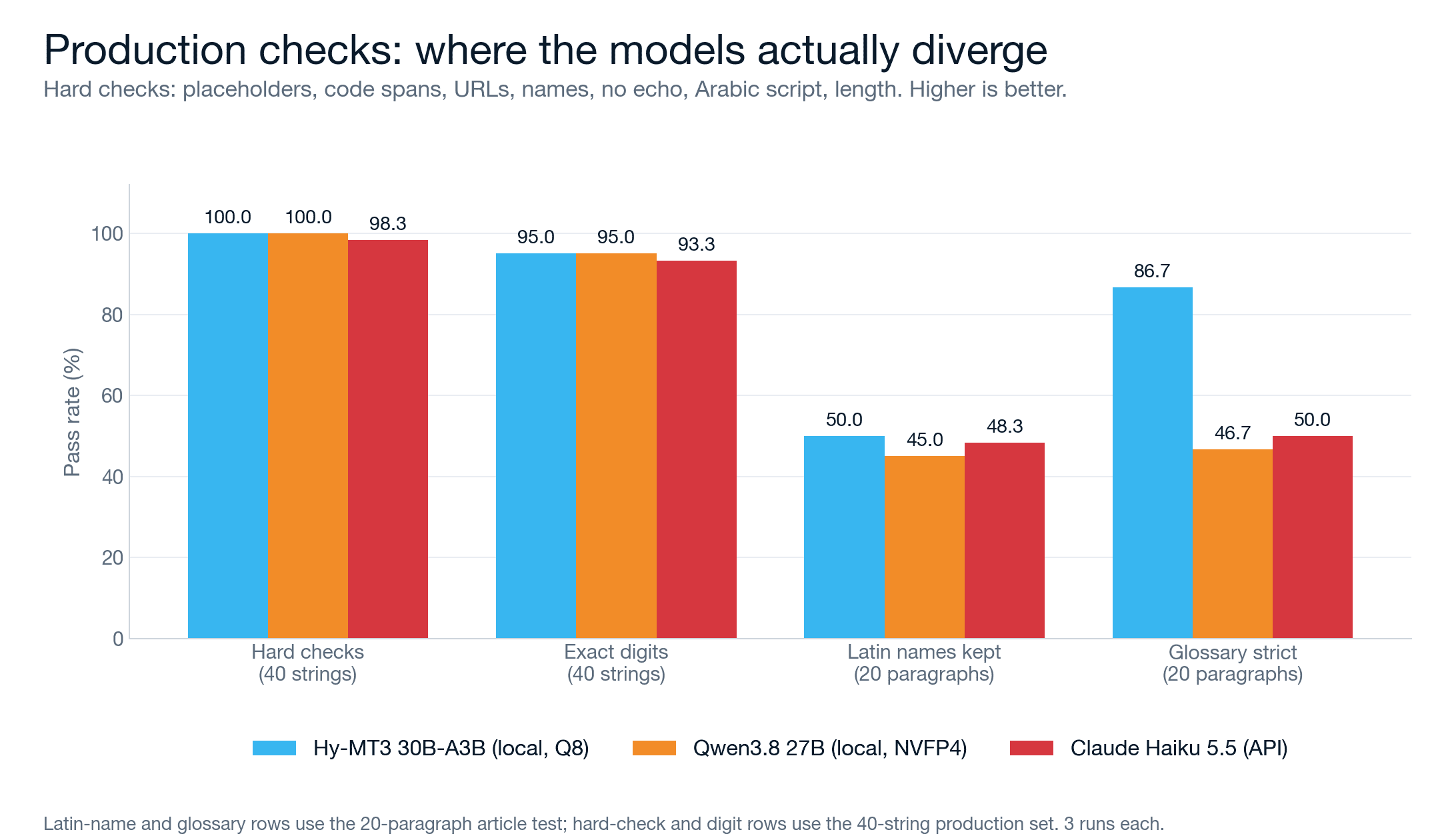
The 40-string set covered UI copy, developer docs, support steps, legal clauses, release notes, CLI errors and blog snippets. Every prompt asked the model to preserve placeholders, code spans, URLs, numbers and product names.
| Check | Hy-MT3 | Qwen3.8 | Haiku |
|---|---|---|---|
| Placeholders | 100% | 100% | 100% |
| Code spans | 100% | 100% | 100% |
| URLs | 100% | 100% | 100% |
| All hard checks | 100% | 100% | 98.3% |
| Exact digits | 95.0% | 95.0% | 93.3% |
| Names kept | 50.0% | 45.0% | 48.3% |
The hard-check failure was Haiku echoing the English source before the translation. Two of its 120 string outputs began with the full English sentence and a line such as "Wait, I need to correct my response". One of those also ran long. The other two runs of each affected segment were clean, so this is a sampling reliability issue, not a broken prompt. It is still the kind of output a CMS pipeline has to reject.
The digit row is a formatting preference, not a correctness row. Hy-MT3 wrote دقيقتين for "2 minutes" and دقيقة واحدة for "1 minute". Both are better Arabic than forcing the digits, but they fail a literal "preserve numbers" check. Qwen and Haiku did the same in a few places. If your pipeline validates numeric tokens, count these as failures. If a human editor reads the output, they are not errors.
The name row needs the same honesty. Most misses were transliterations or translated publication names (Financial Times to فايننشال تايمز, The Information to ذا إنفورميشن), not obvious omissions. If your brand guide requires Latin script, this is the number that matters. If you want Arabic transliteration, it is not a quality failure.
Cost: the local model wins the line item, not the payback
Haiku 5.5 is priced at $0.10 per million input tokens and $0.50 per million output tokens for prompts under 100,000 tokens.7 I counted the actual billed tokens from the API responses, not an estimate from word counts. The whole test billed 90,414 input tokens and 81,756 output tokens; the pack has the per-request counts.
| Test | Words | API cost | $/1M |
|---|---|---|---|
| Article (3 runs) | 4,296 | $0.0122 | $2.83 |
| FLORES (3 runs) | 13,014 | $0.0290 | $2.23 |
| Strings (3 runs) | 3,366 | $0.0088 | $2.61 |
| Whole test | 20,676 | $0.0499 | $2.41 |
⚠ Prices change frequently. The values above are for illustration only and may be out of date. Always verify current pricing directly with the provider before making cost decisions: Anthropic · OpenAI · Google Gemini · Google Vertex AI · AWS Bedrock · Azure OpenAI · Mistral · Cohere · Together AI · DeepSeek · Groq · Fireworks AI · Perplexity · xAI · Cursor · GitHub Copilot · Windsurf.
Both local models have $0 marginal API cost. The question is whether that saves money. A watt-meter run during inference measured 0.51 Wh for 713 words on Hy-MT3 and 0.77 Wh for the same 713 words on Qwen, about $0.11 and $0.16 per million words at $0.15/kWh. At $2.83 per million source words, one hundred million words costs about $283 on Haiku. If a Mac Studio costs $4,000, the API-fee break-even is roughly 1.5 billion words, and that ignores maintenance and the value of the engineer's time. If you already own the machine, the electricity cost is real but small. If you are buying it for translation alone, the API is cheaper for a very long time.
The local case is therefore control, privacy and availability, not the invoice. A local model keeps source text on the machine, works offline, has no rate limit and cannot be retired by a vendor. Those are the reasons to run it. The cost table is the reason not to pretend it pays for itself next quarter.
Speed and memory
Speed is reported separately because the API number includes the network and the local numbers do not. The Haiku figure is end-to-end; the local figures are generation speed.
| Model | Speed | Latency | Memory |
|---|---|---|---|
| Hy-MT3 | 91.5 tok/s | 2.32 s | 30.3GB |
| Qwen3.8 | 61.7 tok/s | 2.46 s | 18GB |
| Haiku | 142.2 tok/s | 2.14 s | n/a |
The token counts are not comparable across models. Hy-MT3 produced 208 output tokens, Qwen 138.5 and Haiku 309 for the same paragraphs; tokenizer and wording both differ. That is why token counts are a bad proxy for word cost across vendors, and why the cost table above uses each model's own billed tokens.
Runtime choice: what actually runs on this Mac
Why the test uses NVFP4, not the FP8 checkpoint
The archive contains Qwen3.8-27B-FP8, but that checkpoint is packaged for vLLM, SGLang and TokenSpeed on CUDA GPUs. It is not an Apple Metal artifact. This is a runtime constraint, not a bad download. The files and the safetensors index are present, and the model card lists those three runtimes.
I still tried the two obvious Mac paths before falling back:
# Transformers 4.57.3
ValueError: The checkpoint you are trying to load has model type `qwen3_5`
but Transformers does not recognize this architecture.

# mlx_lm
FileNotFoundError: No safetensors found in .../Qwen3.8-27B-FP8
The first is a version gap. The checkpoint's config declares transformers_version: 5.8.0.dev0, and 4.57.3 does not know the qwen3_5 architecture. The second message is misleading. MLX reports "no safetensors" when it cannot use the FP8 layout, not because the shards are missing. Neither is a defect in the weights.
The runnable local build on this Mac is Ollama's qwen3.8:27b-mlx tag: NVFP4, 27.8B parameters, 262,144-token context. That is what the benchmark measures. It is not the FP8 checkpoint, so this is a build-level comparison, not a verdict on FP8. If you have a vLLM host with an H100 or H200, run the FP8 checkpoint there and treat these numbers as the Mac-local baseline.
Hy-MT3 needs a recent llama.cpp
The model is newer than the Homebrew llama.cpp 7770 bottle. That binary contained no hy_v3 architecture string, so it could not load the GGUF. This is a packaging/version issue, not a model problem. Upgrading to llama.cpp 1.1.0 (build 12774) loaded the Q8_0 file with all layers offloaded (-ngl 99). The model card recommends temperature 0.7, top_p 1.0, top_k -1 for the 30B-A3B. This test used temperature 0 because translation evaluation needs a stable target.
Haiku 5.5 removes the sampling controls
The first API call returned:
invalid_request_error: `temperature` is deprecated for this model.
This is an API design choice, not a setup mistake. Thinking can be disabled (thinking: {"type": "disabled"} was accepted), but the API rejected temperature, top_p, top_k and seed. There is no supported way to pin sampling on this model. Three runs per paragraph are therefore not three identical runs. They are three samples from the model's default distribution. The two source-echo failures in the string test show one visible risk.
What I would deploy
- If raw Arabic fluency is the only criterion and the text leaves the building: Haiku 5.5. It is cheap, fast, and scored at the top of the COMET-Kiwi table (0.8032, statistically tied with Qwen). At $2.83 per million words, the invoice is not the problem.
- If you have a glossary, a style guide and a CMS: Hy-MT3-30B-A3B. It followed the glossary almost twice as often as either general model, passed every hard production check, and costs nothing per request. Put a human editor on the 13% of terms it still misses.
- If you want one local model for everything: Qwen3.8-27B is the generalist. It tied Haiku on COMET and passed every hard check, but it did not follow the glossary better than Haiku (46.7% vs 50.0%, a statistical tie) and produced a clear grammar error in the set. Use it with a glossary and a post-edit step, not as a drop-in translation engine.
The honest summary: the specialist local model did not beat the API on raw quality, and it did not need to. It beat it on the thing a localization pipeline actually controls.
Limitations
- No human evaluation. COMET-Kiwi, COMET-22, chrF++ and embedding cosine are automatic metrics. A native editor would catch grammar and style issues that COMET does not. The Qwen ينتهي تجربتك error is an example.
- One article. The paragraph test uses a single Wikipedia article on AI agents. It is rich in terminology, but it is not a legal contract, a marketing landing page or Egyptian colloquial Arabic.
- Quantization confound. Hy-MT3 ran at Q8_0, Qwen at NVFP4. The comparison measures the builds that run on this Mac, not the models at equal precision.
- MSA only. The glossary and references are Modern Standard Arabic. Do not generalize these numbers to Egyptian, Gulf or Levantine dialects.
- No speed verdict. Local and API latency include different overheads. The table is descriptive.
Related reads
الأسئلة الشائعة
Did Hy-MT3 beat Claude Haiku 5.5?
On glossary control, yes: 86.7% vs 50.0% strict term matches. On raw paragraph quality, no: 0.7888 vs 0.8032 COMET-Kiwi, a 0.0144 gap that is statistically significant but small. On cost, the local model has no API fee. Haiku cost $2.83 per million source words.
Is a local translation model cheaper than Haiku?
Not on API fees alone at this price. The break-even for a $4,000 machine is roughly 1.5 billion source words at $2.83 per million. Local wins when you already own the hardware, need offline operation, or cannot send the text to a third party.
Can I run Hy-MT3-30B-A3B on a 32GB Mac?
The Q8_0 GGUF is 32.79GB, so no. A smaller quantization or the 1.8B/7B variants are the options to test. This post did not test them. The 96GB machine used here loaded the Q8 build at 30.3GB RSS.
Why did you use a Wikipedia article?
It is a real, citable technical article with a revision ID and a CC BY-SA license, and it covers the terminology an AI product actually uses. The source and the translations are in the pack with the revision and license noted.
Is COMET-Kiwi enough to judge Arabic quality?
No. It is a trained reference-free metric that correlates with human judgments on translation benchmarks, but it does not replace an editor. The Qwen grammar error in the string test sits outside the paragraph metric entirely. Use COMET to compare systems, not to sign off a release.
Can I reproduce this?
Yes. The benchmark pack index links to the corpus, prompts, raw JSONL outputs, token counts, scoring scripts, the Wikipedia revision and the FLORES sample. The only non-public piece is the paid API key.
Footnotes
-
Tencent, "Hy-MT3-30B-A3B-GGUF" model card, released 2026-11-24: 30B-A3B, 102 languages, Apache 2.0. https://huggingface.co/tencent/Hy-MT3-30B-A3B-GGUF ↩
-
Qwen, "Qwen3.8-27B-FP8" model card: 27B dense vision-language model, 262,144-token context, FP8 for vLLM/SGLang/TokenSpeed. The model card linked in the sidebar is the hosted Qwen Cloud listing; this test used the local NVFP4 build. https://huggingface.co/Qwen/Qwen3.8-27B-FP8 ↩
-
Anthropic, "Models overview" and pricing, Claude Haiku 5.5: $0.10/$0.50 per MTok up to 100K-token prompts, 1M context, 128K output, released 2026-10-07. https://platform.claude.com/docs/en/about-claude/models/overview ↩
-
Wikipedia, "AI agent," revision 1387610875, 2026-11-24. CC BY-SA 4.0. https://en.wikipedia.org/wiki/AI_agent ↩
-
Unbabel, "wmt22-cometkiwi-da" model card, reference-free quality estimation. https://huggingface.co/Unbabel/wmt22-cometkiwi-da ↩
-
Meta AI, "FLORES-200" dataset, 1,012 devtest sentences per language. https://github.com/facebookresearch/flores ↩
-
Anthropic, "Pricing," Claude Haiku 5.5: $0.10 input / $0.50 output per million tokens for prompts up to 100,000 tokens. https://platform.claude.com/docs/en/about-claude/pricing ↩
نشرة مجانية
ابقَ على مسار النيرد
رسالة واحدة كلّ أسبوع: عدد الخميس يضمّ شرحًا لمنظومة واحدة، وثلاث وظائف عن بُعد، وتمرينًا واحدًا، وخلاصة بالعربية.