Pinecone Nexus: Is RAG Ending for AI Agents? (2026)
July 25, 2026
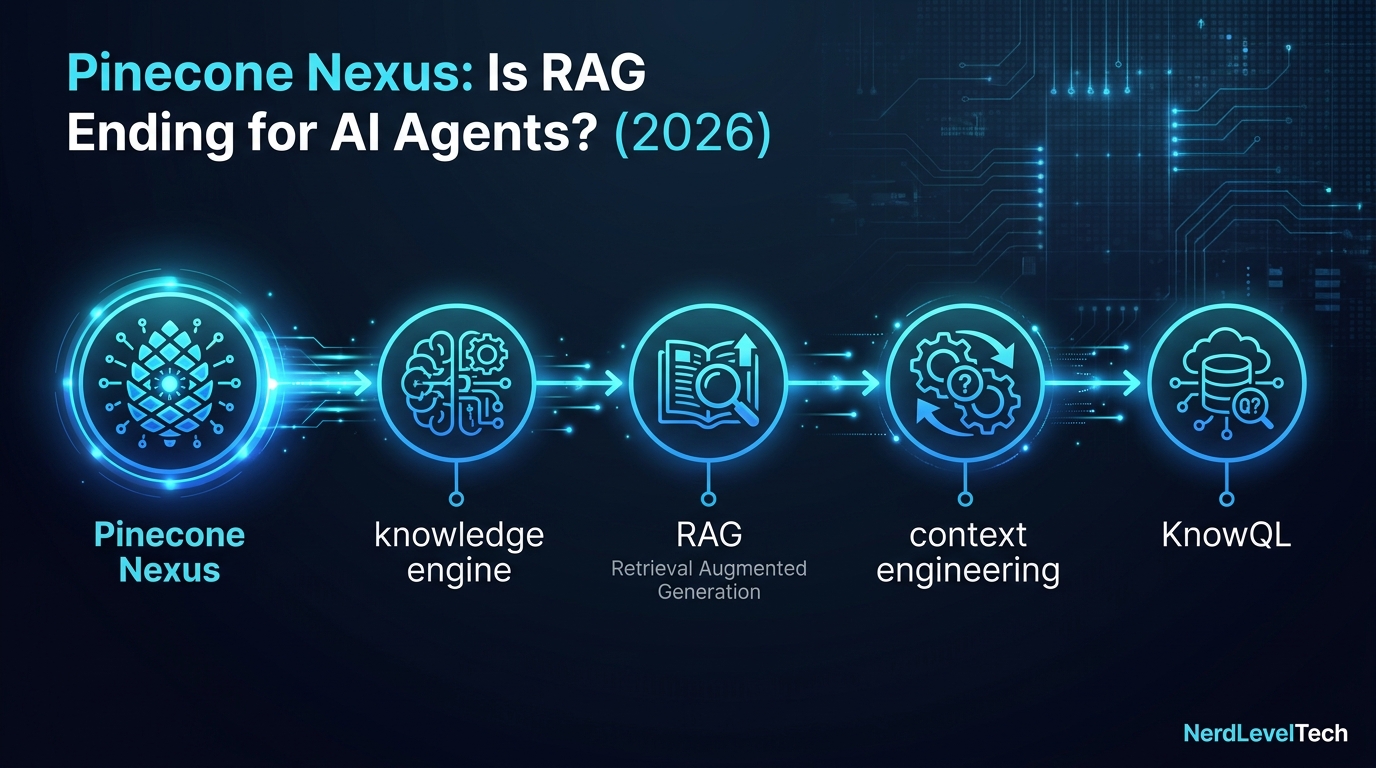
In one line: Pinecone Nexus is a "knowledge engine" for AI agents that compiles an enterprise's scattered data into structured, pre-built artifacts agents query in one step — moving reasoning and token spend out of the per-query retrieval loop that defines RAG and into a one-time curation stage.12
TL;DR: On July 1, 2026, Pinecone — the vector-database company that, by its own account, "defined RAG as a standard pattern" — moved Pinecone Nexus into public preview, nearly two months after opening early access.12 Nexus reframes the problem: rather than letting an agent search, retrieve, and reassemble context on every task, it compiles a company's knowledge into typed artifacts ahead of time and serves them through a declarative query language called KnowQL.13 Benchmarks published by Pinecone and by customers evaluating it during early access show large accuracy and token-cost gains over agentic RAG on bounded document corpora.32 The framing in the trade press — that "the RAG era is ending" — is louder than the evidence: Nexus targets bounded corpora, none of the numbers have been independently reproduced, and the more defensible reading is that retrieval is bifurcating, not dying.456
What you'll learn
- What Pinecone actually announced across May and July 2026, and what "public preview" does and does not mean
- What a "knowledge engine" is, and how it differs from RAG and from a vector database
- How Nexus is put together — Connectors, Workspaces, Contexts, Manifests, and KnowQL
- The specific numbers Pinecone is pointing to, including the ones it leads with, and why the "vendor benchmark" label matters
- Whether RAG is actually "dead" — the evenhanded version, with the counterarguments
- What this means if you are building agents right now
What Pinecone actually announced
Nexus arrived on May 4, 2026 in a pair of same-day posts: a company-level launch announcement from Ash Ashutosh and Edo Liberty introducing Nexus and its query language KnowQL, and an engineering deep dive from Jeff Zhu and Siva Ragavan bluntly titled "Better Models Won't Save Your Agent."13 At that point it was early access only, open to a limited set of design partners.3 On July 1, 2026, Pinecone opened Nexus to public preview, telling anyone with a business use case they could request access.2 Public preview is not general availability: access is still request-gated, and the production deployment path is a separate request.2
The pitch behind the product is a diagnosis, and Pinecone states it aggressively. Frontier models, the company argues, are rarely the limiting factor; the reasoning step is usually fine. What breaks is everything before it. An agent gets a task, searches, retrieves, evaluates, decides it needs more, searches again, and loops — and by the time it can answer, most of the token and latency budget is gone.3 Pinecone puts a number on it, claiming that "roughly 85% of an agent's effort is spent on knowledge retrieval," with task completion rates "stuck at 50–60%," and it dismisses retrieval-at-inference as "the 'ten blue links' era of agentic retrieval."1 That last line is the one the trade press seized on.4
The discipline Pinecone is invoking has a name: context engineering, which it describes as shaping data into knowledge the model can use, instead of asking the agent to reassemble it from raw data at query time.37 Nexus is Pinecone's bet on productizing it.
What a "knowledge engine" is
In Pinecone's framing, a knowledge engine "compiles an enterprise's distributed knowledge into a structured layer agents can query directly, shifting token spend out of the per-query retrieval loop and into a one-time curation step."2 The contrast it is drawing is with retrieval-augmented generation. Classic RAG solves a specific problem well: give a language model access to external knowledge at inference time by retrieving relevant document chunks. That worked because early use cases were request-response — a user asks, the system retrieves, the model answers.3
Agent workloads break that assumption. A single agent task can touch dozens of documents across years and departments, and standard chunk-and-retrieve either misses facts that are not co-located or burns the budget looping to reassemble them.32 A knowledge engine moves that assembly work upstream. Instead of handing the agent chunks and asking it to stitch an answer together, Nexus pre-shapes source data into artifacts — typed, governed pieces of information built for a specific task — so the agent reads a mostly-finished answer rather than reconstructing one.3
Pinecone's own formulation is that Nexus is "a knowledge engine, not a retrieval system," and the distinction it wants is with inference-time retrieval, not with vector search as such.1 It is not retiring its vector index: the company says plainly that "the Pinecone vector database is the foundation; vector primitives and their management remain essential," and Nexus runs on the retrieval substrate Pinecone has spent years building.13 The layer sits above search, aimed at a third kind of knowledge that neither model weights nor vector search captures well — business context, "what a three-year employee knows without searching," scattered across contracts, wikis, HR docs, meeting notes, support tickets, and financial records.2
Is any of this new? Pinecone answers both ways in the same week. The engineering post concedes that "knowledge graphs, entity catalogs, and semantic layers have existed for decades" and that the hard part was never the concept but operationalizing it per domain — while its own section heading insists this is "a new category, not a better pipeline," and the launch post claims a knowledge engine that moves reasoning from retrieval to curation "did not exist until today."13 The honest read is that the instinct is old and the packaging is new.
Inside Nexus: Manifests, Contexts, and KnowQL
In the public-preview build, the moving parts are organized like this.2 Connectors handle ingestion; local file upload, Box, and Microsoft OneLake are live, with Google Drive, Slack, GitHub, Notion, Confluence, and S3 described as close behind.28 A Workspace is the top-level container, one per team or business unit that owns its own data sources and access controls. Inside a Workspace, data is organized into Contexts — one per dataset or knowledge domain.2
The most interesting design choice is the Manifest. A Manifest is a blueprint that tells Nexus how to turn raw documents into structured knowledge artifacts tuned to a domain, and it is meant to be authored by a subject-matter expert rather than a retrieval engineer.2 The patent attorney who knows how patent standards are organized, or the M&A analyst who knows which document categories to cross-reference, designs the artifact types and relationships before any query runs. The agent then inherits that understanding instead of rediscovering the corpus structure on every call.2 This is a real shift in emphasis from May: the launch materials led with an autonomous "context compiler" — a coding agent that iterates on curation and query code against an eval set — whereas the public-preview messaging centers the human-in-the-loop Manifest, with re-curation as the answer to what Pinecone calls knowledge drift.132
Work runs as Tasks — import, curate, and search — inside isolated sandboxes, and everything is queried through KnowQL (Knowledge Query Language), the single interface agents talk to.32 The declarative design is the point: like SQL, the agent states what answer it needs, in what shape, and with what constraints, and the engine decides which contexts to search and which artifacts to compose.13 Pinecone's two May posts describe its surface slightly differently — the engineering post organizes a query into four categories (intent, filter, provenance, and a control budget), while the launch post advertises six core primitives, adding output shape and confidence.13 Either way the ambition is explicit: Pinecone wants KnowQL to be a shared interface rather than a private one, and it has LangChain and Teradata publicly signed up to help advance it.1 That ambition has an obvious hurdle, as The New Stack put it: "KnowQL has to clear the standardization bar SQL cleared, and standards do not get declared into existence by a single vendor."4
For production, Pinecone points to a bring-your-own-cloud deployment where the cluster runs in the customer's own VPC and, the company says, documents never leave the customer's infrastructure. That deployment is request-gated, and as of the May launch Pinecone described BYOC support for Nexus specifically as coming "very soon."12
The numbers Pinecone is pointing to
Pinecone leads with headline figures: task completion rates above 90%, "30x faster time-to-completion," and up to 90% less token spend.1 The trade press repeated them, though not uncritically. Reviewing the completion-rate and token-spend claims, The New Stack wrote: "Take this claim with a grain of salt until production teams confirm" — while arguing that Pinecone's structural case "does not need the numbers to hold."4 Everything below is either Pinecone's own benchmark or a customer evaluation conducted during early access. None of it has been independently reproduced.
Pinecone's named internal benchmark, KRAFTBench, pits Nexus against an agentic-RAG pipeline and a sandboxed coding agent on 493 free-form 10-K filings (about 245MB) from S&P 500 companies, asking 150 hard financial questions with a 120-second, one-million-token budget each.3 Pinecone reports Nexus completing every question at 22.7 seconds average latency and about 6,700 tokens per task, versus 37.9 seconds and roughly 49,000 tokens for agentic RAG, and 84.1 seconds and about 528,000 tokens for the coding agent, which finished only 63% of the questions.3 That is roughly 7× fewer tokens than RAG and about 80× fewer than the coding agent. The accuracy column is more sobering than the headline claims suggest: Nexus scores 0.680, against 0.413 for agentic RAG and 0.585 for the coding agent.3 Nexus wins the comparison clearly, but 68% on the vendor's own harness is not a solved problem.
The public-preview post adds three customer-facing evaluations, all on small question sets. Q2, a digital-banking infrastructure provider, ran its own benchmark without Pinecone in the loop and reported a 95% F1 score across a 20-question eval set; its chief data scientist, Jesse Barbour, said his team could "easily stand up a vector database and run RAG" over its corpus, and that "the hard part is getting an agent to reliably and efficiently assemble the right knowledge for genuinely difficult questions."2 A second benchmark, which Pinecone says it ran with a legal-research AI company over 30,000 documents of EU case law and legislation, pitted Nexus against agentic RAG and a coding agent across 35 questions: Pinecone reports 100% completion at 87% accuracy for Nexus versus 66% completion at 45% accuracy for RAG and 6% completion at 4% accuracy for the coding agent, with token use roughly 9–15× lower.28 A third, run with a data-protection vendor across 598 municipal-meeting documents, reports 90% accuracy against a 65% RAG baseline on a 100-question set, with a one-time curation cost of $2.31 to compile the corpus into twelve artifact types in 34 minutes.2
The direction is consistent across all four: compile once, and the per-query cost collapses. The evidentiary weight is thinner than it first appears. Only the KRAFTBench and legal benchmarks report a full head-to-head against RAG on completion, accuracy, and tokens together; Q2 published no RAG baseline or token comparison beyond its executive's assertion, and the municipal benchmark reports cost per query rather than a token comparison. The corpora are large; the question sets are 20, 35, 100, and 150 items.
Is RAG actually "dead"?
Headlines raced ahead of the product back in May, when Nexus was still early access. VentureBeat framed it as "the RAG era is ending for agentic AI" on the day of the announcement, and The New Stack ran "the company that made RAG mainstream is now betting against it" two days later.45 That is a good story, and an incomplete one.
Start with scope. Pinecone says Nexus is "built for bounded corpora where agents need to reason across documents," at its best where a single question touches dozens of files and standard retrieval starts falling apart.2 That is a real and common shape — financial filings, case law, support archives, government records — but it is a shape, not the whole space. A knowledge base that changes hourly, an open-ended web search, or a lookup that only ever needs one chunk are not obviously improved by paying an upfront compilation cost. Pinecone scopes Nexus to bounded corpora but does not extend that caution to the cases above; its launch materials illustrate Nexus working over fast-moving operational estates that include Slack, Gong, and Jira (as example data sources rather than shipped connectors), and it launched a marketplace of more than 90 knowledge applications spanning sales, HR, and support.1 Exactly where the limits fall is a reading of the evidence, not a line the vendor draws.
The counterargument that holds up best is that retrieval is not disappearing so much as being re-drawn. In January 2026 — months before Nexus existed publicly — Algolia published a rebuttal to a viral essay titled "The RAG Obituary," arguing that the case against RAG is really a case against "naive, slow, passive implementations," and that once hybrid keyword-and-vector retrieval is "fast, structured, predictable, and directly callable by the model, the distinction of RAG vs agents becomes obsolete."6 Algolia sells retrieval, so read it with the same skepticism as Pinecone's benchmarks; but the continuum argument is the one that survives contact with real systems. Compiling knowledge upfront and retrieving it at query time are points on a spectrum, and where a given workload lands depends on how bounded and how stable its corpus is. Pinecone is also not alone in the compilation direction — InfoQ points to comparable efforts from Cognite, RelationalAI, and LlamaIndex, among others.8
Where boosters and skeptics agree is the underlying insight, and it is worth taking seriously even if you never touch Nexus: for agents working a fixed corpus, making the model rediscover the same structure on every task is waste. That is the same lesson showing up in adjacent work on agent memory systems and on how many tools an agent can realistically juggle — the bottleneck in 2026 is less often the model and more often the context you hand it.
Why it matters if you are building agents
The practical takeaway is not "rip out your RAG pipeline." It is a question worth asking about any agent you are shipping: how much of its token bill and latency is spent re-deriving structure it could have been handed? If an agent repeatedly loops over the same bounded set of documents to answer variations of the same question, the compilation-first model is a genuinely different cost curve, because the reasoning-about-the-corpus work is amortized once instead of paid per query.32
There are trade-offs the benchmarks do not foreground. Compilation adds an upstream step — someone has to author the Manifest and re-curate when the corpus drifts — which shifts effort rather than erasing it, and it fits corpora stable enough to be worth compiling.2 It also concentrates a great deal in one vendor's curation layer and query surface; the LangChain and Teradata collaborations suggest Pinecone knows a single-vendor interface is a hard sell, and the bring-your-own-cloud option and field-level provenance are the answers it offers to the governance version of the same worry.12 For teams already thinking in terms of context engineering rather than prompt engineering, and for anyone weighing how much agent behavior should be pinned down at build time versus discovered at run time (the same tension underneath agent tooling protocols like MCP), Nexus is a clear, well-argued data point — provided you read its benchmarks as the vendor's case rather than a settled result.