Muse Glimmer 2026: Where Meta's Open Agent Trails
August 11, 2026
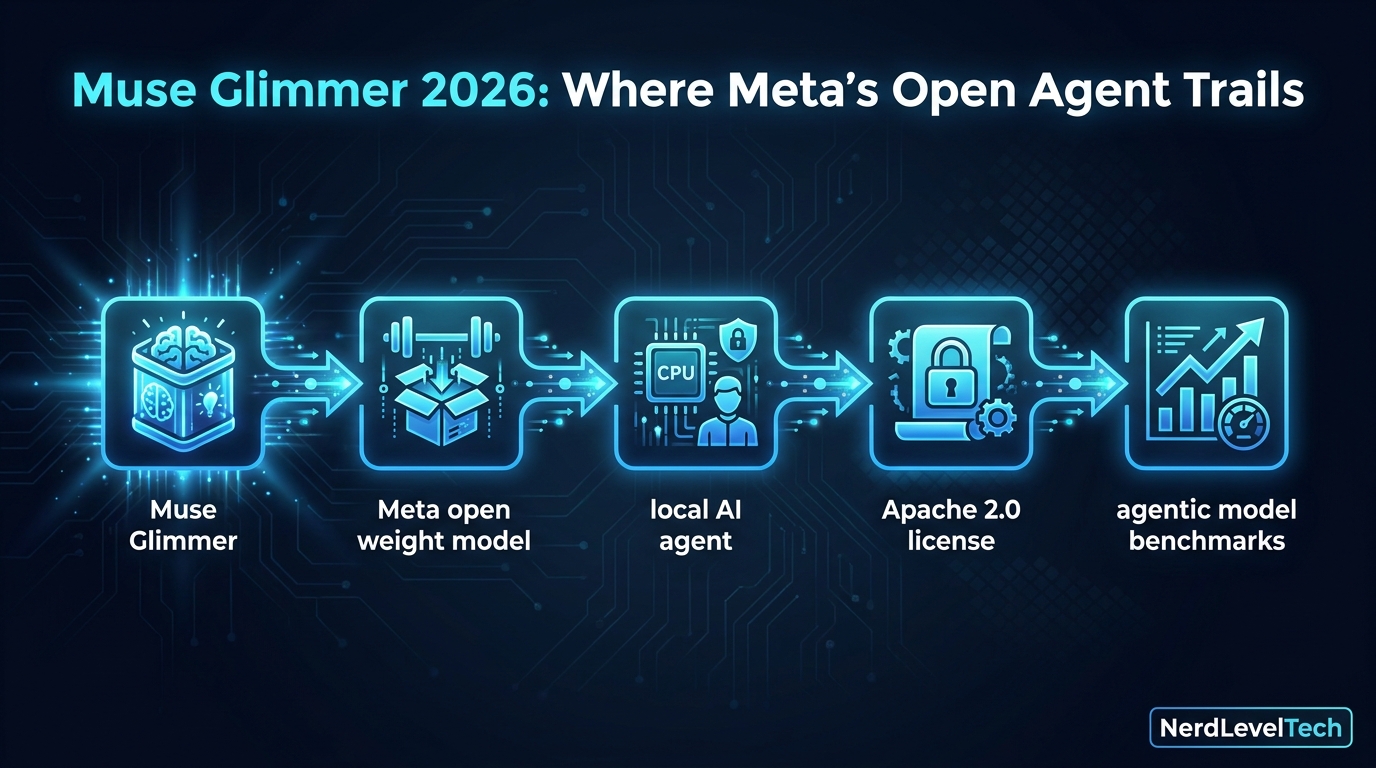
Muse Glimmer is a 30-billion-parameter open-weight agentic model released by Meta Superintelligence Labs on August 10, 2026 under Apache 2.0. It runs on a single consumer GPU, leads the two open models Meta benchmarked it against on tool orchestration, and trails Qwen3.6-27B on computer use and terminal coding.
TL;DR
Meta released Muse Glimmer on August 10, 2026 — a ~29.6B-parameter multimodal model distilled from the closed Muse Spark, published on Hugging Face under Apache 2.0.12
The licence is the part that matters most. Llama shipped under Meta's own Community Licence, which the Open Source Initiative has said does not meet the Open Source Definition.3 Apache 2.0 has no user-count trigger and no field-of-use restrictions.
On Meta's own benchmark table, Muse Glimmer beats Gemma4-31B and Qwen3.6-27B on MCP-Atlas (75.5 vs 54.2 and 62.5), DeepSearch QA, Gaia2 and WildClawBench.2
It loses on the benchmarks that dominate local-model comparisons. Qwen3.6-27B leads OSWorld-Verified (75.6 vs 65.9), Terminal-Bench 2.1 (60.7 vs 51.7) and SWE-Bench Verified (77.2 vs 76.0).2
And its prompt-injection resistance is mid-pack: Meta reports a 28.4% attack success rate on Siren AgentDojo — better than Qwen3.6-27B's 40.3, worse than Gemma4-31B's 25.6.2
What You'll Learn
- What Muse Glimmer is and what Meta actually shipped on August 10
- Why the Apache 2.0 licence is a bigger change than the model
- Which benchmarks Muse Glimmer leads and which it loses
- What the 24 GB hardware claim really requires
- How DFlash speculative decoding produces the 3.1x speed number
- What the published safety scores say about running it unsupervised
What Meta shipped
Muse Glimmer is a dense causal transformer with a bolted-on vision encoder, built for one job: running an agent loop locally.2
Meta's framing is explicit. The model is trained around the sequence an autonomous agent performs — plan, call a tool, read the result, keep going, recover when something fails.1
The headline number is 30B, but the model card is more precise: total parameters are ~29.6B, including a ~1.8B ViT-G/14 perception encoder.2 The vision tower is inside that count, not on top of it.
Other specifications from the model card: 52 layers, a 6,656 hidden dimension, grouped-query attention at 32 query heads to 2 KV heads, a repeating [Local, Local, Local, Global] attention pattern with a 2,048 sliding window, and a 202,048-token vocabulary.2
Context length is listed as 131,072+, input is text and image, output is text only. Audio is not supported and video is processed as individual frames.2
The knowledge cutoff is January 4, 2026.2
Training ran in three phases. Pre-training used logit distillation on Muse Spark's outputs; mid-training added longer-context, agent-heavy data; post-training combined supervised fine-tuning with on-policy distillation and reinforcement learning.1
Everything ships under the same licence: BF16 weights, two 4-bit quantised variants, the DFlash drafter head, and the frozen perception encoder.2
The licence is the real news
Meta's open-model history has an asterisk on it. Llama was distributed under the Llama Community Licence, which carried an acceptable-use policy, naming requirements, and a threshold above which a separate agreement with Meta was required.
The Open Source Initiative said so directly. In a February 2025 post covering Llama 3.x, it wrote that the licence "fails at freedom 0, the freedom to use the model for any purpose," fails Open Source Definition point 5 by discriminating against users, and fails point 6 by restricting fields of endeavour.3
OSI's word for the practice was blunter still: "open washing."3
Apache 2.0 is OSI-approved and carries none of that. Commercial deployment, modification, redistribution and downstream model training are all unrestricted.
The timing frames it. Meta's first proprietary model, Muse Spark, launched April 8, 2026, followed by Muse Spark 1.1 on July 9 and Muse Spark 1.2 alongside Muse Code in early August.4
So Muse Glimmer is the first open release since Meta went closed — and Meta has said an open-weight version of Muse Spark 1.2 is coming too.5
Treat that second part as a stated intention, not a shipped artefact. Muse Spark 1.2 launched with closed weights on August 5, and as of August 11, 2026 Meta has published neither a release date nor a licence for the open version.56
Where Muse Glimmer leads
Meta benchmarked Muse Glimmer at high reasoning strength against Gemma4-31B and Qwen3.6-27B, both in thinking mode.7
The general-agentic block is where the release earns its positioning.
| Benchmark | Muse Glimmer-30B | Gemma4-31B | Qwen3.6-27B |
|---|---|---|---|
| MCP Atlas (Public) | 75.5 | 54.2 | 62.5 |
| DeepSearch QA | 74.6 | 61.7 | 71.1 |
| τ3-Banking | 23.5 | 15.1 | 16.7 |
| WildClawBench | 47.6 | 37.6 | 43.2 |
| Gaia2 | 43.3 | 36.4 | 40.0 |
| SkillsBench (with skills) | 44.3 | 32.4 | 46.6 |
| OSWorld-Verified | 65.9 | 58.5 | 75.6 |
All figures from Meta's published model card.2
MCP-Atlas is the widest margin Muse Glimmer posts anywhere on the table: 13.0 points over Qwen3.6-27B and 21.3 over Gemma4-31B. It is a multi-turn evaluation where the model works across 20+ MCP tool servers such as GitHub, Notion and Twelve Data, graded by an LLM judge on 500 public tasks averaged over four runs.7
That is a real result for the stated use case. If your agent's job is calling many tools in sequence and not losing the thread, this is the axis that matters.
Reasoning follows the same pattern. Muse Glimmer leads AIME 2026 at 94.7, AA-LCR at 80.0, IFBench at 77.0 and Beam128K at 65.1.2
One caveat worth naming: τ3-Banking tops out at 23.5 across all three models. Nobody is good at that benchmark yet. A win there is a win in a low-scoring field.
Where it trails
The losses are not scattered. They cluster on exactly the workloads that dominate the "which local model should I code with" conversation.
| Benchmark | Muse Glimmer-30B | Qwen3.6-27B | Gap |
|---|---|---|---|
| OSWorld-Verified | 65.9 | 75.6 | −9.7 |
| Terminal-Bench 2.1 | 51.7 | 60.7 | −9.0 |
| SkillsBench | 44.3 | 46.6 | −2.3 |
| SWE-Bench Verified | 76.0 | 77.2 | −1.2 |
| SWE-Bench Pro | 51.2 | 50.2 | +1.0 |
Gaps computed from Meta's published figures.2
OSWorld-Verified is the computer-use benchmark — operating a full Ubuntu desktop through screenshots and GUI actions. Qwen3.6-27B is 9.7 points ahead there.2
Terminal-Bench 2.1 is the terminal-agent benchmark, 89 curated tasks run in the Terminus 2 harness. Qwen3.6-27B is 9.0 points ahead.7
SWE-Bench splits. Muse Glimmer edges Pro by 1.0 point but trails Verified by 1.2 — and Meta notes it used Qwen3.6-27B's self-reported score on Verified while running Pro internally, because Qwen's self-reported Pro number was measured on a refined version of the benchmark.7
Multimodal is close but mostly not Meta's. Qwen3.6-27B leads ScreenSpot Pro (76.1 vs 75.4), OmniDocBench v1.5 (77.8 vs 75.8) and MMMU Pro (75 vs 74); Muse Glimmer takes CharXiv Reasoning at 78.8.2
The honest summary: Muse Glimmer is an orchestration model, not a coding model. It wins where the task is "coordinate many tools." It loses where the task is "drive a terminal or a desktop." That distinction is not in the headlines, and it is the one that decides whether the model fits your stack.
This is the second Meta benchmark table in a week worth reading closely. The Muse Code benchmark comparison had a different problem — the harness changed between the two generations being compared.
What "runs on one consumer GPU" requires
At full precision a ~29.6B model needs over 55 GB of memory, which Meta's table maps to a 64 GB VRAM target.12
Quantisation to approximately 4-bit shrinks the language model to under 20 GB, leaving headroom inside a 24 GB or 32 GB envelope for the KV cache, the perception encoder and the speculative-decoding drafter.1
Two builds ship, and the degradation figures are published:
| Build | Degradation | Target hardware |
|---|---|---|
| Full precision | — | 64 GB VRAM |
| K-Quant-Dynamic | 0.2% | 32 GB VRAM |
| K-Quant-17GB | 1.0% | 24 GB VRAM |
Degradation is averaged across accuracy metrics on 15 common benchmarks.2
Read the envelope carefully. The 24 GB figure is the full working envelope, not the weight file — KV cache, vision encoder and drafter all live inside it alongside the quantised weights, which Meta puts at under 20 GB.1
Note also that the RTX 5090 Meta benchmarked on carries 32 GB of GDDR7, not 24 GB.8 The 24 GB tier describes cards like the RTX 4090 and 3090, which Meta did not publish numbers for.
Where the 3.1x speed number comes from
Muse Glimmer ships with a drafter based on DFlash, a block-diffusion speculative-decoding method that predicts an entire block of 16 tokens in a single forward pass.2 The main model verifies the block in parallel, accepting correct tokens and correcting wrong ones.
Meta's published throughput measurements, taken on the K-Quant-17GB build at batch size 1 with greedy decoding:2
| Hardware | Baseline | With DFlash | Speedup |
|---|---|---|---|
| Nvidia RTX 5090 | 74.9 tok/s | 233.4 tok/s | 3.1x |
| Apple M5 Max | 26.6 tok/s | 50.2 tok/s | 1.8x |
| Apple M4 Max | 23.7 tok/s | 37.8 tok/s | 1.5x |
The 3.1x headline is the RTX 5090 result via llama.cpp. Apple silicon, measured through ExecuTorch, lands at 1.5x to 1.8x.2
Both Mac figures stay under 51 tok/s. That is usable for a single agent turn and slow for a long multi-step loop where every tool result triggers fresh generation.
The safety numbers Meta published
Meta published adversarial results rather than omitting them, which is worth acknowledging — and the numbers deserve reading before anyone points this model at real systems.
On Siren AgentDojo, a prompt-injection benchmark combining 97 benign tasks with 35 malicious ones across 949 injection scenarios, Muse Glimmer records a 28.4% attack success rate with 94.2 utility.27
Gemma4-31B is more resistant at 25.6% ASR but less useful at 90.8 utility. Qwen3.6-27B is worse on both counts: 40.3% ASR, 92.7 utility.2
More than one in four injection attempts succeeded — against a model Meta describes as suited to an agent that "manages your schedule, drafts your messages, organizes your files."1
The privacy result is less flattering. On CIMemories, which measures inappropriate disclosure of personal attributes, Muse Glimmer's violation rate is 26.4 against Gemma4-31B's 12.1 — roughly double.2 Qwen3.6-27B is worst at 53.4.
Meta's own guidance is unambiguous: deploy the model inside a system with additional guardrails rather than as a bare endpoint, and add human-in-the-loop confirmation for irreversible actions.2
That guidance is the product. It aligns with what Check Point found breaking agent frameworks at Black Hat 2026 — the exploitable surface is the plumbing around the model, not only the model itself.
How to read Meta's benchmark table
Vendor benchmark tables need a methodology pass. Meta's is more transparent than most, and it contains two disclosures that change how you read the numbers.
First, sourcing is split. τ3-Banking, GDPval-AA v2, Terminal-Bench 2.1, SciCode, MMMU Pro, GPQA Diamond, HLE and AA-LCR are sourced from Artificial Analysis. MCP-Atlas, DeepSearch QA, WildClawBench, Gaia2, SkillsBench, OSWorld-Verified, SWE-Bench Pro, CharXiv, ScreenSpot Pro, OmniDocBench, CIMemories, Siren AgentDojo and Beam128K are Meta's internal runs.7
Muse Glimmer's biggest win — MCP-Atlas at +13.0 — is an internal run. That is not disqualifying, but it is not third-party either.
Second, Meta states the caveat itself: its evaluation setup, including agent tools and system prompts, "may not be specifically tuned for proprietary third-party models," so results "may not reflect these models' best performance."7
To Meta's credit, the methodology also says it reports the most favourable result for competitors between their self-reported scores and Meta's internal reproductions.7 That cuts the other way and is unusual to see stated.
One table entry does not belong on a percentage scale: GDPval-AA v2 is reported as 953 for Muse Glimmer, 811 for Gemma4-31B and 1141 for Qwen3.6-27B.2 Qwen leads it.
What this means for local agents
Muse Glimmer is not the first open-weight model tuned for agentic work. Qwen3.6-27B shipped in April 2026 under Apache 2.0 with agentic coding as a stated target,9 and Mistral Small 4 arrived under Apache 2.0 on March 16, 2026 folding agentic coding into a single model.10
Treat "first" claims in launch coverage with suspicion. What is new here is the combination: a frontier-lab agentic model, at a size that fits consumer hardware, under a licence with no user-count trigger.
The practical read is a split decision. If you are wiring together MCP servers and need reliable multi-tool orchestration offline, Muse Glimmer's MCP-Atlas margin is the strongest case in the three-model comparison Meta published.
If you want a local coding agent or a computer-use agent, Qwen3.6-27B remains ahead on Terminal-Bench 2.1 and OSWorld-Verified by roughly nine points each — on Meta's own numbers.
And regardless of which you pick, the 28.4% injection success rate says the same thing the SkillsBench and agent-skills evidence said: packaging and portability have advanced faster than measured reliability.
The bottom line
The licence change is the durable story. Meta moving from a bespoke community licence to Apache 2.0 removes the legal asterisk that followed every Llama release.
The model is narrower than the coverage suggests. Muse Glimmer wins the orchestration benchmarks and loses the coding and computer-use ones to a model that has been available since April.
And the safety table Meta published — 28.4% injection success, a 26.4 privacy violation rate — is the part to read twice before pointing an always-on local agent at your own files.
References
Footnotes
-
Meta Superintelligence Labs, "Introducing Muse Glimmer: An Open Agentic Model That Runs on Your Device," Meta AI Research, August 10, 2026. https://research.meta.ai/blog/introducing-muse-glimmer-open-agentic-model ↩ ↩2 ↩3 ↩4 ↩5 ↩6 ↩7 ↩8
-
"Muse Glimmer Model Card," meta-models/Muse-Glimmer-30B, Hugging Face, August 2026. https://huggingface.co/meta-models/Muse-Glimmer-30B ↩ ↩2 ↩3 ↩4 ↩5 ↩6 ↩7 ↩8 ↩9 ↩10 ↩11 ↩12 ↩13 ↩14 ↩15 ↩16 ↩17 ↩18 ↩19 ↩20 ↩21 ↩22 ↩23 ↩24 ↩25 ↩26 ↩27 ↩28 ↩29
-
Jordan Maris, "Meta's LLaMa license is still not Open Source," Open Source Initiative, February 18, 2025. https://opensource.org/blog/metas-llama-license-is-still-not-open-source ↩ ↩2 ↩3 ↩4
-
Meta, "Introducing Muse Spark: Meta Superintelligence Labs," April 8, 2026. https://about.fb.com/news/2026/04/introducing-muse-spark-meta-superintelligence-labs/ ↩
-
Larry Dignan, "Meta releases open weight Muse Glimmer model with open Muse Spark 1.2 on tap," Constellation Research, August 10, 2026. https://www.constellationr.com/insights/news/meta-releases-open-weight-muse-glimmer-model-open-muse-spark-12-tap ↩ ↩2 ↩3
-
Meta Superintelligence Labs, "Introducing Muse Code and Muse Spark 1.2," Meta AI Research, August 5, 2026. https://research.meta.ai/blog/introducing-muse-code-and-muse-spark-1-2 ↩ ↩2
-
Meta, "Muse Glimmer Evaluation Methodology," August 2026. https://research.meta.ai/static/muse-glimmer-methodology ↩ ↩2 ↩3 ↩4 ↩5 ↩6 ↩7 ↩8
-
ASUS, "TUF Gaming GeForce RTX 5090 32GB GDDR7 — Tech Specs." https://www.asus.com/motherboards-components/graphics-cards/tuf-gaming/tuf-rtx5090-32g-gaming/techspec/ ↩
-
Qwen Team, Alibaba Group, "Qwen3.6-27B," Hugging Face, April 2026. https://huggingface.co/Qwen/Qwen3.6-27B ↩
-
Mistral AI, "Introducing Mistral Small 4," March 16, 2026. https://mistral.ai/news/mistral-small-4/ ↩