AI Agents in Go: Microsoft Joins Google's Bet in 2026
July 24, 2026
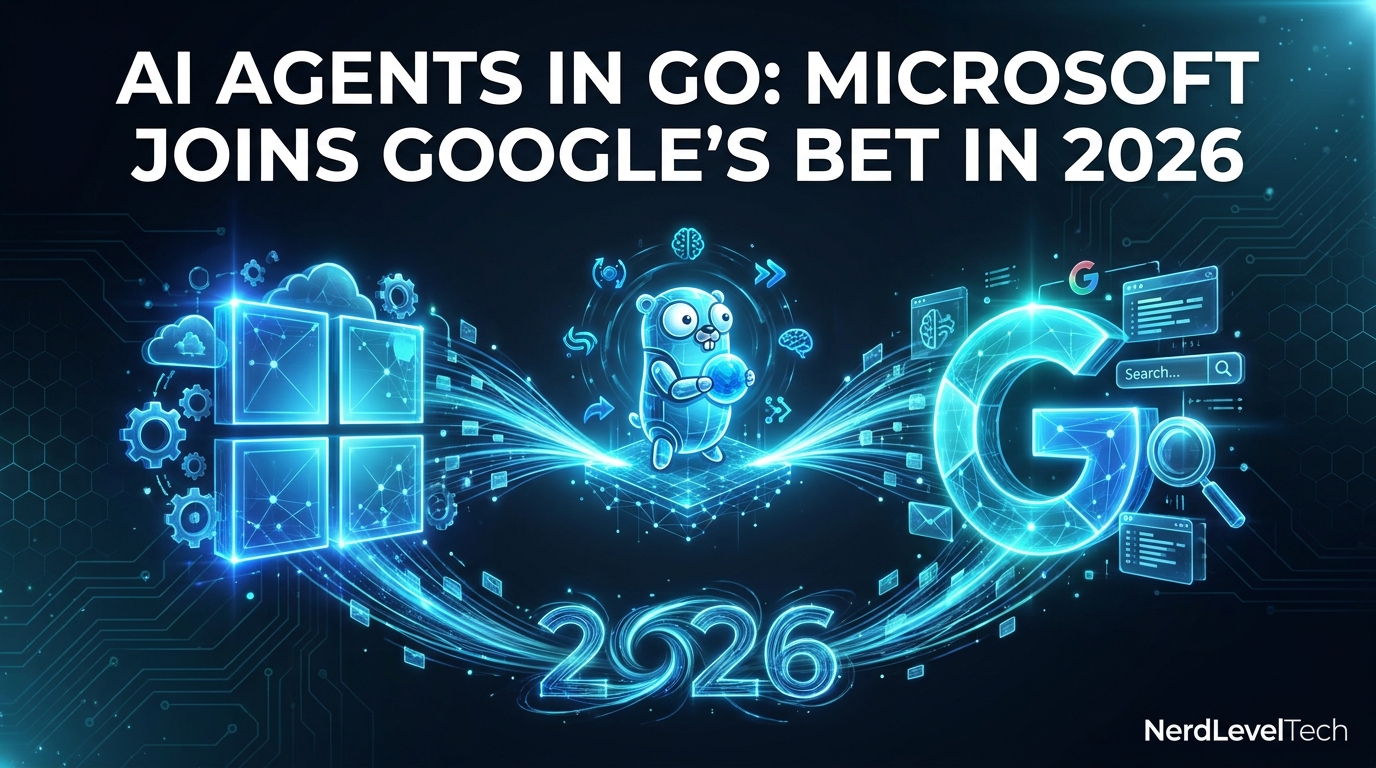
Microsoft put its Agent Framework for Go into public preview on July 10, 2026, roughly eight months after Google shipped an Agent Development Kit for Go. Both cloud giants now offer first-party Go SDKs for building agents. The two leading model labs, OpenAI and Anthropic, still ship their agent SDKs only in Python and TypeScript.
TL;DR
Microsoft Agent Framework for Go reached public preview on July 10, 2026, bringing tools, MCP, multi-agent workflows, and OpenTelemetry tracing to Go developers.1 Google's Agent Development Kit (ADK) for Go landed first, on November 7, 2025.2 That makes two of the biggest infrastructure vendors betting on Go as an agent-building language.
Meanwhile OpenAI's Agents SDK and Anthropic's Claude Agent SDK remain Python-and-TypeScript-only as of July 2026, with Go support for Claude sitting as an open community feature request.34 The split is not accidental: Go is the language cloud-native infrastructure is already written in, and agents increasingly live inside that infrastructure.
What You'll Learn
- What Microsoft shipped in the Go preview, and what is still missing
- Why Google's ADK for Go got there first, and where it stands now
- Why OpenAI and Anthropic remain Python-first
- Why Go is a natural fit for production agents
- A side-by-side comparison of Go support across the four major agent SDKs
What Microsoft Shipped
Microsoft Agent Framework for Go is a Go implementation of the same Agent Framework that already ships for .NET and Python.1 It is aimed at developers moving from single prompt calls to production agent systems — agents that call tools, keep context, coordinate with other agents, and can be observed and governed.
Getting started is a single command:
go get github.com/microsoft/agent-framework-go
The public preview covers a meaningful surface. It includes providers for Microsoft Foundry, Azure OpenAI and OpenAI-compatible models, Anthropic, Gemini, and the A2A protocol.1 On the agent side, it ships tools, MCP, middleware, context providers, approvals, and automatic tool calling.1
For orchestration, it supports multi-agent workflows with routing, checkpoints, streaming, and human review.1 And it wires in OpenTelemetry tracing for agent runs — the same observability posture teams already expect from OpenTelemetry-based agent tracing.1
There is a caveat worth stating plainly. Microsoft says the .NET SDK currently has broader product integrations, and several features are not yet implemented in Go.1 This is a preview, and Microsoft warns that APIs may still evolve as feedback comes in.1
The Go SDK sits alongside the existing .NET and Python SDKs inside the broader Microsoft Agent Framework project — the unified successor to Semantic Kernel and AutoGen that reached general availability on April 3, 2026.15
Google Got There First
Microsoft is joining a bet Google already placed. Google announced the Agent Development Kit for Go on November 7, 2025, extending a framework that already supported Python and Java.2
ADK for Go leaned into multi-agent work from the start. It shipped with support for the Agent2Agent (A2A) protocol, letting a primary agent delegate to specialized sub-agents whether they run locally or remotely.2 As part of that, Google contributed an A2A Go SDK back to the A2A project.2
Google's Go line has kept moving since. ADK Go 2.0, released June 30, 2026, added a graph-based workflow engine with built-in human-in-the-loop and dynamic orchestration.6 By the time Microsoft's preview arrived, Google's Go story was already several releases deep.
Why the Model Labs Are Still Python-First
The contrast with the model labs is the real story. OpenAI's Agents SDK ships in Python and TypeScript/JavaScript, with the two versions kept at feature parity — but there is no Go implementation.3
Anthropic's Claude Agent SDK is the same shape: Python and TypeScript only, giving developers the same agent loop and context management that power Claude Code.4 Go support exists only as an open feature request on the Python SDK repository, not as a shipped product.4 For anything outside Python and TypeScript, Anthropic points developers at running its CLI programmatically.4
There is a logic to it. OpenAI and Anthropic optimize for the fastest path from a model capability to a working prototype, and that path runs through the languages data scientists and application developers already use. Microsoft and Google are optimizing for a different customer: the platform team deploying agents into existing backend systems.
Why Go for Agents
Go's appeal for agents is not hype — it is where the infrastructure already lives. Kubernetes, Docker, containerd, etcd, Prometheus, Helm, Terraform, Consul, and Vault are all written in Go.7 The tooling that runs modern cloud deployments traces back to the language.
The reasons Go won that era carry over to agents. Go compiles to a single statically linked binary with minimal dependencies, which makes distribution and deployment simple across environments.7 Its concurrency primitives suit workloads that fan out across many tool calls and reasoning steps, and fast compilation keeps the iteration loop tight.7
For a team already running Go services, workers, and CLIs, an agent framework in Go means agents can live inside the same codebase and deployment model — no separate Python runtime bolted onto a Go platform. That is precisely the fit Microsoft names: services, CLIs, workers, and cloud-native applications.1 It is the same convergence pushing managed agent runtimes from the big cloud providers.
How the Four Compare
| Vendor / SDK | Go support | Languages offered | First Go release |
|---|---|---|---|
| Microsoft Agent Framework | Yes (public preview) | .NET, Python, Go | Jul 10, 20261 |
| Google ADK | Yes (2.0, Jun 2026) | Python, Java, Go | Nov 7, 20252 |
| OpenAI Agents SDK | No | Python, TypeScript | — 3 |
| Anthropic Claude Agent SDK | No (open request) | Python, TypeScript | — 4 |
The pattern is clean: the infrastructure vendors ship Go; the model labs do not. If you build agents in Go today and want a first-party SDK, your choices are Microsoft and Google.
What It Means for Developers
If your platform is already Go, the calculus just changed. You can now build production agents in your primary language with a vendor-backed SDK rather than reaching for a community port or standing up a Python sidecar. That reduces surface area and keeps observability, deployment, and error handling consistent with the rest of your stack.
If you are on the fence, note the maturity gap. Google's ADK for Go has had months of iteration and multiple releases; Microsoft's is a fresh preview with acknowledged gaps versus its .NET sibling.126 For production work today, Google's Go line is further along, while Microsoft's is worth tracking as it fills in.
And if you are committed to OpenAI or Anthropic models specifically, Go is still reachable — both Microsoft's and Google's frameworks can call those models as providers.12 You just would not use the labs' own SDKs to do it. The framework and the model are separate choices, and Go now has real options on the framework side. That is a different situation than it was even a year ago, when Go agent work meant community projects or wrapping a CLI — much as the framework churn documented in Pydantic AI's v2 rework has reshaped the Python side.
Bottom Line
The Go agent story in 2026 is a story about who is building it. Both major cloud and infrastructure vendors — Microsoft and Google — now ship first-party Go SDKs for agents, while the two leading model labs stay Python-and-TypeScript-first. Microsoft's July 10 preview is the newer, thinner entry; Google's, shipped back in November 2025, is the more mature one. For Go teams, the practical takeaway is simple: building agents in Go no longer means going it alone.
This piece touches on ongoing releases; SDK feature coverage and preview status can change quickly, so check each project's repository for the current state.
Footnotes
-
Microsoft for Go Developers, "Microsoft Agent Framework for Go public preview," July 10, 2026. https://devblogs.microsoft.com/go/microsoft-agent-framework-for-go-public-preview/ — and microsoft/agent-framework-go repository README (feature coverage and .NET/Go parity notes). https://github.com/microsoft/agent-framework-go ↩ ↩2 ↩3 ↩4 ↩5 ↩6 ↩7 ↩8 ↩9 ↩10 ↩11 ↩12 ↩13 ↩14 ↩15 ↩16
-
Google Developers Blog, "Announcing the Agent Development Kit for Go," November 7, 2025. https://developers.googleblog.com/announcing-the-agent-development-kit-for-go-build-powerful-ai-agents-with-your-favorite-languages/ ↩ ↩2 ↩3 ↩4 ↩5 ↩6 ↩7 ↩8
-
OpenAI Agents SDK (Python), GitHub. https://github.com/openai/openai-agents-python — and OpenAI Agents SDK (JavaScript/TypeScript), GitHub. https://github.com/openai/openai-agents-js ↩ ↩2 ↩3 ↩4
-
Anthropic, "Agent SDK overview," Claude Docs. https://platform.claude.com/docs/en/agent-sdk/overview — and "Feature Request: Go/Golang SDK Support," Issue #498, anthropics/claude-agent-sdk-python. https://github.com/anthropics/claude-agent-sdk-python/issues/498 ↩ ↩2 ↩3 ↩4 ↩5 ↩6
-
Visual Studio Magazine, "Microsoft Ships Production-Ready Agent Framework 1.0 for .NET and Python," April 6, 2026. https://visualstudiomagazine.com/articles/2026/04/06/microsoft-ships-production-ready-agent-framework-1-0-for-net-and-python.aspx ↩
-
Google Developers Blog, "Announcing ADK Go 2.0," June 30, 2026. https://developers.googleblog.com/announcing-adk-go-20/ ↩ ↩2
-
Programming Helper Tech, "Go Programming Language 2026: Why Cloud-Native Infrastructure Still Runs on Golang," 2026. https://www.programming-helper.com/tech/go-programming-language-2026-cloud-native-microservices ↩ ↩2 ↩3 ↩4