Managed Agent Runtimes: AWS, Google, Alibaba in 2026
July 21, 2026
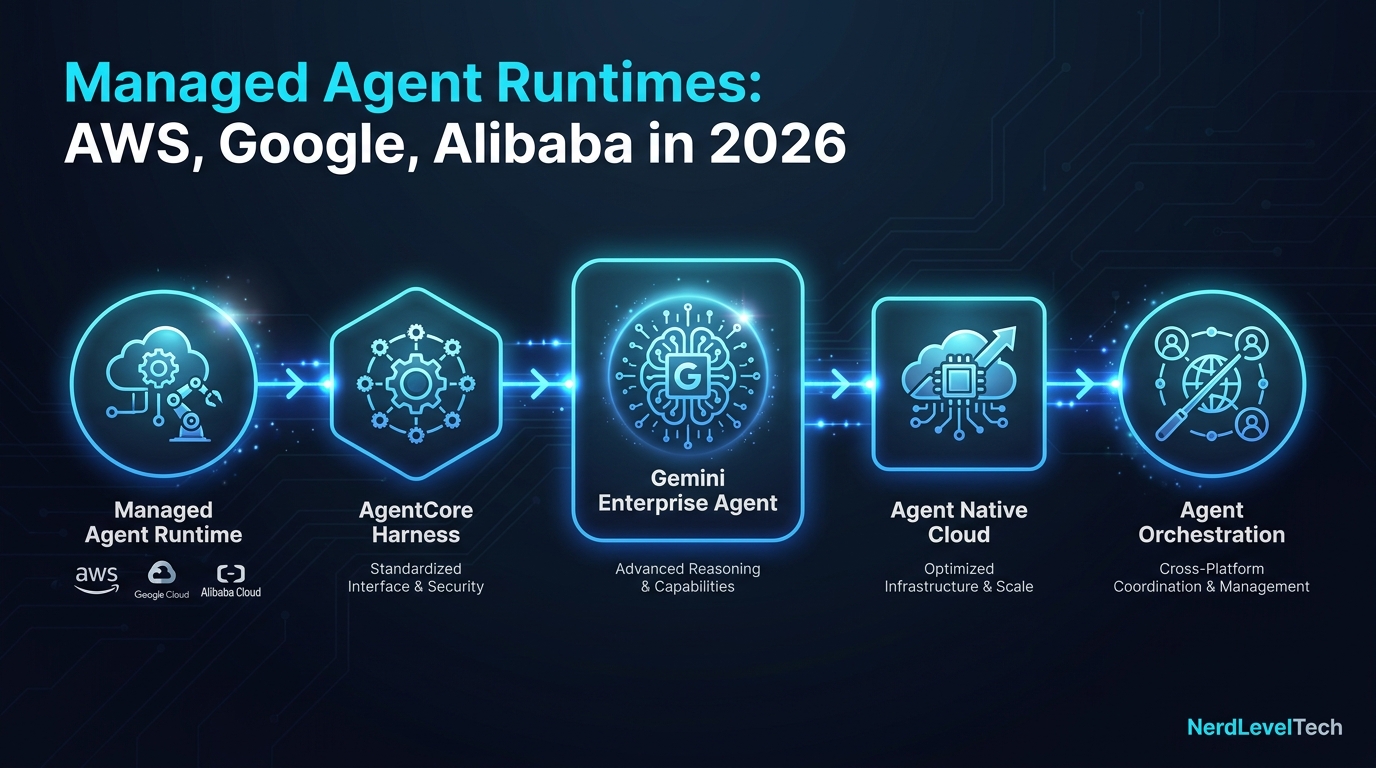
TL;DR: The agent loop — call model, pick tool, feed result back, repeat — is being repackaged as billable cloud infrastructure. AWS made its "agent harness" a configuration object behind two API calls. Google folded all of Vertex AI into a Gemini Enterprise Agent Platform. Alibaba unveiled an "Agent-Native Cloud" suite at WAIC on July 18. Three vendors, three names, one bet: that you should stop writing orchestration code.
The pitch is credible and the primitives really have converged. But in at least one case the announcement and the vendor's own documentation disagree about what has actually shipped — and it is AWS's docs, changelog and regions table on one side, AWS's press release on the other.
In one line: A managed agent runtime is cloud infrastructure that runs an AI agent's orchestration loop for you — model calls, tool execution, sandboxing, memory, identity and tracing — configured rather than coded. AWS, Google and Alibaba each announced one between April and July 2026.
What You'll Learn
- What a managed agent runtime is, and how it differs from an agent framework like LangGraph or CrewAI
- What AWS's AgentCore harness actually gives you, down to the tool types and memory defaults
- Why AWS's announcement says "generally available" while its regions table, docs and changelog still say "preview"
- What Google shipped in April, and the Vertex AI decision buried in the announcement
- What Alibaba unveiled at WAIC 2026, and which of its numbers are company-reported
- The primitives these platforms converge on, and where the public evidence for that convergence runs thin
- What this actually costs on AWS, the one vendor of the three to publish per-unit prices
- When configuration is genuinely enough, and when you should still write the loop yourself
What a Managed Agent Runtime Actually Is
Start with the definition that stuck. Writing in September 2025, Simon Willison settled on a formulation others had already converged on — "an LLM agent runs tools in a loop to achieve a goal" — noting that the "tools in a loop" framing "has been popular for a while" and that Anthropic in particular had settled on it. He had separately crowdsourced 211 competing definitions and found no consensus among them, which was rather the point.1 AWS quotes the same line approvingly in its own launch material.2
The loop was never the hard part. Forty lines of Python will run it. What costs teams weeks is everything wrapped around the loop: sandboxed compute to execute model-generated code, secure tool connections, somewhere for state to live, identity so the agent acts as someone, tracing so you can tell what it did, and isolation so one user's session cannot see another's.
AWS puts the distinction plainly in its documentation: "Every agent has an orchestration layer... Running that loop requires infrastructure underneath: compute to host the agent, a sandbox to safely execute code, secure connections to tools, persistent storage, memory, identity, and observability. Together, this infrastructure forms the agent harness."3
That is the category. A framework — LangGraph, CrewAI, the Claude Agent SDK — gives you a way to express the loop. A managed agent runtime gives you somewhere for the loop to live, and takes over the plumbing underneath it. The two are complements, not rivals, which is why AWS's harness is itself built on an open-source framework and can eject back into one.
AWS: The Agent Loop Behind Two API Calls
AWS announced general availability of the AgentCore harness on June 17, 2026, with the engineering write-up following a day later.42 The harness had been in preview since April.2
The surface is deliberately small: CreateHarness to define an agent, InvokeHarness to run it.2 You declare a model, a set of tools, some skills and instructions; AWS assembles and runs the loop. Trying a different model or adding a tool becomes a configuration change rather than a code change.
Underneath, each session is stateful by default and runs in its own isolated microVM with a filesystem and shell, so the agent can write code, execute it, and keep files and memories across sessions.3 The harness is powered by Strands Agents, AWS's open-source agent framework.3
Four details are worth pulling out, because they are the ones that distinguish this from a hosting wrapper:
Model portability is explicit. Four provider fields — bedrock, openAi, gemini and liteLlm — and you can switch providers mid-session without losing context. AWS's example is planning with Claude Opus, writing code with GPT-5.5, summarizing with Gemini, in one continuous conversation.2 Provider API keys sit in AgentCore Identity's token vault; the agent never sees raw credentials.2
Tools are declarations. Five types: agentcore_gateway (an ARN reference that exposes every OpenAPI, Smithy, Lambda or MCP target behind it), remote_mcp (any MCP server by URL), agentcore_browser, agentcore_code_interpreter, and inline_function for human-in-the-loop approvals.2 If you have been fighting tool-count degradation in large agent tool surfaces, note that a gateway reference expands to every target it fronts — the count discipline is still yours to enforce.
Memory became a default rather than a step. At GA, omitting memory config auto-provisions a managed memory resource with SEMANTIC and SUMMARIZATION strategies, 30-day event expiry, AWS-owned encryption and multi-tenant isolation keyed on actorId.2 It is a real, addressable resource you can query or detach — not a black box.
There is a documented exit. One CLI command exports the harness to Strands-based code that preserves the model, prompt, tools, memory wiring and skills. AWS calls it "a config-to-code translation, not an architecture switch," and says Strands is the first export target with the Claude Agent SDK "coming soon."2
That last point matters more than the feature list. A managed runtime you cannot leave is a trap. A managed runtime with a mechanical export path is a starting position.
The GA Label AWS's Own Documentation Contradicts
Here is where the announcement and the documentation part company.
The June 17 announcement says the harness is "generally available today in all AWS Commercial Regions where AgentCore is available."4 The June 18 blog repeats it: "available today in all AWS Regions where AgentCore is generally available," and links to the regions table.2
Follow that link. As of July 21, 2026, AWS's supported-regions table lists the feature as "AgentCore harness (preview)", with checkmarks in exactly four regions: US East (N. Virginia), US West (Oregon), Europe (Frankfurt), and Asia Pacific (Sydney).5 In the same table, AgentCore Runtime, Gateway, Identity, Built-in Tools and Observability each show sixteen regions — fifteen commercial, plus GovCloud (US-West). AWS's release notes corroborate that split exactly: a May 2026 entry describes a Runtime feature as "available across all 15 AWS Regions where AgentCore Runtime is supported," and a separate May entry announces AgentCore's GA in AWS GovCloud (US-West).56
The harness overview page agrees with the table and not the announcement: "AgentCore harness is in public preview in US West (Oregon), US East (N. Virginia), Asia Pacific (Sydney), and Europe (Frankfurt)."3 That page also carries a banner note — "Deployments across regions are ongoing: currently available in SYD, FRA, and IAD" — which lists three regions where the paragraph below it lists four.3
AWS's own release notes are the third surface, and the most striking one. The AgentCore changelog carries a single harness status entry — "AgentCore harness is now in Public Preview," filed under April 2026, which independently confirms the April preview date.6 There is no corresponding entry for the harness reaching general availability. As of July 21, 2026, the changelog's most recent section is May 2026; it has no June 2026 section at all.6
A fourth signal is smaller but points the same way. The "fastest path" install command in the GA blog is npm install -g @aws/agentcore@preview, using the preview npm dist-tag.2
In fairness, the changelog cuts both ways as evidence. A release-notes page with no June and no July section is itself a page that has not been updated in two months, which makes staleness the most economical explanation for all of this — the docs may simply be behind a rollout that did happen. That reading is entirely consistent with the facts, and it is the one this article would bet on.
But it does not resolve the practical problem. Preview services at AWS are frequently production-usable and the capability set here is real; none of this means the harness does not work. What it means is that a developer who checks today cannot confirm GA from any AWS surface except the announcement itself. Other benign explanations exist too — a staged regional rollout, or a distinction between the harness reached through the CLI and the managed harness resource. AWS has published none of them, and this article does not assert which surface is correct.
The disagreement itself is the verifiable part, and it is what you should act on. If your procurement process treats "GA" as contractual, neither the announcement nor a possibly-stale docs page is sufficient on its own — check the regions table for your specific region, and if it still reads "preview," get written confirmation from your account team before you plan a migration around it.
The general lesson is narrower than "trust the docs." An announcement tells you a launch date and the vendor's intent; documentation tells you the operational reality but can lag it by weeks. When the two conflict, the honest conclusion is that you do not yet know — and for anything load-bearing, that is the moment to ask rather than assume.
Google: Vertex AI Is Now the Agent Platform
Google's move came earlier and was structurally larger. On April 22, 2026, Google Cloud launched the Gemini Enterprise Agent Platform, describing it as "the evolution of Vertex AI."7
Buried in the announcement is a sentence with more consequence than any feature: "Moving forward, all Vertex AI services and roadmap evolutions will be delivered exclusively through the Agent Platform, rather than as a standalone service."7 Vertex AI was not extended with agent features. It was reorganized into an agent platform.
Google grouped the result into four pillars — build, scale, govern, optimize — and the component list reads as a direct map of the same problem AWS is solving:
- Agent Runtime, which Google says delivers sub-second cold starts and supports "long-running agents that run autonomously for days at a time"7
- Agent Sandbox, a hardened environment for executing model-generated code and browser-based computer-use tasks7
- Agent Memory Bank, which generates and curates long-term memories from conversations, with new Memory Profiles for low-latency recall7
- Agent Identity, giving every agent "a unique cryptographic ID" and an auditable trail7
- Agent Gateway, described as "the air traffic control for your agent ecosystem," enforcing Model Armor protections against prompt injection and data leakage7
- Agent Simulation, Evaluation, Observability and Optimizer, plus anomaly detection using "statistical models and an LLM-as-a-judge framework"7
Google also disclosed a usage figure that is useful as a scale marker: more than six trillion tokens are processed monthly on Gemini models through the Agent Development Kit.7 Model Garden offers first-class access to more than 200 models, including third-party ones such as Anthropic's Claude Opus, Sonnet and Haiku.7
Customer-stated results in the announcement should be read as vendor-selected: Payhawk reports cutting expense submission time "by over 50%," and Gurunavi describes an expected satisfaction improvement of "30% or more" — the latter phrased as a forward-looking projection rather than a measured outcome.7 Google's post does not break out which components are generally available versus in preview, and this article does not claim GA status for any of them.
Alibaba: "Agent-Native Cloud," and Two Accounts That Disagree
The newest of the three was announced three days ago, at the World Artificial Intelligence Conference in Shanghai on July 18, 2026. It is also the one where the available accounts do not agree with each other, so it is worth separating them.
What Alibaba Cloud itself says. Its own announcement describes an "Agent-Native Cloud suite" built to "govern, optimize, and orchestrate multi-agent workflows while improving large-model inference efficiency," and names three products rather than a single platform: AgentRun, the existing lifecycle layer covering development, deployment and operations; and two new additions, AgentLoop for real-time tracing, evaluation and optimization of agent performance, and AgentTeams for coordination and governance across multiple agents.8 Alibaba also introduced TokenWorks inside its Platform for AI, available through PAI-EAS, which folds request routing, inference execution, compute reuse and scheduling into one system.8
Read against the other two platforms, that maps cleanly: AgentRun is the runtime, AgentLoop is the observability-and-evaluation layer, AgentTeams is multi-agent orchestration.
Where the secondary coverage diverges. English-language reporting on the same announcement — traced back to a Shanghai Observer report — describes the architecture differently. It attributes the launch to Qi Zhou, head of Alibaba Cloud's Cloud-Native Application Platform, names AgentTeams alongside a component called Agentic Computer for secure cloud-based execution, and cites native sandbox environments, workload isolation, elastic scaling and enterprise identity integration. It also reports internal results: 15 coordinated AI agents handling 85% of developer support requests, a 90% reduction in operational support time, and release cycles compressed to a single day.9
The two accounts overlap on exactly one product name: AgentTeams. Everything else in that paragraph is unconfirmed by Alibaba Cloud's own English announcement, which does not name "Agentic Computer," does not cite the deployment metrics, and does not quote Zhou.8 The likeliest explanation is mundane — Alibaba's English post is a broad WAIC roundup covering earbuds and chips alongside agents, while the Shanghai Observer covered one session in depth, and terminology shifts in translation. But the practical consequence stands: the component name and the headline percentages that have propagated through English coverage cannot be confirmed against Alibaba's own announcement. Treat them as single-sourced, and treat the internal metrics as company-reported figures from a company's own conference session, which is what they are regardless.
Huawei Cloud used the same event to expand its AgentArts platform and the open-source openJiuwen ecosystem into financial services, launching an "Industry AI Workshop – Smart Finance Zone" that aims to cut AI development timelines from months to weeks and development costs by more than 60%.9 That is the same openJiuwen community behind the JiuwenMemory agent-memory stack, released separately on July 1 — the memory layer and the industry-adoption push coming from one ecosystem within three weeks, though only the latter was announced at WAIC.
Availability, pricing and regional coverage for the Agent-Native Cloud products were not disclosed in either account. The comparison that follows therefore leads with Alibaba's own product names and flags anything attested only in secondary coverage.
Where All Three Converge
Strip the branding and the same component shape appears. AWS and Google line up on all seven primitives below. Alibaba's own announcement confirms three of them — runtime, multi-agent orchestration, and observability; the remaining four are either unnamed by Alibaba or attested only in secondary coverage, so the table marks them as such rather than assuming parity.
| Primitive | AWS AgentCore | Google Agent Platform | Alibaba Agent-Native Cloud |
|---|---|---|---|
| Runtime / lifecycle | Harness on AgentCore Runtime3 | Agent Runtime, sub-second cold starts7 | AgentRun — development, deployment, operations8 |
| Isolated execution | Per-session microVM with filesystem and shell3 | Agent Sandbox for model-generated code and computer use7 | Sandboxing reported in secondary coverage; not named in Alibaba's own announcement98 |
| Persistent memory | Managed memory, auto-provisioned by default2 | Agent Memory Bank with Memory Profiles7 | Not named in reviewed sources |
| Agent identity | AgentCore Identity, token vault for provider keys2 | Agent Identity, unique cryptographic ID per agent7 | Identity integration reported in secondary coverage only9 |
| Tool connectivity | Gateway + direct MCP + built-in browser/interpreter2 | Agent Gateway with Model Armor policy enforcement7 | Not named in reviewed sources |
| Multi-agent orchestration | Export to code for custom orchestration2 | Agent-to-agent orchestration7 | AgentTeams — coordination and governance8 |
| Observability and eval | CloudWatch GenAI Observability; AgentCore Evaluations2 | Agent Observability, Simulation, Evaluation, Optimizer7 | AgentLoop — tracing, evaluation, optimization8 |
Two readings of that table are worth holding at once.
The optimistic one: when vendors converge on the same component list, it is usually evidence that a problem is real and its shape is understood. AWS and Google match almost item for item, and what Alibaba has described publicly is consistent as far as it goes. There is no shared spec here to copy — no standards body defined "per-session sandbox plus durable memory plus agent identity plus a policy-enforcing tool gateway." The likelier explanation is that all three watched customers fail to get agents into production for the same recurring reasons. Note also that the announcements were sequential and public — Google in April, AWS in June, Alibaba in July — so each later entrant had the earlier ones to look at. This is convergence, not evidence of independent invention.
The cautious one: convergence on primitives is not convergence on interfaces. CreateHarness is not Agent Runtime is not AgentTeams. The primitives rhyme; the APIs do not. Portability between these platforms today runs through your own abstraction layer or through open protocols such as MCP and A2A — not through anything the vendors have agreed on. This is precisely why the stateless MCP specification work and agent-to-agent protocols matter more, not less, as managed runtimes proliferate.
Microsoft's Agent 365, which went GA earlier this year as a control plane for agent identity and governance, attacks the same territory from the management side rather than the execution side. Four hyperscalers, four vocabularies, one problem.
What It Actually Costs
Of the three, only AWS published per-unit pricing in the material reviewed here.
There is no separate harness fee — you pay for the primitives the agent consumes.2 Runtime compute is billed on active consumption per second at $0.0895 per vCPU-hour and $0.00945 per GB-hour, and AWS makes a specific argument for why that structure suits agents: "Agentic workloads spend significant time waiting on model and tool I/O. Runtime bills only when CPU is actually consumed."2 Browser and Code Interpreter use the same model. Gateway bills per 1,000 invocations and per 1,000 search queries. Memory bills per 1,000 short-term events, per 1,000 long-term records per month, and per 1,000 retrievals. Observability is standard CloudWatch pricing, and model inference is charged separately by Bedrock or the third-party provider.2
The practical consequence: an agent's cost is now spread across at least five meters plus inference, and the meters are not proportional to each other. A chatty agent with few tool calls and a tool-heavy agent with short reasoning turns will have very different bills at the same wall-clock duration. Model your own workload; do not reason from a per-hour figure alone. Prices and tiers change — verify against the current AgentCore pricing page before committing budget.
Google and Alibaba pricing for their agent platforms was not published in the announcements reviewed for this article.
What This Means If You Build Agents
Configuration is genuinely enough more often than engineers expect. If your agent is "call these tools, remember this user, run this code in a sandbox, trace everything," you are describing a solved problem that three vendors will now operate for you. The weeks previously spent on session isolation and credential brokering were never differentiating work.
Check the status label yourself, in your region. The AWS case in this article is not an outlier pattern; it is the normal gap between a launch post and a docs page. Before you plan around a capability, open the vendor's regions or availability table on the day you plan.
Treat the export path as a hard requirement. AWS's config-to-code export is the single most reassuring thing in its GA announcement, precisely because it makes the platform leavable. When you evaluate any managed agent runtime, ask what happens when configuration stops being enough — and be suspicious of any answer that amounts to "rewrite it."
Vendor-reported deployment metrics are marketing until independently reproduced — and check they came from the vendor at all. The widely-repeated figure that 15 agents handle 85% of Alibaba's developer support requests traces to one report of a conference session, not to Alibaba Cloud's own announcement. Google's customer percentages are at least in Google's own post, but they are self-selected. Use numbers like these to size an opportunity, never to justify a decision.
Keep writing your own loop when the loop is the product. If your differentiation lives in custom orchestration — unusual planning strategies, domain-specific control flow, novel multi-agent topologies — a managed harness abstracts away the exact layer you are trying to innovate on. Use the managed primitives underneath and keep the loop.
Bottom Line
Between April and July 2026, three hyperscalers each decided that the agent loop is infrastructure rather than application code, and started selling it that way. The convergence on the same component shape — a managed runtime, sandboxed execution, durable memory, agent identity, a policy-enforcing tool gateway, multi-agent orchestration and tracing — is good evidence that the industry now agrees on what production agents need, with the caveat that Alibaba has publicly detailed less of its stack than the other two.
What it does not yet mean is portability. The primitives rhyme; the APIs do not, and nothing in these announcements makes an agent movable between clouds. Open protocols remain the only real hedge.
And the small thing worth carrying forward: checked together on July 21, AWS's June press release, its current documentation, its regions table and its own changelog disagreed about whether a flagship capability is generally available or in preview. When the vendor's marketing and the vendor's docs conflict, the docs are the ones with the region list.
Related reads
Footnotes
-
Simon Willison, "I think 'agent' may finally have a widely enough agreed upon definition to be useful jargon now," September 18, 2025. https://simonwillison.net/2025/Sep/18/agents/ ↩
-
Kosti Vasilakakis, Alexander Richey, Evandro Franco and Vivek Dalal, "Amazon Bedrock AgentCore harness is now generally available: Go from idea to production-grade agent in minutes," AWS Artificial Intelligence Blog, June 18, 2026. https://aws.amazon.com/blogs/machine-learning/amazon-bedrock-agentcore-harness-is-now-generally-available-go-from-idea-to-production-grade-agent-in-minutes/ ↩ ↩2 ↩3 ↩4 ↩5 ↩6 ↩7 ↩8 ↩9 ↩10 ↩11 ↩12 ↩13 ↩14 ↩15 ↩16 ↩17 ↩18 ↩19 ↩20 ↩21 ↩22 ↩23
-
AWS, "AgentCore harness overview," Amazon Bedrock AgentCore Developer Guide. Accessed July 21, 2026. https://docs.aws.amazon.com/bedrock-agentcore/latest/devguide/harness.html ↩ ↩2 ↩3 ↩4 ↩5 ↩6 ↩7 ↩8 ↩9
-
AWS, "AgentCore harness in now generally available" [sic], AWS What's New. Posted June 17, 2026. https://aws.amazon.com/about-aws/whats-new/2026/06/amazon-bedrock-agentcore-harness-generally-available/ ↩ ↩2 ↩3
-
AWS, "Supported AWS Regions," Amazon Bedrock AgentCore Developer Guide. Accessed July 21, 2026. https://docs.aws.amazon.com/bedrock-agentcore/latest/devguide/agentcore-regions.html ↩ ↩2 ↩3
-
AWS, "Release notes for Amazon Bedrock AgentCore," Amazon Bedrock AgentCore Developer Guide. Accessed July 21, 2026. https://docs.aws.amazon.com/bedrock-agentcore/latest/devguide/release-notes.html ↩ ↩2 ↩3 ↩4
-
Michael Gerstenhaber and Michael Bachman, "Introducing Gemini Enterprise Agent Platform, powering the next wave of agents," Google Cloud Blog, April 22, 2026. https://cloud.google.com/blog/products/ai-machine-learning/introducing-gemini-enterprise-agent-platform ↩ ↩2 ↩3 ↩4 ↩5 ↩6 ↩7 ↩8 ↩9 ↩10 ↩11 ↩12 ↩13 ↩14 ↩15 ↩16 ↩17 ↩18 ↩19
-
Crystal Liu, Shao Xiaoyi, Karen Zhang and Gabbie Fu, "Alibaba Cloud Unveils Agent-Native Innovations at WAIC 2026," Alibaba Cloud Community, July 20, 2026 (originally published on Alizila). https://www.alibabacloud.com/blog/alibaba-cloud-unveils-agent-native-innovations-at-waic-2026_603377 ↩ ↩2 ↩3 ↩4 ↩5 ↩6 ↩7 ↩8 ↩9
-
Vivian Nguyen, "Alibaba Cloud launches Agent Native Cloud to scale enterprise AI agents," Crypto Briefing, July 18, 2026. https://cryptobriefing.com/alibaba-cloud-launches-agent-native-cloud-to-scale-enterprise-ai-agents/ ↩ ↩2 ↩3 ↩4 ↩5