AI Agent Token Costs in 2026: Cheap Tokens, Costly Tasks
July 22, 2026
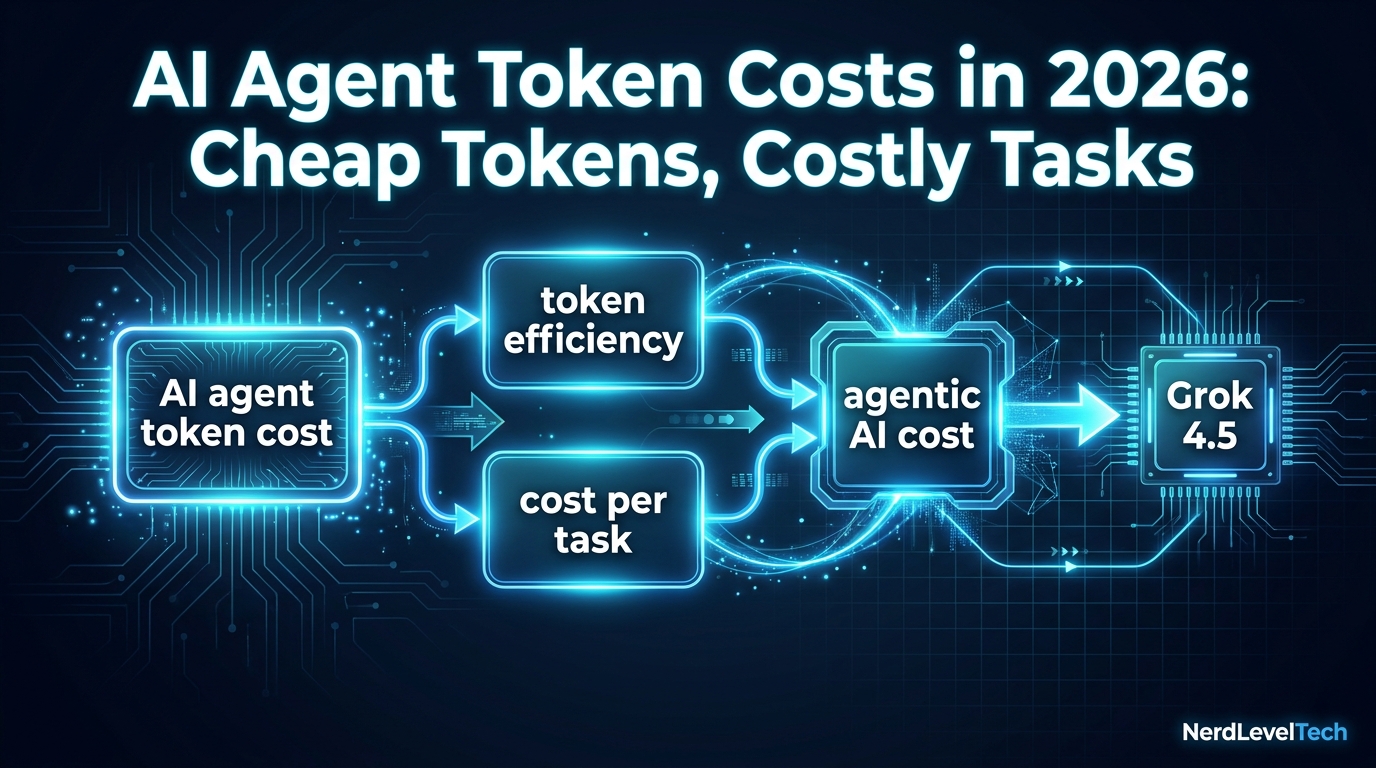
AI agent token costs depend less on the per-token price than on how many tokens each task burns. Agents re-send their growing context on every tool call, so one task can consume far more tokens than a chat — which is why 2026's biggest model launches now compete on token efficiency, not just price.
TL;DR: In July 2026, two of the biggest model launches — OpenAI's GPT-5.6 on July 9 and xAI's Grok 4.5 in mid-July — both led with the same headline: fewer tokens per task, not a higher benchmark score.12
OpenAI's own page for GPT-5.6 opens with "more intelligence from every token, stronger performance per dollar," and reports that GPT-5.6 Sol beats Claude Opus 4.8 on the OSWorld 2.0 computer-use benchmark "while using 85% fewer output tokens."2 xAI priced Grok 4.5 at $2 / $6 per million input/output tokens and claimed "roughly 2x the token efficiency of comparable leading models" — pointing to one benchmark where it resolved tasks with 15,954 output tokens on average versus 67,020 for Opus 4.8, about 4.2x fewer.1
The shift matters because per-token prices keep falling while total agent bills keep rising. An agent re-sends its accumulated context on every step, so the number that decides your bill is tokens per task — and the cheapest model per token is often not the cheapest per task.
What You'll Learn
- Why an AI agent burns far more tokens than a chatbot for the same request
- Why 2026's biggest model launches lead with "token efficiency," not top benchmark scores
- How Grok 4.5 and GPT-5.6 quantify efficiency — and what those numbers actually mean
- Why the cheapest model per token isn't the cheapest per task
- A per-token price comparison across today's leading agent models
- What to measure and change if you're building agents
Why This Matters Now
For two years, the AI pricing conversation was about one number: dollars per million tokens. That number has fallen steadily, and it kept falling in July 2026.
But teams running agents in production noticed their bills going the other way. The reason is structural, and it is finally showing up in how the labs market their models.
An agent is not one model call. It is a loop — read the task, call a tool, read the result, call another tool — and each turn re-sends everything that came before. The per-token price barely moved the needle; the token count did.
That is why GPT-5.6 and Grok 4.5 both foreground efficiency. When your customers' costs are dominated by how many tokens a task consumes, "cheaper per token" is no longer the pitch. "Finishes the job in fewer tokens" is.
Why an Agent Burns Tokens a Chatbot Never Would
A chat message is usually one round trip: your prompt goes in, an answer comes out. An agent doing the same nominal task runs many round trips, and the context grows on each one.
Here is the mechanism. On step one, the model sees the system prompt plus your request. On step two, it sees the system prompt, your request, its own first action, and the tool's response. On step twenty, it re-reads all nineteen prior steps before choosing the twentieth.3
The early context does not get sent once. It gets sent again on every step, so you pay for the same system prompt and the same tool output many times over across a single task.3
Because that history grows with each turn, total tokens processed scale faster than the number of steps. A ten-step task does not cost ten times a single call — it costs closer to the sum of a growing series, which is why long agent runs get expensive out of proportion to what they appear to do.3
How much more than a chat? Estimates vary widely, and that variance is the honest answer. Third-party analyses put agentic workloads anywhere from several times to as much as 100x the tokens of an equivalent single-turn chat, depending on task length, tool count, and how much history is retained.4
One detail matters for optimization: in agentic coding, input tokens — the re-sent context — often dominate the bill, not the output the model writes.34 This is also why context bloat has real teeth; see our breakdown of how many tools an AI agent can actually handle before the tool definitions alone start crowding the window.
The Launch Pitch Changed: Efficiency Is the Headline
The clearest sign that token-per-task cost has become the battleground is the marketing itself.
OpenAI titled the GPT-5.6 announcement "Frontier intelligence that scales with your ambition" and led the page with "more intelligence from every token, stronger performance per dollar."2 A section heading reads, verbatim, "Efficient by default, maximum performance on demand."2
The specifics back the framing. On the Artificial Analysis Coding Agent Index, OpenAI reports GPT-5.6 Sol scoring 2.8 points above Claude Fable 5 "while using less than half the output tokens, taking less than half the time, and costing about one-third less."2
xAI made the same move. Its Grok 4.5 announcement is built around "the highest intelligence per unit of time and cost," served at roughly 80 tokens per second, with "roughly 2x the token efficiency of comparable leading models, solving tasks in under half the number of steps."1
Two of the largest labs, launching a week apart, both chose "fewer tokens, lower cost" as the lead message over "highest score." That is the industry shift in one sentence — and Anthropic's heavy investment in prompt caching, which discounts re-sent input tokens by up to 90%, is the same instinct approached from the pricing side.56
Note what this is not: nobody has stopped reporting benchmarks. GPT-5.6's page carries pages of them.2 The change is that raw capability is now sold paired with an efficiency claim, because a score you can't afford to run at scale doesn't win the deal.
What the Efficiency Numbers Actually Say
It helps to read the two headline efficiency claims precisely, because they are narrower than the round numbers suggest.
xAI's "4.2x fewer tokens" is one specific measurement: average output tokens per SWE-Bench Pro task, Grok 4.5 at 15,954 versus Opus 4.8 (max setting) at 67,020.1 It is output-only, on one benchmark, against one competitor's most expensive configuration. The broader "2x token efficiency" is xAI's own averaged claim across "comparable leading models."1
OpenAI's "85% fewer output tokens" is likewise a single data point: GPT-5.6 Sol versus Opus 4.8 on OSWorld 2.0, where OpenAI says Sol scores higher and spends far less.2 Both labs, notably, use the same competitor — Opus 4.8 — as the inefficient baseline.
Here is the part the round numbers hide: on xAI's own benchmark chart, Grok 4.5 does not top most tables. It leads SWE Marathon at 29.0%, but Claude Fable 5 leads Terminal-Bench 2.1 (84.3% to Grok's 83.3%), SWE-Bench Pro (80.4% to 64.7%), and DeepSWE 1.0.1
That is the whole point of the efficiency pitch. Grok 4.5's argument isn't "highest score" — it's "near-frontier scores at a fraction of the tokens and a fraction of the price." Efficiency is the differentiator precisely because the top-line score isn't.
Cheapest Per Token Isn't Cheapest Per Task
Put the two variables together — price per token and tokens per task — and the ranking you'd get from a pricing page can flip.
First, the price-per-token picture across today's leading agent models, all from official sources:
| Model | Input ($/M) | Output ($/M) | Source |
|---|---|---|---|
| GPT-5.6 Luna | $1.00 | $6.00 | OpenAI2 |
| Grok 4.5 | $2.00 | $6.00 | xAI1 |
| GPT-5.6 Terra | $2.50 | $15.00 | OpenAI2 |
| Claude Opus 4.8 (regular) | $5.00 | $25.00 | Anthropic6 |
| GPT-5.6 Sol | $5.00 | $30.00 | OpenAI2 |
| Claude Fable 5 | $10.00 | $50.00 | Anthropic5 |
Table: Published list prices per million tokens, standard tiers, before caching or batch discounts.
Now fold in tokens-per-task using xAI's own figures for a single SWE-Bench Pro task. This is an illustration of the mechanism, not a total-cost verdict — it counts output tokens only, on one benchmark, at list prices:
- Grok 4.5: 15,954 output tokens × $6/M ≈ $0.096 per task1
- Claude Opus 4.8: 67,020 output tokens × $25/M ≈ $1.68 per task16
That is roughly a 17x gap on output cost for one task — and it comes from two advantages multiplying: about 4.2x fewer tokens and about 4.2x cheaper output per token.16 A pricing page shows you only the second factor. The token count supplies the first, and on agentic work the first is often the larger lever.
Two caveats keep this honest. Input tokens — which xAI did not disclose here — usually dominate agentic bills, so an output-only figure understates absolute cost.4 And "max" is Opus 4.8's most expensive reasoning setting, chosen by xAI; a cheaper setting narrows the gap. The direction holds; the exact multiple is workload-specific.
What to Do If You're Building Agents
The practical takeaway is to stop shopping on price per token and start measuring cost per completed task.
Instrument tokens per task, per model. The only number that maps to your bill is total tokens — input plus output — to get a unit of work done, including retries and failed tool calls. Track it the way you'd track latency.
Route by task, don't default to the flagship. GPT-5.6's own tiers make the case: OpenAI positions Luna and Terra to match or beat older flagships at a fraction of the cost.2 Reserve the most expensive model for the steps that actually need it.
Exploit caching aggressively, because the re-sent context is the cost. Anthropic discounts cached input by up to 90%; OpenAI's GPT-5.6 caching gives cache reads the same 90% discount with a 30-minute minimum cache life.25 For a loop that re-sends the same system prompt twenty times, that discount hits the biggest line item.
Shorten the loop and trim the history. Fewer steps and aggressive context compaction attack the token count directly — the lever the pricing page can't show you. This is the same economic pressure now being sold as managed infrastructure; see our look at managed agent runtimes from AWS, Google, and Alibaba.
The Bottom Line
The price of a token kept falling in July 2026, and the cost of running an agent kept climbing — because those are two different numbers, and only one of them shows up on a pricing page.
GPT-5.6 and Grok 4.5 both read the room. Their launches sold efficiency — intelligence per token, performance per dollar, tasks finished in fewer steps — because that is where the real money in agentic workloads is now spent.12
For anyone building on these models, the lesson is to change the metric. Stop asking what a model costs per million tokens, and start asking what it costs to finish the job. In 2026, cheap tokens and costly tasks live side by side, and the gap between them is the whole game.
References
Related reads
Footnotes
-
xAI, "Introducing Grok 4.5." Pricing ($2/$6 per million input/output tokens), "roughly 2x the token efficiency of comparable leading models," 15,954 vs 67,020 average output tokens per SWE-Bench Pro task (≈4.2x), 80 TPS serving speed, and benchmark charts (SWE Marathon, Terminal-Bench 2.1, SWE-Bench Pro, DeepSWE). https://x.ai/news/grok-4-5 ↩ ↩2 ↩3 ↩4 ↩5 ↩6 ↩7 ↩8 ↩9 ↩10 ↩11 ↩12 ↩13
-
OpenAI, "GPT-5.6: Frontier intelligence that scales with your ambition," July 9, 2026. Tagline "more intelligence from every token, stronger performance per dollar"; GPT-5.6 pricing (Sol $5/$30, Terra $2.50/$15, Luna $1/$6 per million); "surpasses Opus 4.8 while using 85% fewer output tokens" on OSWorld 2.0; Coding Agent Index efficiency claim; prompt-caching terms. https://openai.com/index/gpt-5-6/ ↩ ↩2 ↩3 ↩4 ↩5 ↩6 ↩7 ↩8 ↩9 ↩10 ↩11 ↩12 ↩13 ↩14
-
Stanford Digital Economy Lab, "How are AI agents spending your tokens?" (May 5, 2026), summarizing the paper "How Do AI Agents Spend Your Money? Analyzing and Predicting Token Consumption in Agentic Coding Tasks" (Bai, Huang, Wang, Sun, Mihalcea, Brynjolfsson, Pentland, Pei). Agents re-read accumulated context on each step — "one big pricey context snowball" — and "the high cost is in input tokens rather than output." https://digitaleconomy.stanford.edu/news/how-are-ai-agents-spending-your-tokens/ ↩ ↩2 ↩3 ↩4 ↩5
-
Third-party analyses of agent token consumption and cost per task, which estimate agentic workloads at several-fold to ~100x the tokens of an equivalent chat and note that input tokens often dominate agentic-coding cost. Estimates vary by task and methodology. https://leanopstech.com/blog/agentic-ai-cost-runaway-token-budget-2026/ ↩ ↩2 ↩3 ↩4 ↩5
-
Anthropic, Claude Fable 5 pricing ($10 input / $50 output per million tokens; up to 90% prompt-caching discount on input). https://platform.claude.com/docs/en/about-claude/pricing ↩ ↩2 ↩3
-
Anthropic, "Introducing Claude Opus 4.8" (regular pricing $5 input / $25 output per million tokens; fast mode $10/$50; up to 90% caching savings). https://www.anthropic.com/news/claude-opus-4-8 ↩ ↩2 ↩3 ↩4